
William Dunham
Author of Journey through Genius: The Great Theorems of Mathematics
About the Author
Works by William Dunham
The Mathematical Universe: An Alphabetical Journey Through the Great Proofs, Problems, and Personalities (1994) 502 copies, 1 review
Tagged
Common Knowledge
- Canonical name
- Dunham, William
- Legal name
- Dunham, William Wade
- Birthdate
- 1947-12-08
- Gender
- male
- Education
- University of Pittsburgh (BS | 1969)
Ohio State University (MS | 1979 | PhD | 1974) - Occupations
- Truman Koehler Professor of Mathematics (Muhlenberg College)
- Awards and honors
- George Pólya Award (1992)
Trevor Evans Award (1997)
Lester R. Ford Award (2006)
Trevor Evans Award (2008) - Nationality
- USA
- Associated Place (for map)
- USA
Members
Reviews
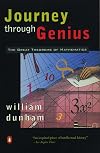
I read this book while I was in the hospital recovering from surgery. It held my morphined attention. 'Nuff said? Probably not.
I'm coming to consider truly substantive "popular" scientific exposition to be a high art, indeed: many attempt it & few are successful. This book is one of the rare successes. It does not dumb down, but it speaks warmly and invitingly to the reader.
A total treat & one to keep. I want to re-read it in a more lucid state.
I'm coming to consider truly substantive "popular" scientific exposition to be a high art, indeed: many attempt it & few are successful. This book is one of the rare successes. It does not dumb down, but it speaks warmly and invitingly to the reader.
A total treat & one to keep. I want to re-read it in a more lucid state.
This is a brilliant intellectual journey through some of the great theorems of mathematics. The author writes very clearly and evocatively--then, there is the math. I am not a mathematician, and I frequently get lost in the rows after rows of numbers that go into the proofs of each theorem. Still, through Dunham's excellent explanations, I am able at least to grasp the gist of what is being said and to understand the intellectual achievement involved. I learned a lot reading this book about show more the beauty of mathematics and how geniuses--because that is the apt word here--have unraveled some of its mysteries over the centuries. This is not a long book, and while the math can be dense, and the ideas themselves may verge on giving you a headache as you struggle to understand them, the journey through genius (great title) is actually a very pleasant one for anyone with a bit of curiosity about a subject they may feel they don't understand well enough. This book will certainly increase your understanding of mathematics a bit--but it will increase your understanding and appreciation of mathematicians a LOT. show less
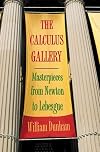
This is one of the most interesting books on the history of Calculus that I have ever read. It does require a moderate amount of mathematical knowledge (although not more than the standard first year undergraduate Analysis courses), but it is written with such a brilliance that one reads it with the eagerness more frequently experienced when reading a good thriller. But then, the history of Mathematical Analysis is, when we look at it in the proper way, one of the most fascinating and show more thrilling episodes in the intellectual history of mankind. This book is but one of the different stories that can be written: not being the history of Calculus, not even a history, it is, as the title indicates, a gallery, like an art gallery: reading along it we travel from the founding fathers Newton and Leibitz, until the pinacle of rigor and generality (and beauy!!) attained in the beginning of the 20th Century by Baire and Lebesgue. Along the way we visit some of the brilliant ideas of the Bernoulli brothers, Euler, Cauchy, Riemann, Liouville, Weierstrass, Cantor, and Volterra, and we see how, in two and a half centuries, the combined work of these (and others) outstanding minds shaped one of the most beautiful and powerful of all human creations. Like in any art gallery, a lot of names, some of then genius, are missing, but what is there is enough to tell a story, to disquiet and to awe the visitor. All in all, this is a magnificent book that all teachers and students of mathematics should read. It is also a work that should sadden us for the beauty herein is not likely to be appreciated by many more. It comes to mind the following famous poem by Fernando Pessoa, one of the most celebrated of all portuguese poets (in my loose translation): Newton's binomial is as beautiful as the Venus of Milo. The trouble is that few people can be aware of this. And the (generalized) Newton's binomial expansion is just the beginning: it is the very first section of the first chapter in this book... show less

A wonderful book that samples Euler’s work in several areas of mathematics. This is not a traditional biography focusing on Euler’s life, but rather a tour through a small portion of Euler’s amazing work. A first year course in Calculus would be helpful, but most of the mathematics can be followed with a college level algebra class. Each chapter covers several of Euler’s most impressive contributions to a specific branch of mathematics. While Euler contributed to every major area of show more the mathematics of his time, this book limits itself to eight (Number Theory, Logarithms, Infinite Series, Analytic Number Theory, Complex Variables, Algebra, Geometry, and Combinatorics). The chapters begin with a brief background of the area before Euler, then describe Euler’s contribution, and end with an epilogue that traces Euler’s impact forward in history.
What stands out in this book is how Dunham artfully takes the reader through the mathematics. Proofs are presented in a very approachable way that highlights Euler’s surprising twists and leaps of genius. Unlike the traditional (dry) way that proofs are usually presented, the author stays with you through the proofs, explaining key steps and commenting on Euler’s overall strategy. I was so impressed with how the author pulled this off that I immediately ordered his book “The Calculus Gallery”. show less
What stands out in this book is how Dunham artfully takes the reader through the mathematics. Proofs are presented in a very approachable way that highlights Euler’s surprising twists and leaps of genius. Unlike the traditional (dry) way that proofs are usually presented, the author stays with you through the proofs, explaining key steps and commenting on Euler’s overall strategy. I was so impressed with how the author pulled this off that I immediately ordered his book “The Calculus Gallery”. show less
Lists
Awards


You May Also Like


Statistics
- Works
- 6
- Members
- 2,086
- Popularity
- #12,323
- Rating
- 4.0
- Reviews
- 20
- ISBNs
- 26
- Languages
- 4
- Favorited
- 5