Augustin-Louis Cauchy was one of the giants of nineteen century's Mathematical Analysis. His importance in shapping the field and definitely steering the subject into the rigorous mathematical discipline we know today, can be gauged by the number of times his name appears connected with mathematical objects and results of present day currency (Cauchy sequence, Cauchy criterion for series, Cauchy root test, Cauchy-Hadamard theorem, the Cauchy-Riemann equations, the Cauchy integral formulas,...) this not to speak of the very notion of limit and continuity, whose rigorous definition is very much Cauchy's work, or the first rigorous definition of integral (now disused, but nevertheless of history intereste.) However great Cauchy was, he did not work alone or ab initio. He was one, admitedly a very important one, of a plethora of great mathematicians that helped build one of the most impressive of humanity's intelectual achievements: the rigorous foundations of Mathematical Analysis. The story, of course, does not end with Cauchy, but this excellent and enticing book actually centers its action on the work previous to Cauchy's as well as on Cauchy's own achievements: in it, the importance of Euler, D'Alembert, Ampère, Poisson, Lagrange (of course), and the unjustely somewhat forgotten Bernand Bolzano, is properly addressed, in addition to a very stimulating account of Cauchy's own work.

A brilliant book about Satan as an historically constructed character. From the obstructive angel of the Hebrew Bible, to the Prince of Darkness and the incarnation of Evil in the Gospels, the processes that led to the diabolization of Satan (no pun intended!) were manifold: theological, but also social and political. This book, by a prestigious Princeton scholar of early Christianity, does a terrific job in analysing and presenting these events in a historical perspective and in a way intelligible by an interested lay person. The book describes in considerable detail the conflicts emerging within the jewish communities in the aftermath of the Jewish War and the destruction of Jerusalem's temple by the Romans, as well as the progressive separation of the followers of Jesus, from a jewish sect into an autonomous movement, and their efforts to simultaneous exculpate the romans from the death of their founding leader, and to blame it on their fellow jews, whose non recognition of their dead leader as the Messiah could only be satanicaly inspired. In Jesus' followers view this ill fated inspiration was seen as the reason for the cataclysmic war that have just been lost. This frame of mind, conducing to the expedite device of diabolization of worldly events, characteristic of the early Christian world view (and also of other Jewish sects, such as the Essenes) led, progressively, from the rejection of their jewish connection, to an uncompromising stance towards the pagan world, show more and to the diabolization of non canonical Christians (heretics) later on. The influence of this lengthy theological construction was pervasive for the past two millenia and still lives with us today in the world view (conscious or otherwise) of countless Jews, Christians, and Muslims worldwide. At least for this reason, this outstanding book should be read with attention. show less
Ordinary Men: Reserve Police Battalion 101 and the Final Solution in Poland by Christopher R. Browning

A modern classic. This book, first published in 1992, is an extremely important study about the Holocaust. Browning describes how a unit of ordinary, middle-aged, conscripted reserve policemen without the special ideological indoctrination of the type received by the members of the SS, became active participants in the murder of several thousands of Polish jews. The book starts by an analysis of the first occurences of Final Solution policies in occupied Russia in 1941, and then describes the actions of the Reserve Battalion 101 in Poland in the fall of 1942 and in 1943. The last two chapters contain extremely insightful and penetrating observations about the processes that could have transformed five hundred ordinary men into a group of mass murderers. In the Afterword to this British edition the author examines the critique the original American edition was subjected to by Daniel Goldhagen in his best-selling book Hitler's Willing Executioners. Goldhagen's biased methodology, lack of consistency, his double standards, and his skewed use of, and sometimes disregard for, the sources, is here brilliantly and devastantingly exposed. This book is a remarkable work of serious scholarship that do help us to understand (in)human behaviour not only in Nazi Germany but also in our own time. Indispensable!
For more than thirty years the British ruled Palestine. Having entered Jerusalem in November 1917 in the wake of the campaign against the joint Ottoman-German forces, they left it in May 1948 in the mist of the Jewish-Arab war and the Zionist terrorist campaign that resulted in the foundation of the State of Israel and the destruction of the Palestinian Arab society. In the mean time the British fulfilled the plead made to the Zionism movement in 1917 by Lord Balfour and laid the foundation of the Jewish state the Zionists have dreamed of. The relationship between the local British administration, the British government in London, the Zionist Organization, and the Jewish population in Palestine was not always smooth but London kept its promise and did help the Zionists (their fellow Europeans) against the native Arab majority when they needed more support and protection. As a result the Jewish population of Palestine rose from less than 10% in 1919 to a bit more than 1/3 in 1948, it organized itself politically and militarily under the British umbrella, and prepared itself for the final show-down with the Arab population whose organization and leaders, never too strong or organized anyway, had been mostly destroyed in the suppression of the Arab revolt of 1936-39, and could at no point match the superior administrative organization, military efficiency and international public relations skills of the Zionists. This excelent book describes these events and traces the show more diplomatic and political discussions between the British and the Zionists during these tumultuous years. The book is not only extremely interesting and well written, but also very entertaining and lively, due to the author very competent use of a score of diaries, letters and other private documents to make the reader feel the mood of the times and the atmosphere surronding the historical events: Count Ballobar's (Spain's consul in Jerusalem in the last days of the Ottoman rule) and Al-Sakakini's diaries are particularly delighful. The only drawback is the somewhat misleading subtitle: the book is essentially about the Yishuv and the Zionist Organization under British rule, not about the Arabs, that, although treated with a commendable degree of fairness and understanding when they enter the narrative, they do so, in most of the cases, only in reaction against the Jews or the Administration. They are mainly part of the landscape and not a subject of the narrative in an equal footing with the other two partners in the struggle for Palestine. Apart from this minor detail, which has probably more to do with the subtitle of the english translation than with the original intention of the author, this is indeed a first rate book. show less
This book, by the famed Italian architect and humanist Alberti, first published in 1435, was intended to be a presentation of the theoretical rudiments of painting to fellow painters or to those aspiring to become one. In it, Alberti gives a detailed exposition on the correct representation of lines, planes and other surfaces, on the rules of central perspective, of composition, of light, shade and colour, and of the harmonious combination of these diverse elements in order to produce a pleasent painting. Go back to Nature is the main thurst of the argument, always coached with a fair number of citations of classical sources in a tipical Renaissance discourse, but he also instructs the painters to aquire a solid culture in the ''liberal arts'' (geometry, poetry, and rhetoric) besides prescribing some moral pre-requisites and social skills! A very pleasant reading.
This book is made up of four essays. The reflection of World War II in German literature is their common theme. The longest and, to me, the most interesting chapter is the first one, titled Air War and Literature. It is based on lectures given by Sebald in Zürich, in the autumn of 1997, and in it the author exposes the terrible events that were the destruction of the German cities by aerial bombardments during the second half of the war, and the almost complete absence of reflection of these traumatic acts of war in the post-war German literature. It just happened by change that I finished reading this brilliant essay about these unspeakable events on the 13th of February 2005: sixty years, to the day, after the destruction of Dresden by Allied bombing, one of the most infamous acts of the bombing campaign. The fact that these most tragic of events is almost completely forgoten in the literature is probably a reflection of the real deep scars it left in the survivors and in German society at large. Sebald points exactly to this when, in page 31, he tells the story of the Swedish author Stig Dagerman, then a journalist for a Swedish newspaper, who describes a journey in 1946, in a crammed commuter train approaching Hamburg, in which he is the only passenger looking out of the windows to the lunar landscape of ruins devoided of all human life that were the result of one of the most devastating attacks of the war, in the summer of 1943. The inability of facing these past show more events is curiously similar with the unwillingness of most of the jewish survivors of the death camps to speak of their experiences in the two decades following the end of the war (as clearly demonstrated in the book by Peter Novick.) This comparison is mine (not Sebald's) and is maybe even heretical, but it uncovers, I believe, a deep human defense mechanism that allow survivors of really profound traumatic events to deal with their past experiences and go on living. This fascinating essay by Sebald is deeply illuminating, disturbing, and thought provoking. The other three essays of the book, about the reflections of the war and its memory in the work of Alfred Andersch, Jean Améry, and Peter Weiss, were, to me, less interesting (although the middle one arose my curiosity about Améry's oeuvre, and I intend to read some o$ works in the near future,) but their are probably equally relevant for someone more knowledgeable than myself on the post-war German literary landscape. show less
''One of the most salient features of our culture is that there is so much bullshit.'' This opening phrase of Frankfurt's essay can well become as famous as some openings that have acquired myth status (I think of García Márquez in Cien Años de Soledad, or (why not?) of Marx and Engels in The Communist Manifesto.) In this short essay, the emeritus moral philosopher at Princeton dissects the term, its meaning, its usage, the possible reasons for its widespread usage in contemporary society. And ends this brilliant essay in an equaly brilliant way: ''Our nature are, indeed, elusively insubstancial (...). And insofar as this is the case, sincerity itself is bullshit''. No further words needed.
The english translation of the german original Das Sogenannte Böse, Zur Naturgeschichte der Aggression, this book is a masterpiece. A brilliant essay on animal behaviour by an outstanding scientist, with deep insights into human nature and society. Outstanding!

A short novel by the famous russian-american writer in which we witness the events taking place after the suicide of the protagonist who lived among a tight group of russian émigrés in 1920's Berlin. He postumously tries to figure out, from the contradictory opinions of those around him, who was a misterious character called Smurov. A beautiful work about the problem of appearences, identity and its social significance.

A short story, set in seventeenth century Paris, involving the young Nicolas Poussin, an established painter Pourbus, and an old master called Frenhofer, who is constructed to be the greatest painter of his day. Frenhofer reveals to his younger admirers that he has been working on a secret painting which has consumed all his creative powers for the past ten years. When they finally manage to convince Frenhofer to let them see the Unknown Masterpiece, it $ to them to be nothing but a mess of lines and layers of paint, and their reactions unfold a dramatic end to the story. A very enjoyable little book about the meaning and goals of the artistic creation.

This book's subtitle (How the mind creates mathematics) is a clear description of the leitmotif of the book: to understand the neurological basis of elementary mathematical calculations. The author is a cognitive neuropsychologist (with a first degree in mathematics) and his main thesis is that Evolution has endowed humans (and other higher animal species) with an innate ability for intuitive counting which, coupled with the human capacity for language, is the basis of the unique mathematical capacity of the human species. In support of this thesis Dehaene amasses an extraordinary variety of evidence, namely a number of very inteligently designed animal experiments, as well as psycologist's tests with humans, even amazing experiments with babies as young as five months that clearly established the erroneous nature of some aspects of Piaget's construtivist theory of child development. These, together with evidence from modern brain imaging techniques and clinical data about several types of brain lesions, helps to build a very compelling case about the physiological mechanism behind the human ability to do mathematics. In the last chapter, Dehaene allows himself a more philosophically minded speculation about the implications his analysis and conclusions have for pedagogical matters, as well as for the philosophical debate among Platonists, Formalists, and Intuitionists on the foundations of mathematics, with some surprisingly reasonable arguments in favor of (a mild show more version of) intuitionism. Summing up: reading this book was a wondrous experience and I am sure I will often return to parts of it in the future. Nobody interested in Mathematics, its teaching, or the mechanisms of brain functioning, should miss this book! show less
Os Novos Muros da Europa: a Expansão da NATO e as Oportunidades Perdidas do Pós-guerra Fria by Carlos Santos Pereira

This book, about the post-cold war Europe, is written by one of the leading portuguese journalists specialized in the subject. A book full of facts, with some fine analysis of events, it is, nevertheless, rather confuselly written at points, and the journalistic approach - as opposed to an historical one - is all too evident. The unadorned and crude language of not a few passages makes the reading painful. All summed up, being the author someone whose analysis in newspapers and on TV are always interesting and non-conformists, this work was something of a disapointment: it could, and should, have been a much better book...

A portuguese translation of Bélie Nótchi, this short story is really a much too romantic literary piece of work for my taste, but being very short one can finish it quite quickly...

When I picked up this one hundred and fifty pages long book I thought I was in for a tough reading experience: after all the fact that it had only two paragraphs (one of which is one hundred and forty nine pages long...) did suggest a dense piece of literature. But appearences are indeed misleading: it is a very easy to read (although not light), very interesting book. Its main character, an ailing chilean priest and literary critic, indulges in an extensive one night monologue remembering aspects of his life (some pretty bizarre ones, such as when he gave a set of lectures on marxism to Pinochet's Junta) and pondering on the meening of it all. A fast, febrile, writing. An excelend book by one of the most important contemporary latin american writers.

A short story based on a real situation lived by the author's grandfather. The wretched existence of an old man clinging to life on the hope of receiving the promised government's pension.

An extremely interesting and informative study about the portuguese neutrality in World War II, the economical and comercial dealings with both the Allies and Nazi Germany, and the long post war negociations about the German assets in Portugal and the "Nazi gold problem". Written by one of the leading portuguese historians of the period, this is a compulsory reading to anyone interested in these problems. A detailed analysis of a fascinating episode in diplomatic history.

This is a great study about the nature and history of the concepts of nation and nationalism since the French Revolution. The difficulty (or even the impossibility) of giving a definition encompassing all the meanings of these terms in their various historical situations and contexts is masterly exposed by Hobsbawm. This second edition of the book concludes with some reflections about the explosion of new nationalisms in the wake of Yougoslavia and Soviet Union disapearence: Hobsbawm sees this flurry of nationalism as the unfinished business of 1918, not as part of a new global political programme for the twentieth century, concluding that "the very fact that historians are at least beginning to make some progress in the study and analysis of nations and nationalism suggests that (...) the phenomenon is past its peak". He may as well be right...

A delightful short story about a man that wakes and finds out his nose has gone and it is walking in town disguised as a State Counselor!...

Hildegard of Bingen was a 12th century Benedictine nun that became famous for her mistic visions, her wisdom, her struggle against Church corruption, and, last but not least, her music. This book, the portuguese translation of the american original Scarlet Music, is a fictional biography of her. An accomplished attempt to convey the life and times of a 12th century German abbess to a 21st century reader.

Portuguese translation of the german original Der Tod in Venedig. The story of a forbidden and self-destructive passion of an old writer by a boy incarnating his ideal of classical beauty. A poignant portrait of love and decadence.

This book is the portuguese translation of the russian original Смерть Ивана Ильпча. This is a terrible book. Admittedly a masterpiece, but a terrible work nevertheless: the portrait of a high level judge's life from the moment he discovers he has an incurable illness until his innescapable death. One probably needs a genius of Tolstoy's stature to be able to produce such a portrait, at once engaging and depressing, of human suffering and decay.

In an effort to regain his lost memory after a stroke, the narrator revisits places, magazines and books of his infancy, and slowly reconstructs his roots in 1930's and 1940's Italy. This book by Eco, tinged with a fair amount of autobiographical stuff, is not only very intriguing, but visualy very beautiful due to the enormous amount of colour reproductions taken from book and record covers, magazines, objects, comic strips, that help the narrator reconstruct his emotial memory and give the book a distinct appearence, quite unlike any of Eco's other works.
Mister Jelly Roll: The Fortunes of Jelly Roll Morton, New Orleans Creole and "Inventor of Jazz" by Alan Lomax

This book is a classic of jazz biography and oral history. It was first published in 1950, based on the recordings and interviews conducted in the end of the thirties by Allan Lomax for the Library of Congress, where he, together with his father John Lomax, created the Archive of American Folk Song and were responsible for innumerous and important interviews and recordings of American folk music, blues and early jazz, with a large number of its original practitioners that, in most cases, would have remained in total obscurity without their endevour. Jelly Roll Morton, born in 1890 in New Orleans, was the first great jazz composer, arranger, and band leader, and its first recorded great pianist, famous for his boastful claim of having "invented jazz in 1902". He was also a pool player, a gambler, and a pimp. Having achieved some notority in the twenties and early thirties with a wonderful series of recordings for RCA Victor with his Red Hot Peppers, he has gone down oblivion by the time Lomax interviewed him, and this book was largely responsible for his postumous recognition as one of the great early jazz creators. His colourful life and the lively first person speach of most of the chapters turned the reading of this book into a deligthful time. And to listen to his RCA Victor recordings and to his Library of Congress music recordings published by Rounder while reading the book was a very enjoyable experience indeed.

Alternating chapters where the author writes in the first person with others written by an impersonal narrator (that tends to become less impersonal until he materializes as a written text given to the author) this book is centered on the life of a (fictional?) nicaraguan photographer, and through his life and that of his father, one is guided in an amazing litterary journey through the history of mid nineteen century Nicaragua, and then to a trip across the european continent where one meets the strange court of archduke Luis Salvador, Flaubert and Turgueniev, Chopin and George Sand, and on... A novel where is difficult to distinguish between fact and fiction, a job certainly not made easier by the author's use of photographs scattered all over the book, a la Sebalb. A very enjoyable book.
A harsh view of the (formally) democratic local government system presently in place in Colombia, but actually applicable to a much wider context, this book tells the story of the narrator's brother (like him, an homosexual...) when he decides to run for mayor of his hometown, and of what happens during his term in office. The candid observations of the cynical narrator about the deeds of his brother and of the townspeople makes for a funny, even if at times dispirited, story.

Covering the 20th Century up to 1984 this is the third and last of the three volumes of this work by Galeano. There is no way to describe it other than by confessing the sense of humbleness one is left with after completing its reading. This work is, in my opinion, a masterpiece of epic proportions that will by itself ensure the Uruguayan author a lasting place in the pantheon of 20th Century writers.

This second volume of Memoria del Fuego covers the 18th and 19th Centuries. It really cannot be truly conveyed the sheer beauty of each vignette. Among such a large number of them, I would (almost at random) select the one about the portuguese who was the first Canadian mailman (1717), a colonial poem (1780), the one on Chilean national industry (1832), or those about guano (1879) or the first football match between Buenos Aires and Montevideo (1889); but, brilliant like these, we have almost every single one of the three hundred and fifty nine chapters in this volume!
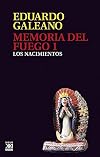
In the beginning of the third volume of this work the author himself states that he ignores to what genre the book belongs: narrative, essay, epic poetry, cronicle, testimony... maybe all of them, maybe none. Indeed, if one's objective is to pigeonhole this work, he or she is most likely at a loss, but if one is not worried at all about this type of classification activities and just wants to enjoy the fruition of a great work, this is an unqualified masterpiece. Without doubt, one of the most impressive, nay perfect, works of literature I ever read. The author embarks on a five centuries voyage through the history of America (mainly, but not exclusively, Latin America) in a work that not only conveys the history, but all the rest: the smells, the colours,and the sounds; the deserts, the islands, the mountains, the rivers, and the jungles; the lives, the main events sometimes at an amazing new perspective, the unknown and almost insignificant events shading a new light on the whole, the famous and the anonymous; the battles, the revolutions, the counter revolutions, the strikes, the day to day livin$ the football matches, the soap operas... Each chapter is something between a half and two pages; it is headed by the year and the place, a title and then the vignette about something or someone, written in the beautiful and intense, sometimes ironic, prose of Galeano; it ends with a reference to the sources, listed in the bibliography, upon which the episode was based (and show more there is more then a thousand of them for the three volumes...) A chapter can be either directly connected with a latter one, where the story is continued, or only indirectly so, but in either case different chapters, even when unconnected, slowly builds up the story in an almost impressionistic way: small pieces building up the large picture, with the occasional broad stroke to organize the canvas. It is really impossible to convey the sheer beauty of some of the chapters, and the overwhelming sense of admiration with which I completed the reading of the three volumes. The work was originally published between 1982 and 1986, and the first volume starts with a number of native American founding myths and then covers the years from the arrival of the Europeans in 1492 to the end of the 17th Century. show less

Does a love story with a ninety years old character makes sense? This book proves that it does. But there is something in it that makes for a somewhat disturbing reading. Maybe that is the hallmark of great literature...