
Julian Havil
Author of Gamma: Exploring Euler's Constant
About the Author
Julian Havil is a retired former master at Winchester College, England, where he taught mathematics for more than three decades. His many books include John Napier: Life, Logarithms, and Legacy; The Irrationales: A Story of the Numbers You Can't Count On; and Gamma: Exploring Euler's Constant (all show more Princeton). show less
Image credit: via Princeton University Press
Works by Julian Havil
Tagged
Common Knowledge
Members
Reviews
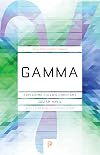
The most brilliant technical math book I have enjoyed in years. A labor of love by a teacher/mathematician. I learnt a lot about Gamma.
Did you know that the chances of two randomly picked integers being co-prime is 1:pi squared divided by six ? Just one of the charming side results using "elementary methods". Go on and delve into the history and the application by Euler, and others into this weird constant that keeps popping up in unnatural physical settings and mathematical ones, including show more the Riemann conjecture. show less
Did you know that the chances of two randomly picked integers being co-prime is 1:pi squared divided by six ? Just one of the charming side results using "elementary methods". Go on and delve into the history and the application by Euler, and others into this weird constant that keeps popping up in unnatural physical settings and mathematical ones, including show more the Riemann conjecture. show less

Havil is a delightful mathematician (author of "Gamma") who revels in the wonders of 18th century mathematics, and shares these with his readers in lively prose, and full algebraic derivations. He has done it again, combining newer results (Don E KNuth Elevator problem, Besicovitch set) with old ones (probability of a run of a certain length in digits in a random sequence) and a clever parlor/classroom trick based on that.
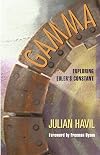
The constant γ (called the Euler, or the Euler-Mascheroni) constant plays a significant role in Number Theory. Being, like π or e, one of the ubiquitous mathematical constants, it is, still today, remarkably less well known than its famous counterparts: this lack of knowledge is ilustrated by the fact that no one knows if γ is either a rational or a irrational! This nice popular science book tells the story of γ (if one may say so...) starting with John Napier's celebrated work on show more logarithms, then going on to discuss the harmonic series (starting with the celebrated proof of its divergence by Nicholas Oresme, c.a. 1350), and the Zeta function, the Gamma function, and the definition of γ. It the proceeds with a digression about some properties of γ, unexpected relations of the harmonic series and the logarithm function to problems in other areas (such as the optimal choice problem, and Benford's law), and concluding with two chapters about the distribution of primes and the work of Riemann (including his famous hypothesis.) Overall, this is a very interesting book that offers a relaxed exploration of a number of important mathematical issues in an enjoyable style. show less
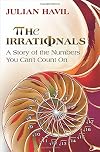
Ostensibly a popularization, but similar to Havil's earlier books _Gamma_ and _Nonplussed!_ in that any reader who wants to follow any substantial fraction of it in detail had better be conversant with a lot of college-level math. For me, the going first got especially rough in the chapter (#6) on rational approximations of irrationals (which is important later in identifying those irrationals, such as e and pi (and "almost all" others!), that are transcendental). There Havil himself admits, show more "We are wallowing in deep mathematical water, where statements are barely believable and proofs barely understandable." (p 176) Still, the book can give interested amateurs an impression of how the pros delve into the complexities of the real-number continuum. show less
Lists
Awards

You May Also Like


Statistics
- Works
- 7
- Members
- 805
- Popularity
- #31,684
- Rating
- 3.9
- Reviews
- 6
- ISBNs
- 31
- Languages
- 1
- Favorited
- 1