
John Derbyshire
Author of Prime Obsession: Bernhard Riemann and the Greatest Unsolved Problem in Mathematics
About the Author
John Derbyshire is a mathematician and linguist by education, a systems analyst by profession, and a celebrated writer in his spare time. His work appears frequently in the National Review and The New Criterion. Born and raised in England, he has made his home in the United States for the past 15 show more years. He currently lives in Huntington, New York, with his wife and two children show less
Series
Works by John Derbyshire
Prime Obsession: Bernhard Riemann and the Greatest Unsolved Problem in Mathematics (2003) 1,014 copies, 13 reviews
Old Gold Towns of Victoria 1 copy
Obsesja liczb pierwszych 1 copy
Fire from the Sun, Volume 3 1 copy
Associated Works
Counterpoints: 25 Years of The New Criterion on Culture and the Arts (2007) — Contributor — 48 copies
Life, Liberty, and the Pursuit of Happiness: Ten Years of the Claremont Review of Books (2012) — Contributor — 17 copies
Men Versus the Man: A Correspondence Between Robert Rives La Monte, Socialist, and H. L. Mencken, Individualist (1910) — Preface, some editions — 10 copies
Tagged
Common Knowledge
- Birthdate
- 1945-06-03
- Gender
- male
- Nationality
- UK (birth)
USA - Places of residence
- Huntington, New York, USA
- Associated Place (for map)
- New York, USA
Members
Reviews
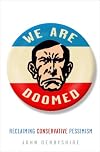
Most American conservatives, especially since Sept. 11th, exhibit signs of brain damage. And John Derbyshire diagnoses the problem: too much happy talk, too much optimism and not enough pessimism. There are limits about what man can do with himself and the natural world. Humans are not blank slates that can be remade to fit whatever utopian scheme can be dreamed up. Conservatives are supposed to know this and see things as they are. Liberals are there to take care of the happy talk and show more wishful thinking.
Now this is not an all purpose gloomfest. Derbyshire acknowledges all sorts of apocalyptic possibilities of the natural sort - resource depletion, climate change, and asteroid strike, but he doesn't talk about them. Rather he restricts himself to the social and political disasters that await America in the future. And he talks directly to conservatives. Wipe that smile off your face, he tells them. Get your mind around the fact that America does not and cannot exist outside the currents of history, that America has not been given a pass by God to do whatever it wants without horrible consequences.
And the particular delusions of optimism Derbyshire attacks? Diversity is not our strength, quite the opposite. It corrodes national identity. That presidents and legislators are not deserving of the respect, power, and money we give them. Harry Truman had to borrow money to write his memoirs. High culture has produced nothing of value after the 1950s. Pop culture has produced little of worth. A world of female empowerment is a world nudged closer to totalitarianism. Women are generally fanatical and unthoughtful about their politics. Education has become a cultish object of worship which assumes any child can become anything - if enough money is spent. Evolution is, of course, real, but it miraculously came to an end 60,000 years ago and humans never, never exhibit signs of inherited racial differences in mental aptitudes. Inside every foreigner is an American trying to get out - said transformation only needing billions of taxpayer dollars and the occasional occupation by American troops. Particular scorn is saved for conservatives who oppose immigration restrictions out of nostalgia, faulty notions of human nature, and bad historical analogies. Finally, the dismal science gets smacked around for claiming that the chaos of globalization and free trade will build a better world - a faith based assertion merely based on historical analogy.
All this is delivered in chapters of concise prose full of quantative and historical arguments. If, like me, you are already a fan of John Derbyshire's writing, you will recognize several sections. (And Derbyshire freely acknowledges the work of Steve Sailer in shaping this book too.) The only material that was new to me was from cognitive science in Chapter 7. It's some of the bleakest material here. After all, virtually every flavor of conservatism is based on the idea of humans having free will. But then, we probably have no choice but to believe that.
It's all stitched together with wit and conversational style. This is bracing despair. Congenitally optimistic conservatives will likely find something that darkens their world a bit. At least I hope so.
And if you find the whole package convincing and are tempted to use this book to convert liberals, just remember, as explained in the chapter on human nature, humans habitually deceive themselves. Indeed, it seems evolution rewards self-deceit. You probably won't get anywhere.
And the same chapter also notes that the depressed, the melancholy are the ones that most know the true lay of the land. It seems Socrates might have been wrong. It's the unexamined life that's worth living. show less
Now this is not an all purpose gloomfest. Derbyshire acknowledges all sorts of apocalyptic possibilities of the natural sort - resource depletion, climate change, and asteroid strike, but he doesn't talk about them. Rather he restricts himself to the social and political disasters that await America in the future. And he talks directly to conservatives. Wipe that smile off your face, he tells them. Get your mind around the fact that America does not and cannot exist outside the currents of history, that America has not been given a pass by God to do whatever it wants without horrible consequences.
And the particular delusions of optimism Derbyshire attacks? Diversity is not our strength, quite the opposite. It corrodes national identity. That presidents and legislators are not deserving of the respect, power, and money we give them. Harry Truman had to borrow money to write his memoirs. High culture has produced nothing of value after the 1950s. Pop culture has produced little of worth. A world of female empowerment is a world nudged closer to totalitarianism. Women are generally fanatical and unthoughtful about their politics. Education has become a cultish object of worship which assumes any child can become anything - if enough money is spent. Evolution is, of course, real, but it miraculously came to an end 60,000 years ago and humans never, never exhibit signs of inherited racial differences in mental aptitudes. Inside every foreigner is an American trying to get out - said transformation only needing billions of taxpayer dollars and the occasional occupation by American troops. Particular scorn is saved for conservatives who oppose immigration restrictions out of nostalgia, faulty notions of human nature, and bad historical analogies. Finally, the dismal science gets smacked around for claiming that the chaos of globalization and free trade will build a better world - a faith based assertion merely based on historical analogy.
All this is delivered in chapters of concise prose full of quantative and historical arguments. If, like me, you are already a fan of John Derbyshire's writing, you will recognize several sections. (And Derbyshire freely acknowledges the work of Steve Sailer in shaping this book too.) The only material that was new to me was from cognitive science in Chapter 7. It's some of the bleakest material here. After all, virtually every flavor of conservatism is based on the idea of humans having free will. But then, we probably have no choice but to believe that.
It's all stitched together with wit and conversational style. This is bracing despair. Congenitally optimistic conservatives will likely find something that darkens their world a bit. At least I hope so.
And if you find the whole package convincing and are tempted to use this book to convert liberals, just remember, as explained in the chapter on human nature, humans habitually deceive themselves. Indeed, it seems evolution rewards self-deceit. You probably won't get anywhere.
And the same chapter also notes that the depressed, the melancholy are the ones that most know the true lay of the land. It seems Socrates might have been wrong. It's the unexamined life that's worth living. show less
Prime obsession : Bernhard Riemann and the greatest unsolved problem in mathematics by John Derbyshire
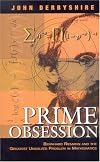
"This isn't magic. There's a reason this stuff works," my high school math teacher used to say. Of course, there are some contentions, hypotheses, in math where we don't know if they work, if they are true.
For professional mathematicians, one of the most important of these is the Riemann Hypothesis. Everlasting fame amongst mathematicians, and, incidentally, a million dollars is waiting for the person who can nail the truth of the "RH" down.
Unlike some famous math problems, the gist of the show more RH is not readily apparent to most non-mathematicians. Derbyshire has to spend some time explaining what is meant by "All non-trivial zeros of the zeta function have real part one-half." And, as someone whose formal math instruction ended with four years of high school math and who reads the very occasional popular math book by Gleick, Peterson, or Paulos, I'm pretty much the target audience Derbyshire pitches that explanation to.
The book's style reminded me of the science histories of James Burke. But where Burke's work is a pinball version of history, caroming from person to person, theory to theory, Derbyshire's is a train of mathematical explanation covering the work leading up to, and proceeding from, the RH. Occasionally, Derbyshire stops at some station, pulls up the blind, and looks at some area of tangential interest: famous mathematicians including Gauss, Hilbert, Russell, Dyson, and Turing (who thought RH untrue and attempted to build a computing device to disprove it); German educational reforms of the early 19th century; the Cambridge Five spies; and, most often, since this book is ostensibly a biography of him, the life of Bernhard Riemann. But it's not long before we're back on that math train again. This is not to shortchange the non-math interludes of the book. Derbyshire's quick asides gave me a lot of ideas for further reading. And, if less than half of the book's 422 pages cover Riemann's life, you still get some idea of his protean mind so important not only to mathematics but modern physics.
Derbyshire's claim that, if you don't understand the RH after he explains it you never will, seems credible. I won't claim I immediately followed his chain of explanations the first time around. But that had more to do with trying to read this book in 15 minute intervals over a week rather than Derbyshire's prose. Upon reviewing many sections again, things became clearer.
The book briefly notes some of the consequences of RH, practical and theoretical. A lot of math is based on the assumption it's true. And the RH may have some mysterious relation to the world of quantum physics. In the commercial and military worlds, where encryption methods based on prime numbers are important, the RH, which has to do with the distribution of primes, may have significant importance if proved true.
I think one of the best things about this book is that, briefly, in a simple way, a non-mathematician like me can get some small idea of the excitement mathematicians feel upon discovering some curious pattern in the world of numbers.
The only complaint I have with this book is its format. Is it too much to ask that, in the age of computerized typesetting and with an author whose footnotes are all worth reading, that we put those footnotes at the bottom of the relevant page and not at the end of the book? show less
For professional mathematicians, one of the most important of these is the Riemann Hypothesis. Everlasting fame amongst mathematicians, and, incidentally, a million dollars is waiting for the person who can nail the truth of the "RH" down.
Unlike some famous math problems, the gist of the show more RH is not readily apparent to most non-mathematicians. Derbyshire has to spend some time explaining what is meant by "All non-trivial zeros of the zeta function have real part one-half." And, as someone whose formal math instruction ended with four years of high school math and who reads the very occasional popular math book by Gleick, Peterson, or Paulos, I'm pretty much the target audience Derbyshire pitches that explanation to.
The book's style reminded me of the science histories of James Burke. But where Burke's work is a pinball version of history, caroming from person to person, theory to theory, Derbyshire's is a train of mathematical explanation covering the work leading up to, and proceeding from, the RH. Occasionally, Derbyshire stops at some station, pulls up the blind, and looks at some area of tangential interest: famous mathematicians including Gauss, Hilbert, Russell, Dyson, and Turing (who thought RH untrue and attempted to build a computing device to disprove it); German educational reforms of the early 19th century; the Cambridge Five spies; and, most often, since this book is ostensibly a biography of him, the life of Bernhard Riemann. But it's not long before we're back on that math train again. This is not to shortchange the non-math interludes of the book. Derbyshire's quick asides gave me a lot of ideas for further reading. And, if less than half of the book's 422 pages cover Riemann's life, you still get some idea of his protean mind so important not only to mathematics but modern physics.
Derbyshire's claim that, if you don't understand the RH after he explains it you never will, seems credible. I won't claim I immediately followed his chain of explanations the first time around. But that had more to do with trying to read this book in 15 minute intervals over a week rather than Derbyshire's prose. Upon reviewing many sections again, things became clearer.
The book briefly notes some of the consequences of RH, practical and theoretical. A lot of math is based on the assumption it's true. And the RH may have some mysterious relation to the world of quantum physics. In the commercial and military worlds, where encryption methods based on prime numbers are important, the RH, which has to do with the distribution of primes, may have significant importance if proved true.
I think one of the best things about this book is that, briefly, in a simple way, a non-mathematician like me can get some small idea of the excitement mathematicians feel upon discovering some curious pattern in the world of numbers.
The only complaint I have with this book is its format. Is it too much to ask that, in the age of computerized typesetting and with an author whose footnotes are all worth reading, that we put those footnotes at the bottom of the relevant page and not at the end of the book? show less

I love this book so much that I own not one, but two first editions, on the off chance that one may be lost if I ever get around to sending it to the author with a request for his signature. Quirky, humorous, generous, it tells a story of middle age, lost love, and the satisfactions to be found in living up to one's responsibilities. The voice of the narrator, a former Red Guard who escaped China by swimming to Hong Kong and now works in New York, is almost pitch perfect--quite an show more accomplishment for a middle-aged white Brit whose only novel this is. Even better is how Derbyshire lets us see more than the narrator does, even as he narrates his story. I can't really tell the plot without giving too much away, but the story is surprising, engaging, and altogether wonderful. Go read it now, and be enchanted by humanity and all its foibles, faults, and moments of grace. show less
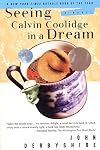
I had just finished reading Dünkirchen and was looking for an antidote for exposure to all that gore. I thought I could use some light-hearted G-rated fiction, so I plucked this book off the shelf where it had been languishing for two decades. I mean, the title did sound funny and the cover was bright and colorful.
Wow, what a bad choice. Derbyshire shares with us the vulgar expressions in common use in Hong Kong, explicit details of how he thinks it feels to participate in a gang rape, show more etc. Don't make the mistake I did and confuse paleoconservatism with social conservatism. show less
Wow, what a bad choice. Derbyshire shares with us the vulgar expressions in common use in Hong Kong, explicit details of how he thinks it feels to participate in a gang rape, show more etc. Don't make the mistake I did and confuse paleoconservatism with social conservatism. show less
Lists
Awards


You May Also Like


Associated Authors
Statistics
- Works
- 15
- Also by
- 4
- Members
- 1,832
- Popularity
- #14,048
- Rating
- 4.0
- Reviews
- 32
- ISBNs
- 39
- Languages
- 9
- Favorited
- 3
