

Bruce Goldstone
Author of Great Estimations
About the Author
Image credit: via Macmillan Publishers
Works by Bruce Goldstone
Tagged
Common Knowledge
- Gender
- male
Members
Reviews

When a mysterious box is found in a Finnish barn, its contents are revealed as a chronicle of Gnomish Christmas customs. From the arrival of Sinterklaas and his assistant Little Piet on December 6th, through the Christmas Rounds done on Christmas Night, and concluding with Edda Night on January 6th, Christmas in Gnomish culture is a month-long celebration. With games and songs, presents and plays, the merry and generous Gnomes celebrate with one another, and with all the animals of the show more natural world, who are in their care...
This delightful little fantasy guidebook contains lots of descriptions of Gnomish customs, a few Gnomish songs (complete with musical notation), and a few Gnomish teaching tales. The text is from American children's author Bruce Goldstone, and the artwork from Rien Poortvliet, co-creator, together with Wil Huygen, of the celebrated Dutch children's classic, Gnomes. A delightful little book, A Gnome's Christmas is the perfect holiday title for readers who love stories about little gnomes or tomten. The cover is decorated in red velvet, and there is a Gnome decoration included in an envelope at the rear. Although I have not yet read Gnomes (it has been on my to-read shelf for many years), I picked this one up with anticipation, given my usual enjoyment of this kind of story, and I was not disappointed! Recommended to anyone looking for magical Christmas books featuring these gentle and merry caretakers of the natural world. show less
This delightful little fantasy guidebook contains lots of descriptions of Gnomish customs, a few Gnomish songs (complete with musical notation), and a few Gnomish teaching tales. The text is from American children's author Bruce Goldstone, and the artwork from Rien Poortvliet, co-creator, together with Wil Huygen, of the celebrated Dutch children's classic, Gnomes. A delightful little book, A Gnome's Christmas is the perfect holiday title for readers who love stories about little gnomes or tomten. The cover is decorated in red velvet, and there is a Gnome decoration included in an envelope at the rear. Although I have not yet read Gnomes (it has been on my to-read shelf for many years), I picked this one up with anticipation, given my usual enjoyment of this kind of story, and I was not disappointed! Recommended to anyone looking for magical Christmas books featuring these gentle and merry caretakers of the natural world. show less
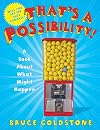
A fun, educational book that teaches children about possibilities and probabilities. I like this book because it's not a boring informational text. The pictures are bright, colorful, and are everyday things that children can relate to. I also like how the author interacts with his readers by giving them problems and encourages a response. This book can definitely be used when teaching a lesson on possibilities.
What is the possibility of finding a book about probability that is fun, engaging, informational, and accurate? Bruce Goldstone’s That’s a Possibility does a good job of introducing children to the mathematical concept of probability. This fun book, full of bright colors and quality photographs, is sure to interest readers and show them that it is not impossible to have fun while learning. I would recommend it for your library.
That’s a Possibility is a nonfiction concept book with a show more picture format for young readers. The concept being introduced here is probability. Familiar aspects of probability, like possible and impossible, are at the beginning of the book. The book takes the reader from recognizable to unfamiliar aspects of probability like combinations and permutations. Although the words combination and permutation are not mentioned until the author’s note at the end, readers will become familiar with commonly used vocabulary around the concept of probability. Noteworthy vocabulary words, such as probably, likely, certain, and impossible, are printed in enlarged text to pop out at the reader. Readers will also discover the relationships and patterns of things possible (buying a yellow gumball) and impossible (buying a pink polka dotted gumball). This concept book will likely be the first informational book a child reads about probability. Based on the pictures and text size, the target audience appears to be emergent readers in grades one through four. I have noticed that many books include photographs of people in the same age range as their reading audience. The three photographs of kids included in this book seem to be between five and eight years old. The large font size and spacing is also attractive to readers of this age. Page titles are written in large, colorful, bold text with quirky angles that elementary school children might find appealing. Look at the word aren’t in the title on page 18. The first letter A is slightly tilted to the left and has lines that shoot off at angles not parallel to the pages. This spells fun to pre-adolescent readers.
One of the strengths of That’s a Possibility is its format. Don’t judge a book by its cover? Well this cover is telling me to jump right in. The front cover has a gumball machine full of yellow gumballs and one blue one. The background is bright blue with sun stripes emanating from behind the machine as if they were jumping out at you saying, “Try me!” The title is printed on the top of the page big and bold. The title font even has a three dimensional effect to get your attention. A starburst on the top left asks the question, “Will you get the blue gumball?” Kids will want to open the book to find out what might happen. I like the wordplay on the inside cover asking what the odds are that you will find fun stuff in this book. Their answer, “That’s a certainty!”
High quality photographs can be found throughout the book. It contains photos of a cat, a dog, birds, rabbits, robots, and gumballs; all things that kids like. The images are bright and shiny. You can see the light reflecting off of the frog’s skin as it races against the rabbit and robot. Images and text are laid out to fill up the entire page, leaving little unused space. Page backgrounds are diverse keeping each page turn interesting. The sun stripes are a common theme throughout the book. The text within the pages is connected to the photographs. A close up of an ant carrying a relatively giant leaf goes along with text asking what is possibly going to happen. Photographs are also used to create charts. A chart on page 25 lists the possible outcomes for rolling two dice. All of the outcomes are represented in a triangular chart that shows the number seven having more possibilities than other numbers. Another graphical representation shows images of Squidgy the Bear wearing every possible combination of 10 shirts and 10 pants. Seeing 100 bears on a page is visually powerful. The readers should get a sense that a lot of possibilities exist with fewer clothes than many kids have in their bedroom.
The content included in this book is basic and I feel it would benefit by being more in-depth. For example, the demonstration with Squidgy the Bear shows the 100 possible combinations of pants and shirts, but excludes the idea that multiplying the 10 shirts by the 10 pants would give you 100. This information would educate the reader that the power of mathematics can take a time consuming problem (dressing the bear 100 times) and make it simple (multiplying). I don’t teach young children, so I assume Goldstone left things out that he suspected were too advanced for his readers. Although he demonstrates permutations and combinations, it is not until the author’s note at the end that he actually gives these concepts a name. Although I would not expect to see children calculating permutations, I think they would benefit from being introduced to these concepts by name in the main pages of the book. Otherwise, Goldstone does a great job of introducing students to probability. The book poses many questions to get the reader thinking critically and actively involved. I especially like the questions asking what is impossible. Page 15 includes some images of differently shaped dog treats. Most of them are in the shape of a bone with a couple rings and one heart. The expected question of what possible shapes the dog will eat is asked. The next question asks the unexpected question of what shapes are impossible for the dog to eat. I can picture children in school raising their hands with answers of “French fry” and “salamander.” A boring book would not bring out creativity and engagement like this one.
The book is easy and lighthearted with many demonstrations and questions. The style is fun and charming. As an adult reader, I found some of Goldstone’s jokes to fall flat and some attempts at cuteness to be unnecessary. A good example of his fun style is when he supposes a dog will eat one treat and immediately follows by asking how likely it is the dog will eat only one treat. That dog with his tongue sticking out sure looks like he would eat the entire lot. Two pages later Goldstone makes a joke about an ant throwing confetti at a surprise party. Given the reader level, I can let this slide, but it is pushing the boundary of anthropomorphism and would be best left out. There are other humorous ways to demonstrate impossibility. Another attempt at cuteness that I do not understand is the naming of the stuffed bear on page 26. One of the two sentences on the page names the bear. Maybe children find the name Squidgy humorous, but I felt it was unnecessary and distracting. Interrupting the flow to identify the bear’s name does not add any value to the book. I guess the title Bearly Possible, instead of Barely Possible, is cute enough and appropriate to the spread to make up for the derailment to introduce Squidgy.
This book is a basic introduction to the field and does not need plenty of access features. I was pleased to see the author’s note, Try This at Home page, and the explanations at the end of the book. The author’s note finally gives the mathematical nomenclature to some of the concepts covered in the book. Outcomes, permutations, and combinations are explained briefly on this page. Goldstone explains that a combination contains order and a permutation does not contain order. It would bolster the learning experience for Goldstone to mention that combinations, like the bear outfit example, are independent events while permutations, like the race results, are dependent events. The Try This at Home page describes two activities that readers can do with common household items. These activities are in paragraph form and read like an instruction manual rather than a fun exercise. I could hear Charlie Brown’s teacher saying, “Wonk, wonk, wonk” when I read the words aloud. The spinner and marble exercises would be better as bulleted steps or maybe in an activity box on the side of a page. Numbering the steps may make them easier for young experimenters to understand and follow. The last page of text, titled Notes, answers deeper questions about the board game and the dice chart. The book would benefit from a Further Reading section, a Bibliography, and even a Glossary. Further reading would help the more advanced mathematicians dig deeper into the world of probability and statistics. Wouldn’t it be great for students to calculate the number of phone numbers in an area code or probability of winning the lottery? A glossary would give readers a reference of the topics covered and a concise reminder of what they learned. A bibliography and more information about the author would help the accuracy of the book. Who is Bruce Goldstone? Is he an educator? Is he a mathematician? Where does he get his information about odds? Those answers are not found in this book. The readers only know is that he has written other books and spends most of his time in New York and Buenos Aires. The back jacket cover has an intriguing picture of him with dice floating all around his head. I want to know more!
An intricate design is not necessary for a short book like this one. It is organized in a simple-to- complex format with characteristics of a compare-contrast structure. The simple ideas at the beginning are presented in questions of what is possible and what is impossible. If one of the balloon shapes pop, will it be the monkey? More complex ideas at the end discuss the odds of a quarter landing on tails and the number of possible outcomes in a permutation without replacement (frog, rabbit, and robot race). Comparing what is possible and contrasting what is not possible is reiterated throughout the beginning pages. Larger possibilities with smaller odds, like the bear wardrobe, are demonstrated toward the end of the book.
I would vote to add That’s a Possibility to my school’s library. Currently, the collection contains one similar book on probability which is Do you wanna bet? Your chance to find out about probability by Jean Cushman published in 1991. Although the topic is similar, I perused Cushman’s book to find that it is written in more of a storybook format than a picture format. Goldstone’s book contains bright colors and photographs that I would expect in a modern nonfiction book. It may not be the ultimate stop for books about probability, but it does a good job of introducing the concept. Our library needs more mathematics books for young readers that are not simply workbooks. This eye-catching page-turner will be a great addition.
Instructors and librarians could use this book to start class discussions amongst classes in grades one through four. The world of possible and impossible is very broad for children. What shape biscuit is impossible for the dog to eat on page 15? Children are bound to offer up an extensive amount of silly ideas to this question. That’s a Possibility also includes some specific exercises for readers to try. Children can follow the directions to make paper plate spinners with common household items. Teachers could assign them to record 100 spins and analyze their results. Is the probability of the spinner landing on each value equivalent? I can picture walking into a classroom and seeing groups of children flipping coins and rolling dice. The groups could record the outcomes and evaluate them based on what they learned.
Books on likelihood and prediction are important for developing minds. Readers will be challenged to think not only about getting a gumball, but about the possibilities and probabilities in life. What is the likelihood I will be accepted to Yale? Is it possible to be accepted without applying? Future statisticians will know that acquiring data and making decisions will increase their understandings of possibilities in life. That’s a Possibility will help them on their learning journey. show less
That’s a Possibility is a nonfiction concept book with a show more picture format for young readers. The concept being introduced here is probability. Familiar aspects of probability, like possible and impossible, are at the beginning of the book. The book takes the reader from recognizable to unfamiliar aspects of probability like combinations and permutations. Although the words combination and permutation are not mentioned until the author’s note at the end, readers will become familiar with commonly used vocabulary around the concept of probability. Noteworthy vocabulary words, such as probably, likely, certain, and impossible, are printed in enlarged text to pop out at the reader. Readers will also discover the relationships and patterns of things possible (buying a yellow gumball) and impossible (buying a pink polka dotted gumball). This concept book will likely be the first informational book a child reads about probability. Based on the pictures and text size, the target audience appears to be emergent readers in grades one through four. I have noticed that many books include photographs of people in the same age range as their reading audience. The three photographs of kids included in this book seem to be between five and eight years old. The large font size and spacing is also attractive to readers of this age. Page titles are written in large, colorful, bold text with quirky angles that elementary school children might find appealing. Look at the word aren’t in the title on page 18. The first letter A is slightly tilted to the left and has lines that shoot off at angles not parallel to the pages. This spells fun to pre-adolescent readers.
One of the strengths of That’s a Possibility is its format. Don’t judge a book by its cover? Well this cover is telling me to jump right in. The front cover has a gumball machine full of yellow gumballs and one blue one. The background is bright blue with sun stripes emanating from behind the machine as if they were jumping out at you saying, “Try me!” The title is printed on the top of the page big and bold. The title font even has a three dimensional effect to get your attention. A starburst on the top left asks the question, “Will you get the blue gumball?” Kids will want to open the book to find out what might happen. I like the wordplay on the inside cover asking what the odds are that you will find fun stuff in this book. Their answer, “That’s a certainty!”
High quality photographs can be found throughout the book. It contains photos of a cat, a dog, birds, rabbits, robots, and gumballs; all things that kids like. The images are bright and shiny. You can see the light reflecting off of the frog’s skin as it races against the rabbit and robot. Images and text are laid out to fill up the entire page, leaving little unused space. Page backgrounds are diverse keeping each page turn interesting. The sun stripes are a common theme throughout the book. The text within the pages is connected to the photographs. A close up of an ant carrying a relatively giant leaf goes along with text asking what is possibly going to happen. Photographs are also used to create charts. A chart on page 25 lists the possible outcomes for rolling two dice. All of the outcomes are represented in a triangular chart that shows the number seven having more possibilities than other numbers. Another graphical representation shows images of Squidgy the Bear wearing every possible combination of 10 shirts and 10 pants. Seeing 100 bears on a page is visually powerful. The readers should get a sense that a lot of possibilities exist with fewer clothes than many kids have in their bedroom.
The content included in this book is basic and I feel it would benefit by being more in-depth. For example, the demonstration with Squidgy the Bear shows the 100 possible combinations of pants and shirts, but excludes the idea that multiplying the 10 shirts by the 10 pants would give you 100. This information would educate the reader that the power of mathematics can take a time consuming problem (dressing the bear 100 times) and make it simple (multiplying). I don’t teach young children, so I assume Goldstone left things out that he suspected were too advanced for his readers. Although he demonstrates permutations and combinations, it is not until the author’s note at the end that he actually gives these concepts a name. Although I would not expect to see children calculating permutations, I think they would benefit from being introduced to these concepts by name in the main pages of the book. Otherwise, Goldstone does a great job of introducing students to probability. The book poses many questions to get the reader thinking critically and actively involved. I especially like the questions asking what is impossible. Page 15 includes some images of differently shaped dog treats. Most of them are in the shape of a bone with a couple rings and one heart. The expected question of what possible shapes the dog will eat is asked. The next question asks the unexpected question of what shapes are impossible for the dog to eat. I can picture children in school raising their hands with answers of “French fry” and “salamander.” A boring book would not bring out creativity and engagement like this one.
The book is easy and lighthearted with many demonstrations and questions. The style is fun and charming. As an adult reader, I found some of Goldstone’s jokes to fall flat and some attempts at cuteness to be unnecessary. A good example of his fun style is when he supposes a dog will eat one treat and immediately follows by asking how likely it is the dog will eat only one treat. That dog with his tongue sticking out sure looks like he would eat the entire lot. Two pages later Goldstone makes a joke about an ant throwing confetti at a surprise party. Given the reader level, I can let this slide, but it is pushing the boundary of anthropomorphism and would be best left out. There are other humorous ways to demonstrate impossibility. Another attempt at cuteness that I do not understand is the naming of the stuffed bear on page 26. One of the two sentences on the page names the bear. Maybe children find the name Squidgy humorous, but I felt it was unnecessary and distracting. Interrupting the flow to identify the bear’s name does not add any value to the book. I guess the title Bearly Possible, instead of Barely Possible, is cute enough and appropriate to the spread to make up for the derailment to introduce Squidgy.
This book is a basic introduction to the field and does not need plenty of access features. I was pleased to see the author’s note, Try This at Home page, and the explanations at the end of the book. The author’s note finally gives the mathematical nomenclature to some of the concepts covered in the book. Outcomes, permutations, and combinations are explained briefly on this page. Goldstone explains that a combination contains order and a permutation does not contain order. It would bolster the learning experience for Goldstone to mention that combinations, like the bear outfit example, are independent events while permutations, like the race results, are dependent events. The Try This at Home page describes two activities that readers can do with common household items. These activities are in paragraph form and read like an instruction manual rather than a fun exercise. I could hear Charlie Brown’s teacher saying, “Wonk, wonk, wonk” when I read the words aloud. The spinner and marble exercises would be better as bulleted steps or maybe in an activity box on the side of a page. Numbering the steps may make them easier for young experimenters to understand and follow. The last page of text, titled Notes, answers deeper questions about the board game and the dice chart. The book would benefit from a Further Reading section, a Bibliography, and even a Glossary. Further reading would help the more advanced mathematicians dig deeper into the world of probability and statistics. Wouldn’t it be great for students to calculate the number of phone numbers in an area code or probability of winning the lottery? A glossary would give readers a reference of the topics covered and a concise reminder of what they learned. A bibliography and more information about the author would help the accuracy of the book. Who is Bruce Goldstone? Is he an educator? Is he a mathematician? Where does he get his information about odds? Those answers are not found in this book. The readers only know is that he has written other books and spends most of his time in New York and Buenos Aires. The back jacket cover has an intriguing picture of him with dice floating all around his head. I want to know more!
An intricate design is not necessary for a short book like this one. It is organized in a simple-to- complex format with characteristics of a compare-contrast structure. The simple ideas at the beginning are presented in questions of what is possible and what is impossible. If one of the balloon shapes pop, will it be the monkey? More complex ideas at the end discuss the odds of a quarter landing on tails and the number of possible outcomes in a permutation without replacement (frog, rabbit, and robot race). Comparing what is possible and contrasting what is not possible is reiterated throughout the beginning pages. Larger possibilities with smaller odds, like the bear wardrobe, are demonstrated toward the end of the book.
I would vote to add That’s a Possibility to my school’s library. Currently, the collection contains one similar book on probability which is Do you wanna bet? Your chance to find out about probability by Jean Cushman published in 1991. Although the topic is similar, I perused Cushman’s book to find that it is written in more of a storybook format than a picture format. Goldstone’s book contains bright colors and photographs that I would expect in a modern nonfiction book. It may not be the ultimate stop for books about probability, but it does a good job of introducing the concept. Our library needs more mathematics books for young readers that are not simply workbooks. This eye-catching page-turner will be a great addition.
Instructors and librarians could use this book to start class discussions amongst classes in grades one through four. The world of possible and impossible is very broad for children. What shape biscuit is impossible for the dog to eat on page 15? Children are bound to offer up an extensive amount of silly ideas to this question. That’s a Possibility also includes some specific exercises for readers to try. Children can follow the directions to make paper plate spinners with common household items. Teachers could assign them to record 100 spins and analyze their results. Is the probability of the spinner landing on each value equivalent? I can picture walking into a classroom and seeing groups of children flipping coins and rolling dice. The groups could record the outcomes and evaluate them based on what they learned.
Books on likelihood and prediction are important for developing minds. Readers will be challenged to think not only about getting a gumball, but about the possibilities and probabilities in life. What is the likelihood I will be accepted to Yale? Is it possible to be accepted without applying? Future statisticians will know that acquiring data and making decisions will increase their understandings of possibilities in life. That’s a Possibility will help them on their learning journey. show less
oh my goodness
Excellent book for youngsters, and for anyone who thinks that they're "due" for a change of luck. No matter how many times you flip heads, there's always a 50% chance of heads again (assuming a fair coin of course). Possible, likely, probable, unlikely, improbable, impossible. Learn them when you're young so you don't throw money away gambling, or so you know how to read health and science news, etc. I definitely not only recommend this, but hope I can find more by the author.
Excellent book for youngsters, and for anyone who thinks that they're "due" for a change of luck. No matter how many times you flip heads, there's always a 50% chance of heads again (assuming a fair coin of course). Possible, likely, probable, unlikely, improbable, impossible. Learn them when you're young so you don't throw money away gambling, or so you know how to read health and science news, etc. I definitely not only recommend this, but hope I can find more by the author.
Lists
Awards


You May Also Like


Associated Authors
Statistics
- Works
- 25
- Members
- 2,560
- Popularity
- #10,033
- Rating
- 4.0
- Reviews
- 51
- ISBNs
- 57
- Languages
- 3