
Margaret Visser
Author of The Rituals of Dinner: The Origins, Evolution, Eccentricities, and Meaning of Table Manners
About the Author
Margaret Visser is the author of three previous books: "Much Depends on Dinner", "Rituals of Dinner", & "The Way We Are". She lives in Barcelona. (Bowker Author Biography)
Image credit: Photo by Nigel Beale / Flickr
Works by Margaret Visser
The Rituals of Dinner: The Origins, Evolution, Eccentricities, and Meaning of Table Manners (1991) 916 copies, 9 reviews
Much Depends on Dinner: The Extraordinary History and Mythology, Allure and Obsessions, Perils and Taboos of an Ordinary Meal (1986) 704 copies, 5 reviews
The Geometry of Love: Space, Time, Mystery, and Meaning in an Ordinary Church (2000) 274 copies, 5 reviews
Associated Works
The Smiles of Rome: A Literary Companion for Readers and Travelers (2005) — Contributor — 66 copies, 2 reviews
Tagged
Common Knowledge
- Canonical name
- Visser, Margaret
- Birthdate
- 1940-05-11
- Gender
- female
- Education
- University of Toronto (BA|1970|MA|1973|Ph.D|1980)
Sorbonne University - Occupations
- university professor
broadcaster
classicist
food historian
columnist - Organizations
- York University [Toronto]
- Awards and honors
- Glenfiddich Award, Foodbook of the Year (1989)
Jane Grigson Award for Scholarly Distinction (1982)
International Association of Culinary Professionals' Literary Food Writing Award (1982)
Sweeney Award (2004) - Agent
- Linda McKnight
Pagnamenta, Zoë - Relationships
- Visser, Colin (husband)
- Nationality
- Canada (naturalized)
South Africa (birth) - Birthplace
- Germiston, South Africa
- Places of residence
- Toronto, Ontario, Canada
Zambia
Barcelona, Catalonia, Spain
Members
Reviews

This is an excellent book. I enjoyed the application of an academic intellect toward understanding the boundaries that set our fate: honour and shame, boredom and embarrassment. I appreciated Visser's consideration of our Western (Christian) heritage, which attempts to escape fate through mercy and forgiveness. However, the last page brings it all together: we have a choice to remain bound to fate or to choose freedom instead by embracing love.

Margaret Visser has one of the best stocked minds I've ever encountered. Educated as a Classics professor, she has expanded her publications to include the Colombian food exchanges, and this gem of a book. It deals with architecture and its details but is also an extended exploration of human our relationship with sacred spaces. And therefore with the concept of the sacred itself. To be read and reread.
Gift of Thanks: The Roots, Persistence and Paradoxical Meanings of a Social Ritual by Margaret Visser
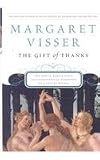
Why Do We Say Thank You
Having read a few other books of from Margaret Visser, I was eager to read "The Gift of Thanks" and was once again impressed by Visser's multi-disciplinary approach to the exploration of such a common everyday ritual. The book is sociological, psychological, philological, philosophical, historical, geographical, etc... You can really appreciate how she unpacks the complexity of the many cultural and religious traditions of giving thanks as she weaves together such show more diverse literary works and philosophies such as Homer's Iliad, indigenous philosophies of the Maoris, Max Weber, and Immanuel Kant.
The most relevant parts of Visser's insights were the intersection of this ancient ritual and modernity, how despite the heavy influences of commercialization and commodification, the social act of giving and its reciprocity continues. But also how modernity changes our perceptions and actions, at one point Visser explores the point that is often made that "I don't need gratitude, everything I want I can buy."
The book is rather long at close to 400 pages, but it is a fast read and Visser's commentary about all the many sources she analyzes is very engaging. Overall, I definitely recommend this book for anyone who has ever thought more about giving thanks. show less
Having read a few other books of from Margaret Visser, I was eager to read "The Gift of Thanks" and was once again impressed by Visser's multi-disciplinary approach to the exploration of such a common everyday ritual. The book is sociological, psychological, philological, philosophical, historical, geographical, etc... You can really appreciate how she unpacks the complexity of the many cultural and religious traditions of giving thanks as she weaves together such show more diverse literary works and philosophies such as Homer's Iliad, indigenous philosophies of the Maoris, Max Weber, and Immanuel Kant.
The most relevant parts of Visser's insights were the intersection of this ancient ritual and modernity, how despite the heavy influences of commercialization and commodification, the social act of giving and its reciprocity continues. But also how modernity changes our perceptions and actions, at one point Visser explores the point that is often made that "I don't need gratitude, everything I want I can buy."
The book is rather long at close to 400 pages, but it is a fast read and Visser's commentary about all the many sources she analyzes is very engaging. Overall, I definitely recommend this book for anyone who has ever thought more about giving thanks. show less
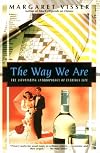
This is a collection of micro-essays on being human, on being "The Way We Are". It is an apt title. John Fraser, in his foreword to the book, describes this type of work as a "visserism", and says: "more 'hmmms' have been uttered at the end of a Visser column than after anything else published in the magazine [Saturday Night]." That perfectly describes these wandering explorations. It is an unpredictable and eclectic mix of topics, such as High Heels, Greetings, The Fireplace, Christmas show more Pudding, Crossword Puzzles, Vacations, Bells, etc. In just several brief pages (always accompanied by several references, for brevity does not excuse a lack of academic rigor), she is able to convey concisely why a particular subject is of interest, and outlines its appropriate etymology, anthropologic signficance, and evolution into modern usage, replete with interesting anecdotal examples. She places the subject in its ancient history and describes how it has echoed through the ages and sometimes achieved a symbolism. It is a marriage of enthusiastic curiosity with a love of research. show less
Lists
Awards


You May Also Like


Associated Authors
Statistics
- Works
- 10
- Also by
- 2
- Members
- 2,436
- Popularity
- #10,538
- Rating
- 3.8
- Reviews
- 32
- ISBNs
- 66
- Languages
- 4
- Favorited
- 1