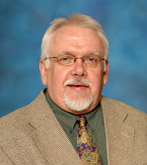
Richard J. Cox
Author of No Innocent Deposits: Forming Archives by Rethinking Appraisal
About the Author
Richard J. Cox is professor at the School of Information Sciences, University of Pittsburgh.
Works by Richard J. Cox
Personal Archives and a New Archival Calling: Readings, Reflections and Ruminations (2008) 40 copies, 1 review
Vandals in the Stacks?: A Response to Nicholson Baker's Assault on Libraries (Contributions in Librarianship and Information Science) (2002) 24 copies, 1 review
The Demise of the Library School: Personal Reflections on Professional Education in the Modern Corporate University (2010) 11 copies
Closing an Era: Historical Perspectives on Modern Archives and Records Management (New Directions in Information Management) (2000) 5 copies
American archival analysis : the recent development of the archival profession in the United States (1990) 3 copies
Tracing the history of the Baltimore structure: A guide to the primary and secondary sources (1980) 2 copies
A name index to the Baltimore city tax records, 1798-1808, of the Baltimore City Archives (1981) 1 copy
Tagged
Common Knowledge
- Gender
- male
- Education
- University of Pittsburgh (PhD)
- Occupations
- educator (archival education)
- Awards and honors
- Society of American Archivists Fellow
- Places of residence
- Pittsburgh, Pennsylvania, USA
- Associated Place (for map)
- Pennsylvania, USA
Members
Reviews
Personal Archives and a New Archival Calling: Readings, Reflections and Ruminations by Richard J. Cox
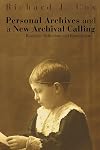
Richard J. Cox's Personal Archives and a New Archival Calling: Readings, Reflections and Ruminations (Litwin Books, 2008) is one archivist's take on the state of the field. Cox is one of the most thoughtful and always-worth-reading archivists out there, and this extended essay on the role of personal archives is certainly one that should be examined closely by those of us who continue to face every day the challenges wrought by recent technological and societal shifts.
Cox argues that as show more technology and a record-keeping impulse seems to be propelling people to create and maintain personal archives, professional archivists should be prepared to engage with the public in real, meaningful ways - assisting them in the retention and preservation of personal and family documents, and coming to grips with the ways in which blogs, digital photography and other digital forms will impact both personal archives and institutional collections.
This wide-ranging book reveals Cox's vast knowledge of contemporary authors and their writings. He quotes and examines everyone from Derrida to David Weinberger, Simon Worrall to Sven Birkerts, Paul Collins to Robert Darnton and Anthony Grafton. His bibliography runs to more than forty pages, and one would do well to mine it for a very useful reading list.
A timely, necessary look at the archival world as it is, and a positive prescription for how it could be.
http://philobiblos.blogspot.com/2009/06/book-review-personal-archives-and-new.ht... show less
Cox argues that as show more technology and a record-keeping impulse seems to be propelling people to create and maintain personal archives, professional archivists should be prepared to engage with the public in real, meaningful ways - assisting them in the retention and preservation of personal and family documents, and coming to grips with the ways in which blogs, digital photography and other digital forms will impact both personal archives and institutional collections.
This wide-ranging book reveals Cox's vast knowledge of contemporary authors and their writings. He quotes and examines everyone from Derrida to David Weinberger, Simon Worrall to Sven Birkerts, Paul Collins to Robert Darnton and Anthony Grafton. His bibliography runs to more than forty pages, and one would do well to mine it for a very useful reading list.
A timely, necessary look at the archival world as it is, and a positive prescription for how it could be.
http://philobiblos.blogspot.com/2009/06/book-review-personal-archives-and-new.ht... show less
Vandals in the Stacks?: A Response to Nicholson Baker's Assault on Libraries (Contributions in Librarianship and Informa by Richard J. Cox
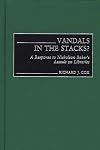
Richard Cox writes a valiant response to Nicholson Baker’s Double Fold, citing heavily from the previous work to show the flaws in Baker’s critique and attempt to set the record straight from the library and archives point of view. One of Baker’s biggest fault in his work is the nasty, dismissive tone he takes which discredits his points. Luckily Cox can put that aside to address the major issue which is really how the public views libraries and archives and how librarians and show more archivists need to improve public relations regarding what it is they (we?) actually do. Another flaw of Baker is that he writes too many pages beating the same points out, which Cox unfortunately follows suit writing an equally long book responding with the same counterpoints repeatedly reiterated. The two books together make for a good jumping off point in library and archival educational discussion.
Quotes:
“I have long taught future archivists that one key to being a good archivist is being a good destroyer, otherwise society would be drowning in information and evidence.” – (p. 86)
“Nicholson Baker’s qualifications as a novelist may get him into trouble here . . . There are many similarities in writing history and historical fiction, but only one purports to make an effort to provide an accurate representation of the past.” (p. 121)
“Nicholson Baker has given us a kind of truncated view of library and archival preservation; while he makes references to events or attitudes at particular time periods, Baker often seems to blend them all into one porridge and lacks any sense of change, past and in progress. Baker switches back and forth between practices ranging over a half century without considering the nature of progress within fields such as archives, librarianship, and preservation. It is a fatal error, minimizing the validity of his ideas and concerns. “ (p. 192)
“What may be ironic is that my own views about the presidential library system may be as controversial to some as Nicholson Baker’s views about library and archival preservation are to me (and others). There is much, I suspect, that we have in common, especially in trying to influence change within the fields responsible for managing our documentary heritage. The primary difference, I think, is that I work from within and with a greater knowledge of and sensitivity to the nuances of the issues than what Mr. Baker possess. The chief value of Baker’s Double Fold may be that it serves as a warning to individuals like me that we cannot take for granted that we or our discipline will be understood or appreciated by external observers.” (p. 196) show less
Quotes:
“I have long taught future archivists that one key to being a good archivist is being a good destroyer, otherwise society would be drowning in information and evidence.” – (p. 86)
“Nicholson Baker’s qualifications as a novelist may get him into trouble here . . . There are many similarities in writing history and historical fiction, but only one purports to make an effort to provide an accurate representation of the past.” (p. 121)
“Nicholson Baker has given us a kind of truncated view of library and archival preservation; while he makes references to events or attitudes at particular time periods, Baker often seems to blend them all into one porridge and lacks any sense of change, past and in progress. Baker switches back and forth between practices ranging over a half century without considering the nature of progress within fields such as archives, librarianship, and preservation. It is a fatal error, minimizing the validity of his ideas and concerns. “ (p. 192)
“What may be ironic is that my own views about the presidential library system may be as controversial to some as Nicholson Baker’s views about library and archival preservation are to me (and others). There is much, I suspect, that we have in common, especially in trying to influence change within the fields responsible for managing our documentary heritage. The primary difference, I think, is that I work from within and with a greater knowledge of and sensitivity to the nuances of the issues than what Mr. Baker possess. The chief value of Baker’s Double Fold may be that it serves as a warning to individuals like me that we cannot take for granted that we or our discipline will be understood or appreciated by external observers.” (p. 196) show less
Arquivos pessoais: um novo campo profissional: leituras, reflexões e reconsiderações by Richard J. Cox
Localização: HLB 593
Aug 22, 2024Portuguese (Brazil)
You May Also Like


Associated Authors
Statistics
- Works
- 22
- Members
- 282
- Popularity
- #82,538
- Rating
- 3.7
- Reviews
- 3
- ISBNs
- 28
- Languages
- 1
- Favorited
- 1