
Mike Madrid
Author of The Supergirls: Fashion, Feminism, Fantasy, and the History of Comic Book Heroines
Series
Works by Mike Madrid
The Supergirls: Fashion, Feminism, Fantasy, and the History of Comic Book Heroines (2009) 223 copies, 10 reviews
Divas, Dames & Daredevils: Lost Heroines of Golden Age Comics (2013) — Editor — 71 copies, 15 reviews
The Supergirls: Feminism, Fantasy, and the History of Comic Book Heroines (Revised and Updated) (2016) 46 copies, 11 reviews
Vixens, Vamps & Vipers: Lost Villainesses of Golden Age Comics (2014) — Editor — 42 copies, 9 reviews
The Latino Century: How America's Largest Minority Is Transforming Democracy (2024) 13 copies, 1 review
Associated Works
Tagged
Common Knowledge
- Birthdate
- 20th century
- Gender
- male
- Nationality
- USA
- Associated Place (for map)
- USA
Members
Reviews

Summary: In The Supergirls, Mike Madrid takes a look at comic book heroines, from the inception of the genre in in the 1930s until today. In a genre that has primarily been written by - and for - men, the way that women are depicted has frequently been a reflection of the prevailing social attitudes about gender, sex, femininity, and feminism. The differences in power, popularity, motivation, and costume between comic book heroines and their male counterparts over the year has often mirrored show more the state of American gender relations, and women's search for identity and and battle for equality has taken place not only in real life, but also across the pages of superhero comics.
Review: I'm a relevant latecomer to the world of comics in general, and my entrée was via collected graphic novels that look and feel like books - single-issue serial comics just don't hold the same allure for me. I also haven't particularly gravitated towards the superhero comics; with the exception of (very) sporadic X-men issues when I was younger, my only brushes with superheroes in print have been Watchmen, and the comics associated with The Amazing Adventures of Kavalier and Clay. My knowledge of various superhero characters is drawn almost entirely from their TV and movie incarnations, with some help from attending costume parties with folks who are nerdier than I am (at least when it comes to comic books.) Despite all of this, however, I still found Madrid's The Supergirls both easy to follow and very interesting.
I think that this accessibility to the layperson is definitely this book's biggest strength. Madrid is clearly incredibly well-versed in the history of comics, and he's very good at summarizing characters' backstories, personas, and main story arcs clearly and succinctly (not always an easy task, given some of the convoluted logic of some superhero universes). He's also quite talented at describing how the characters and the genre as a whole have changed over time, and relating the superheroes and heroines to the prevailing mores and attitudes of their day. At times, I did feel like he was skimming the surface - relying too much on describing the patterns rather than giving a really in-depth critical analysis of them - but most of the time he strikes the right balance of drawing enough connections to hold the reader's interest without ever tipping over into feeling dry or overly-academic.
So, apart from learning a lot about the history of superheroines, I also thought that Madrid made a number of very cogent points about the history of feminism, and the shifting relationships between gender, power (or the lack thereof), sex and desirability, and identity (secret and otherwise). Some of these were relatively obvious - such as the fact that while there is no shortage of "man" superheroes - SuperMAN, BatMAN, etc. - there are relatively few "woman" superheroes, and that even grown women frequently got stuck with a "girl" moniker. Some of Madrid's points, however, were things that I had never noticed or thought to consider, such as the disproportionate number of superheroines with "stand and point" superpowers (i.e. psychic abilities, shooting electricity from the fingertips, etc.) - so that they can fight the bad guys without getting sweaty or mussing their hair.
My only main complaint about this book was the near-total lack of pictures. That whole "thousand words" thing is a cliché because it's true, and the more Madrid talked about things like changes in Wonder Woman's costumes over time, the more I wanted to just see a few representative panels illustrating what he was talking about. I'm sure that there were copyright/licensing issues that kept this book text-only, but more illustrations or a small section of color plates would have been a huge boon. 4 out of 5 stars.
Recommendation: While I think this book will certainly appeal to comic-book-geeks, I don't think that they're its only audience. People who enjoy sociological or cultural studies or modern pop-culture history, particularly with a feminist slant, should definitely pick this one up as well. show less
Review: I'm a relevant latecomer to the world of comics in general, and my entrée was via collected graphic novels that look and feel like books - single-issue serial comics just don't hold the same allure for me. I also haven't particularly gravitated towards the superhero comics; with the exception of (very) sporadic X-men issues when I was younger, my only brushes with superheroes in print have been Watchmen, and the comics associated with The Amazing Adventures of Kavalier and Clay. My knowledge of various superhero characters is drawn almost entirely from their TV and movie incarnations, with some help from attending costume parties with folks who are nerdier than I am (at least when it comes to comic books.) Despite all of this, however, I still found Madrid's The Supergirls both easy to follow and very interesting.
I think that this accessibility to the layperson is definitely this book's biggest strength. Madrid is clearly incredibly well-versed in the history of comics, and he's very good at summarizing characters' backstories, personas, and main story arcs clearly and succinctly (not always an easy task, given some of the convoluted logic of some superhero universes). He's also quite talented at describing how the characters and the genre as a whole have changed over time, and relating the superheroes and heroines to the prevailing mores and attitudes of their day. At times, I did feel like he was skimming the surface - relying too much on describing the patterns rather than giving a really in-depth critical analysis of them - but most of the time he strikes the right balance of drawing enough connections to hold the reader's interest without ever tipping over into feeling dry or overly-academic.
So, apart from learning a lot about the history of superheroines, I also thought that Madrid made a number of very cogent points about the history of feminism, and the shifting relationships between gender, power (or the lack thereof), sex and desirability, and identity (secret and otherwise). Some of these were relatively obvious - such as the fact that while there is no shortage of "man" superheroes - SuperMAN, BatMAN, etc. - there are relatively few "woman" superheroes, and that even grown women frequently got stuck with a "girl" moniker. Some of Madrid's points, however, were things that I had never noticed or thought to consider, such as the disproportionate number of superheroines with "stand and point" superpowers (i.e. psychic abilities, shooting electricity from the fingertips, etc.) - so that they can fight the bad guys without getting sweaty or mussing their hair.
My only main complaint about this book was the near-total lack of pictures. That whole "thousand words" thing is a cliché because it's true, and the more Madrid talked about things like changes in Wonder Woman's costumes over time, the more I wanted to just see a few representative panels illustrating what he was talking about. I'm sure that there were copyright/licensing issues that kept this book text-only, but more illustrations or a small section of color plates would have been a huge boon. 4 out of 5 stars.
Recommendation: While I think this book will certainly appeal to comic-book-geeks, I don't think that they're its only audience. People who enjoy sociological or cultural studies or modern pop-culture history, particularly with a feminist slant, should definitely pick this one up as well. show less

I would never had guessed that the Golden Age of comics possessed such a wide range of female hero characters-- most of what's remained in the popular consciousness are fairly straightforward superheroes, like Wonder Woman, the Phantom Lady, or, uh, Firebrand*?
There are definitely superheroes here, but they are probably some of the less interesting heroines on offer. If you've ever read collections of any of the lesser Golden Age superheroes, like Sandman, you'll know what to expect: quick show more criminal plots wrapped up by personality-less characters. There are still some standouts, though, such as Mother Hubbard, an ugly witch who uses her powers to aid America in the war effort in a story by Bill Madden. Though her magic makes her so powerful there doesn't seem to be much that can stop her! I found most of the war comics similarly generic, though it was neat seeing all the different roles the women held, from super-spies to super-nurses.
There are also a number of tales here of fantasy and science fiction heroines: epic adventurers across time and space. For many of these, the individual tales here aren't so interesting as Mike Madrid's synopses of their publication history-- I want to know about the storied histories of Fantomah, Mystery Woman of the Jungle, who is at various points a goddess, a jungle queen, and an Egyptian ruler; Queen Camilla of the Lost Empire, who goes from being a warrior queen to a lost jungle girl; Gale Allen and the Girl Squadron, who fly through space battle pirates; and the Magician from Mars, exiled from her home planet by the evil Hood. They sound fascinating!
No, the real good stuff here comes in the tales of "everyday" women fighting the good fight against evil. Barbara Hall's "Introducing the Blonde Bomber" does exactly what the title implies, introducing Honey Blake, a newsreel camerawoman who is also a chemist, and uses her reporting and scientific powers to fight crime. Apparently she appeared regularly in a number of comics for about five years; I'd like to seek more of them out. There's also Jill Trent, Science Sleuth who battle crime with her friend/possible lesbian lover, here in the tale "The Freezer Ray!" by Ken Battefield and Frank Frazetta. I like these stories of women are captivating not (only) through their beauty, but through their intellectual superiority to every man around them!
Probably the best story in the book is by Bill Draut, who went on to have a successful career for DC in the Silver Age, especially in horror comics. The Calamity Jane tale "The Man Who Met Himself" has (like, apparently most Calamity Jane tales) an entertaining frame where Jane seeks out Draut to get her to illustrate her most recent adventure. Jane is very much a typical hardboiled detective... only she's a woman, and her condescending attitude to everyone she meets is terrific fun. This is another character I'd definitely seek out more adventures of... if I ever clear out my current backlog of digital comics to read! Since these stories are in the public domain now, most can be read for free online, and I suspect I would enjoy getting to explore this forgotten corner of comics history.
* Not an actual Golden Age heroine, apparently, much like the "original" Fury. show less
There are definitely superheroes here, but they are probably some of the less interesting heroines on offer. If you've ever read collections of any of the lesser Golden Age superheroes, like Sandman, you'll know what to expect: quick show more criminal plots wrapped up by personality-less characters. There are still some standouts, though, such as Mother Hubbard, an ugly witch who uses her powers to aid America in the war effort in a story by Bill Madden. Though her magic makes her so powerful there doesn't seem to be much that can stop her! I found most of the war comics similarly generic, though it was neat seeing all the different roles the women held, from super-spies to super-nurses.
There are also a number of tales here of fantasy and science fiction heroines: epic adventurers across time and space. For many of these, the individual tales here aren't so interesting as Mike Madrid's synopses of their publication history-- I want to know about the storied histories of Fantomah, Mystery Woman of the Jungle, who is at various points a goddess, a jungle queen, and an Egyptian ruler; Queen Camilla of the Lost Empire, who goes from being a warrior queen to a lost jungle girl; Gale Allen and the Girl Squadron, who fly through space battle pirates; and the Magician from Mars, exiled from her home planet by the evil Hood. They sound fascinating!
No, the real good stuff here comes in the tales of "everyday" women fighting the good fight against evil. Barbara Hall's "Introducing the Blonde Bomber" does exactly what the title implies, introducing Honey Blake, a newsreel camerawoman who is also a chemist, and uses her reporting and scientific powers to fight crime. Apparently she appeared regularly in a number of comics for about five years; I'd like to seek more of them out. There's also Jill Trent, Science Sleuth who battle crime with her friend/possible lesbian lover, here in the tale "The Freezer Ray!" by Ken Battefield and Frank Frazetta. I like these stories of women are captivating not (only) through their beauty, but through their intellectual superiority to every man around them!
Probably the best story in the book is by Bill Draut, who went on to have a successful career for DC in the Silver Age, especially in horror comics. The Calamity Jane tale "The Man Who Met Himself" has (like, apparently most Calamity Jane tales) an entertaining frame where Jane seeks out Draut to get her to illustrate her most recent adventure. Jane is very much a typical hardboiled detective... only she's a woman, and her condescending attitude to everyone she meets is terrific fun. This is another character I'd definitely seek out more adventures of... if I ever clear out my current backlog of digital comics to read! Since these stories are in the public domain now, most can be read for free online, and I suspect I would enjoy getting to explore this forgotten corner of comics history.
* Not an actual Golden Age heroine, apparently, much like the "original" Fury. show less
 This review was written for LibraryThing Early Reviewers.
Mike Madrid's follow-up to Divas, Dames & Daredevils, which I've read but not yet reviewed, focuses on female villains of the Golden Age of Comics. Its array of characters feels a lot less diverse than the female heroes of the previous book-- I suppose there's only so many criminal plots in the Golden Age model one can come up with-- but it's still pretty enjoyable at times.
Some of these comics are terrible, of course, but some are genuinely good: it's obvious why Will Eisner (Espionage show more starring Black X: "Night of the Living Bombs") and Jack Cole (Plastic Man: "The Figure") are the artists we still know today, because they stand out head and shoulders above the other ones collected here. Even in 1940, Eisner is already starting to do cool stuff with panel borders and the conventions of the medium, and Cole's figure work is just fun. I don't remember DDD having any contributions by latterly-famous artists, so it's a nice touch on Madrid's part. Shame about the actual story of the Black X installment, though!
Once you get beyond the stereotypical superhero tales (especially the World War II-influenced ones), there's some good stuff here. "Crimebuster meets He She" (by Charles Biro) has a half-man, half-woman as a villain, though their means of operation is completely implausible: at one point, they swindle a woman of her fortune by marrying her, which requires He She to make sure the woman never sees their left side! There are a lot of smart and active women here-- you have to be both to be a villain, after all-- which as Madrid points out, defy some of our expectations of Golden Age comics women, mostly formed (I suspect) by the girlfriends in superhero comics. Some just seem evil, some are jealous, and many turn to crime when society leaves them little choice.
The section on race features a diverse range of villains-- Nepalese, African, Indian, Japanese-- though of course some of them are pretty distasteful, such as Merlin the Magician's adventure "Temple of the Man-Eating Spider" by Fred Gaurdineer, where Merlin (evidently a modern British adventurer who knows magic, not the Actual Merlin) semi-randomly decides to steal a Nepalese diamond so he can give it to Churchill to fun the war effort; for the offense of trying to stop him from stealing from them, he blows up their temple. Rulah the (white) Jungle Goddess versus Maya the (black) Nazi sympathizer in "Bloodstained Fangs!" (by Matt Baker) primarily seems to be an excuse for some woman-on-woman bath-wrestling action.
The best stories here are definitely the "true crime" ones, all collected from a 1948-51 series called, delightfully, Crimes by Women. These are the most lurid, are the most fun, and feature the most interesting villains. "Belle Guness: The Monster of Laporte," by the mysterious one-named Carter, is about a woman who kills her abusive husband in a moment of frustration... and then realizes how much money one can make by killing husbands over and over. "Madame Muscle: Maid of Steel" (move over, Supergirl!) is about a circus strongwoman who's manipulated into going bad, but then turns the table on her manipulators with a series of increasingly audacious heists; she's so ridiculous, you have to love her, I think. At one point she wrenches the door off the car she's in and throws it at a pursuing police car!
Best of all is "Mable Reine: Queen of the Jungle" (unlike with Rulah, it's a metaphor), about a girl raised by train-jumpers... until one of the train-jumpers is killed by the police, and she decides to start a societal revolution and raises an army. She loses, of course, but atta girl! You can see why these true crime stories were so popular, and these small doses of them definitely hold up today. If the rest of Crimes by Women is this fun, I'd definitely read a whole collection of just that!
Fans of the DC universe should note that this volume actually contains four stories that I think would have been (or could have been) in continuity during the post-Crisis on Infinite Earths/pre-Flashpoint era, when many of the Golden Age comics later acquired by DC were considered to have actually happened when they were published. The first of the many Manhunters, Dan Richards, faces "Red-Haired Kate" in a 1943 story by Al Bryant. The original Doll Man takes on "Beauty and Her Beasts" (her plan is to kill or disfigure all women more attractive than her) in a 1946 story also by Al Bryant. A postwar Blackhawk Squadron is beset by "Madame Butterfly," a Japanese spymaster out for revenge for the death of her lover during the war in a 1949 story by Bill Woolfolk, Reed Crandall, and Chuck Cuidera. And Plastic Man faces "The Figure," a woman with a great figure who's great with figures in a 1950 tale by Jack Cole. There's no reason these Golden Age tales couldn't fit into the pre-reboot DCU as far as I can see! show less
Some of these comics are terrible, of course, but some are genuinely good: it's obvious why Will Eisner (Espionage show more starring Black X: "Night of the Living Bombs") and Jack Cole (Plastic Man: "The Figure") are the artists we still know today, because they stand out head and shoulders above the other ones collected here. Even in 1940, Eisner is already starting to do cool stuff with panel borders and the conventions of the medium, and Cole's figure work is just fun. I don't remember DDD having any contributions by latterly-famous artists, so it's a nice touch on Madrid's part. Shame about the actual story of the Black X installment, though!
Once you get beyond the stereotypical superhero tales (especially the World War II-influenced ones), there's some good stuff here. "Crimebuster meets He She" (by Charles Biro) has a half-man, half-woman as a villain, though their means of operation is completely implausible: at one point, they swindle a woman of her fortune by marrying her, which requires He She to make sure the woman never sees their left side! There are a lot of smart and active women here-- you have to be both to be a villain, after all-- which as Madrid points out, defy some of our expectations of Golden Age comics women, mostly formed (I suspect) by the girlfriends in superhero comics. Some just seem evil, some are jealous, and many turn to crime when society leaves them little choice.
The section on race features a diverse range of villains-- Nepalese, African, Indian, Japanese-- though of course some of them are pretty distasteful, such as Merlin the Magician's adventure "Temple of the Man-Eating Spider" by Fred Gaurdineer, where Merlin (evidently a modern British adventurer who knows magic, not the Actual Merlin) semi-randomly decides to steal a Nepalese diamond so he can give it to Churchill to fun the war effort; for the offense of trying to stop him from stealing from them, he blows up their temple. Rulah the (white) Jungle Goddess versus Maya the (black) Nazi sympathizer in "Bloodstained Fangs!" (by Matt Baker) primarily seems to be an excuse for some woman-on-woman bath-wrestling action.
The best stories here are definitely the "true crime" ones, all collected from a 1948-51 series called, delightfully, Crimes by Women. These are the most lurid, are the most fun, and feature the most interesting villains. "Belle Guness: The Monster of Laporte," by the mysterious one-named Carter, is about a woman who kills her abusive husband in a moment of frustration... and then realizes how much money one can make by killing husbands over and over. "Madame Muscle: Maid of Steel" (move over, Supergirl!) is about a circus strongwoman who's manipulated into going bad, but then turns the table on her manipulators with a series of increasingly audacious heists; she's so ridiculous, you have to love her, I think. At one point she wrenches the door off the car she's in and throws it at a pursuing police car!
Best of all is "Mable Reine: Queen of the Jungle" (unlike with Rulah, it's a metaphor), about a girl raised by train-jumpers... until one of the train-jumpers is killed by the police, and she decides to start a societal revolution and raises an army. She loses, of course, but atta girl! You can see why these true crime stories were so popular, and these small doses of them definitely hold up today. If the rest of Crimes by Women is this fun, I'd definitely read a whole collection of just that!
Fans of the DC universe should note that this volume actually contains four stories that I think would have been (or could have been) in continuity during the post-Crisis on Infinite Earths/pre-Flashpoint era, when many of the Golden Age comics later acquired by DC were considered to have actually happened when they were published. The first of the many Manhunters, Dan Richards, faces "Red-Haired Kate" in a 1943 story by Al Bryant. The original Doll Man takes on "Beauty and Her Beasts" (her plan is to kill or disfigure all women more attractive than her) in a 1946 story also by Al Bryant. A postwar Blackhawk Squadron is beset by "Madame Butterfly," a Japanese spymaster out for revenge for the death of her lover during the war in a 1949 story by Bill Woolfolk, Reed Crandall, and Chuck Cuidera. And Plastic Man faces "The Figure," a woman with a great figure who's great with figures in a 1950 tale by Jack Cole. There's no reason these Golden Age tales couldn't fit into the pre-reboot DCU as far as I can see! show less
This review was written for LibraryThing Early Reviewers.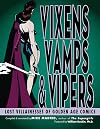
Vixens, Vamps & Vipers: Lost Villainesses of Golden Age Comics
Compiled and annotated by Mike Madrid
Exterminating Angel Press
Reviewed by Karl Wolff
Madame Doom. Fraulein Halunke. Skull Lady. Veda the Cobra Woman. Shoebox Annie French. These are only a few memorable women featured in Mike Madrid's new book, Vixens, Vamps & Vipers: Lost Villainesses of Golden Age Comics. The Golden Age existed from "the late 1930s [to the] mid '50s." As Madrid asserts in his opening essay, "These women were show more surprisingly emancipated for what we today think of as a more conservative age." Vixens acts as a companion piece to Divas, Dames, & Daredevils, a collection that explores lost Golden Age superheroines. Comics, long decried as an inferior medium, offers an illuminating reflection on the issues of the day. The Golden Age comics, unhampered by the Comics Code Authority of 1954, possess a strange cocktail of female liberation, schlocky romance elements, and downright unsettling racial stereotypes.
To focus on the craft and execution of the writing and art can sometimes obscure other more fascinating issues. In an anthology like this, Madrid preserves what would otherwise be considered ephemera or trash. Truth be told, for every stand-out example of comic book craftsmanship, there's more than enough examples of mediocre art, cardboard characters, and lame plots. What can we discover about society's mores from these examples?
Included in this collection is a strip about the detective Black X foiling the plot Madame Doom. With art by Will Eisner and Dan Zolnerowich, Black X discovers the Madame Doom's terrorist plot using human bombs. Eisner's Black X has a faithful Indian sidekick named Batu. The Black X comic is illustrative of the trope where the villainess must repress her romantic desires for the hero. Batu is not the only non-white sidekick, but he comes across as the least cringe-worthy in this collection.
On the issue of race, "Rulah: Jungle Goddess" presents a downright vertigo-inducing example of World War 2-era race politics. Rulah, the heroine, rules over her jungle kingdom with benevolence. She's white (natch) and her subjects are black. Her enemy is Mava (black) who is having an affair with a Nazi officer. Mava wants to use Nazi flying bombs to take over Rulah's jungle kingdom and liberate the African tribes. Since this is a comic book written in 1941, the difference between good and evil is stark and obvious to the reader. To the modern reader, it is a confusing mess of benevolent racism (good guys) and a black woman befriending a Nazi (bad guys). Some comics age like fine wine. Others age like mayonnaise on city pavement in the middle of July. For all of its bewildering, migraine-inducing race politics, gung ho patriotism, and imperialist condescension, "Rulah" is a worthwhile object of study.
The Golden Age offers numerous other examples. Unlike the predictable white bread superheroines, the villainesses were racially diverse. This racial diversity was one of the first casualties of the Comics Code. Beyond defanging villainesses, the enemies of the heroes became less violent, less diverse, and less interesting. Thank you, Frederick Wertham, for destroying art and turning Eisenhower's America into a hellscape of blandness. It is fascinating how similar American and the Soviet Union were in their desire to suppress allegedly dangerous artistic expression.
One of my favorite comics in this collection was "Mable Reine: Queen of the Jungle," by an unknown artist. The jungle in this case wasn't the same one occupied by Rulah and Sheena, but the hobo jungles of the Great Depression. "Mable Reine" reads like a cross between Gangs of New York and The Lord of the Flies. Mable is orphaned after a plane carrying her family crashes. She's the only survivor, receiving food and aid from a pair of hobos. After she gets arrested, she sharks her way up the criminal food chain. Mixing the skills of a criminal mastermind and a revolutionary leader, she leads hobo assaults on small towns. It's like The Dark Knight Rises, except that Bane is a teenage girl and a hobo. Forget Marvel and DC, Hollywood should make this movie right now!
Despite the crudeness of execution, the comics collected here presents a fascinating snapshot of America at a different time. The book can work as an object of personal amusement, a portable archive, and raw material for academics investigating American sexual and racial politics. It's also fun to read.
Out of 10/9.0
http://www.cclapcenter.com/2015/01/book_review_vixens_vamps_viper.html show less
Compiled and annotated by Mike Madrid
Exterminating Angel Press
Reviewed by Karl Wolff
Madame Doom. Fraulein Halunke. Skull Lady. Veda the Cobra Woman. Shoebox Annie French. These are only a few memorable women featured in Mike Madrid's new book, Vixens, Vamps & Vipers: Lost Villainesses of Golden Age Comics. The Golden Age existed from "the late 1930s [to the] mid '50s." As Madrid asserts in his opening essay, "These women were show more surprisingly emancipated for what we today think of as a more conservative age." Vixens acts as a companion piece to Divas, Dames, & Daredevils, a collection that explores lost Golden Age superheroines. Comics, long decried as an inferior medium, offers an illuminating reflection on the issues of the day. The Golden Age comics, unhampered by the Comics Code Authority of 1954, possess a strange cocktail of female liberation, schlocky romance elements, and downright unsettling racial stereotypes.
To focus on the craft and execution of the writing and art can sometimes obscure other more fascinating issues. In an anthology like this, Madrid preserves what would otherwise be considered ephemera or trash. Truth be told, for every stand-out example of comic book craftsmanship, there's more than enough examples of mediocre art, cardboard characters, and lame plots. What can we discover about society's mores from these examples?
Included in this collection is a strip about the detective Black X foiling the plot Madame Doom. With art by Will Eisner and Dan Zolnerowich, Black X discovers the Madame Doom's terrorist plot using human bombs. Eisner's Black X has a faithful Indian sidekick named Batu. The Black X comic is illustrative of the trope where the villainess must repress her romantic desires for the hero. Batu is not the only non-white sidekick, but he comes across as the least cringe-worthy in this collection.
On the issue of race, "Rulah: Jungle Goddess" presents a downright vertigo-inducing example of World War 2-era race politics. Rulah, the heroine, rules over her jungle kingdom with benevolence. She's white (natch) and her subjects are black. Her enemy is Mava (black) who is having an affair with a Nazi officer. Mava wants to use Nazi flying bombs to take over Rulah's jungle kingdom and liberate the African tribes. Since this is a comic book written in 1941, the difference between good and evil is stark and obvious to the reader. To the modern reader, it is a confusing mess of benevolent racism (good guys) and a black woman befriending a Nazi (bad guys). Some comics age like fine wine. Others age like mayonnaise on city pavement in the middle of July. For all of its bewildering, migraine-inducing race politics, gung ho patriotism, and imperialist condescension, "Rulah" is a worthwhile object of study.
The Golden Age offers numerous other examples. Unlike the predictable white bread superheroines, the villainesses were racially diverse. This racial diversity was one of the first casualties of the Comics Code. Beyond defanging villainesses, the enemies of the heroes became less violent, less diverse, and less interesting. Thank you, Frederick Wertham, for destroying art and turning Eisenhower's America into a hellscape of blandness. It is fascinating how similar American and the Soviet Union were in their desire to suppress allegedly dangerous artistic expression.
One of my favorite comics in this collection was "Mable Reine: Queen of the Jungle," by an unknown artist. The jungle in this case wasn't the same one occupied by Rulah and Sheena, but the hobo jungles of the Great Depression. "Mable Reine" reads like a cross between Gangs of New York and The Lord of the Flies. Mable is orphaned after a plane carrying her family crashes. She's the only survivor, receiving food and aid from a pair of hobos. After she gets arrested, she sharks her way up the criminal food chain. Mixing the skills of a criminal mastermind and a revolutionary leader, she leads hobo assaults on small towns. It's like The Dark Knight Rises, except that Bane is a teenage girl and a hobo. Forget Marvel and DC, Hollywood should make this movie right now!
Despite the crudeness of execution, the comics collected here presents a fascinating snapshot of America at a different time. The book can work as an object of personal amusement, a portable archive, and raw material for academics investigating American sexual and racial politics. It's also fun to read.
Out of 10/9.0
http://www.cclapcenter.com/2015/01/book_review_vixens_vamps_viper.html show less
This review was written for LibraryThing Early Reviewers.Lists
Awards


You May Also Like


Associated Authors
Statistics
- Works
- 5
- Also by
- 2
- Members
- 395
- Popularity
- #61,386
- Rating
- 3.6
- Reviews
- 46
- ISBNs
- 11
