

Callimachus
Author of Callimachus: Hymns and Epigrams; Lycophron; and Aratus
About the Author
Callimachus was an Alexandrine grammarian and poet. He was a native of Cyrene in Africa. He lived at Alexandria where was a cataloguer of the famous library of Alexandria, from about 260 B.C. until his death about 240 B.C. Among his students were Arostophanes of Byzantium and Apollonius Rhodius show more Callimachus wrote numerous works on a variety of subjects, but of these only his poems exist, which are characterized by elegance and learning. In his day he was widely admired and later served as a model for Catullus and the Roman elegiac poets, especially Ovid. (Bowker Author Biography) show less
Image credit: Image © ÖNB/Wien
Works by Callimachus
Callimachus: Aetia, Iambi, Hecale and Other Fragments; Musaeus: Hero and Leander (1958) 101 copies, 1 review
Callimachus: The Fifth Hymn: The Bath of Pallas (Cambridge Classical Texts and Commentaries) (1985) 11 copies, 1 review
Callimachus: Hymn to Demeter (Cambridge Classical Texts and Commentaries) (1984) 10 copies, 1 review
Callimachi Hymni, epigrammata, et fragmenta, ex recensione Theodori J. G. F. Graevii, cum eiusdem animadversionibus (1761) 6 copies
Miscellaneous Epics and Elegies. Other Fragments. Testimonia (Loeb Classical Library) (2022) 6 copies
Delphi Complete Works of Callimachus (Illustrated) (Delphi Ancient Classics Book 84) (2017) 6 copies
Inni: Chioma di Berenice 4 copies
[Opere] 4 copies
Callimachus' hymns I, II, V, VI 3 copies
Callimaque 3 copies
Epigrammes Hymnes 3 copies
Inni 1 copy
Himnos 1 copy
Giambi 1 copy
Hymnus in Dianam 1 copy
Epigrammes - Hymnes de Callimaque ,Emile Cahen (Sous la direction de) ( 15 janvier 2003 ) (1705) 1 copy
Epigrammes- Hymnes 1 copy
Carmina 1 copy
Callimaco Greco-Italiano 1 copy
Hymns and Epigrams (Greek) 1 copy
Reliquiae omnes, vols. 1-2 1 copy
Hymns (Greek) 1 copy
Epigrams, Fragmenta (Greek) 1 copy
Poems of Callimachus 1 copy
Inni . Chioma di Berenice / Callimaco. A cura di Valeria Gigante Lanzara [EST: Coma Berenices] 1 copy
Hymnus in Dianam 1 copy
Associated Works
World Poetry: An Anthology of Verse from Antiquity to Our Time (1998) — Contributor — 499 copies, 2 reviews
Games of Venus: An Anthology of Greek and Roman Erotic Verse from Sappho to Ovid (The New Ancient World) (1991) — Contributor — 55 copies, 1 review
Queen of Olympos: A Devotional Anthology for Hera and Iuno (Second Edition) (2013) — Contributor — 13 copies, 1 review
The Delphian Course : Part Three : Greek Drama, Philiosopy and Literature, the Story of Rome (1913) — Contributor — 8 copies
Ode to Boy: An Anthology of Same-Sex Attraction in Literature, Volume One: From Antiquity Through the Eighteenth Century (2014) — Contributor — 3 copies
Tagged
Common Knowledge
- Canonical name
- Callimachus
- Legal name
- Callimachos
- Other names
- Καλλίμαχος
- Birthdate
- 310/305 BC
- Date of death
- 240 BC
- Gender
- male
- Occupations
- Library of Alexandria
poet - Relationships
- Apollonius Rhodius (student)
- Nationality
- Ptolemaic Egypt
- Places of residence
- Cyrene, Libya
Alexandria, Egypt
Athens, Greece - Map Location
- Egypt
Members
Reviews
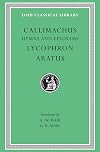
These two Callimachus Loebs date from 1958, and Loeb have no plans to publish new editions. That is disgraceful!
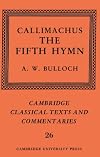
Typical postgrad text. Nothing about it sticks in my mind, tho.

Typical postgrad text. Nothing about it sticks in my mind, tho.
Λυκόφρων descries a mind that is intense and clever like that of a wolf. Lycophron's "Alexandra" is so astute as to have aroused the invidia of Byzantine critics.
Καλλίμαχος, whose name reads 'fighting nobly', was responsible for the cataloging of that famous Library of Alexandria which was a bulwark against obscurantists.
Ἄρατος ὁ Σολεύς means the desirable (or wanted) man from Soli. Aratus' "Phaenomena" was translated by Marcus Tullius Cicero "in his early show more youth." show less
Καλλίμαχος, whose name reads 'fighting nobly', was responsible for the cataloging of that famous Library of Alexandria which was a bulwark against obscurantists.
Ἄρατος ὁ Σολεύς means the desirable (or wanted) man from Soli. Aratus' "Phaenomena" was translated by Marcus Tullius Cicero "in his early show more youth." show less
Lists
You May Also Like


Associated Authors
Statistics
- Works
- 77
- Also by
- 9
- Members
- 596
- Popularity
- #42,150
- Rating
- 3.9
- Reviews
- 7
- ISBNs
- 50
- Languages
- 7
- Favorited
- 4