
Maggie Haberman
Author of Confidence Man: The Making of Donald Trump and the Breaking of America
About the Author
Works by Maggie Haberman
Confidence Man: The Making of Donald Trump and the Breaking of America (2022) — Author; Narrator, some editions — 586 copies, 17 reviews
Regime Change: Inside the Imperial Presidency of Donald Trump (2026) — Author — 139 copies, 3 reviews
Tagged
Common Knowledge
- Legal name
- Haberman, Maggie Lindsy
- Birthdate
- 1973-10-30
- Gender
- female
- Education
- Sarah Lawrence College (Bachelors|1995)
- Occupations
- news correspondent
political analyst - Organizations
- The New York Times
Cable News Network (CNN) - Awards and honors
- Front Page Award for Journalist of the Year (2018)
Pulitzer Prize for National Reporting
Aldo Beckman Award for Journalistic Excellence - Agent
- Matt Latimer (Javelin)
Keith Urbahn (Javelin) - Relationships
- Haberman, Clyde (father)
- Short biography
- Maggie Lindsy Haberman (born October 30, 1973) is an American journalist, a White House correspondent for The New York Times, and a political analyst for CNN. She previously worked as a political reporter for the New York Post, the New York Daily News, and Politico. She wrote about Donald Trump for those publications and rose to prominence covering his campaign, presidency, and post-presidency for the Times. In 2022, she published the best-selling book Confidence Man: The Making of Donald Trump and the Breaking of America. [Wikipedia]
- Nationality
- USA
- Birthplace
- New York, New York, USA
- Associated Place (for map)
- New York, USA
Members
Reviews
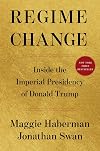
Maggie Haberman and Jonathan Swan’s meticulously reported book, Regime Change: Inside the Imperial Presidency of Donald Trump, offers a stark, deeply detailed account of the first year of Donald Trump’s second term in the White House. Published in June 2026, the non-fiction narrative draws on hundreds of interviews to bring readers inside the most closely guarded rooms of the administration. Rather than simply chronicling day-to-day political events, the journalists paint a definitive show more portrait of a radically transformed presidency, one that has been completely liberated from the traditional constraints that defined Trump’s initial four years in office. The authors argue that this second term represents an unprecedented shift in American governance, essentially amounting to a domestic regime change that has fundamentally altered the nature of the executive branch and how the rest of the world understands American power.
A central theme of the book is the stark contrast between Trump’s first and second terms, specifically focusing on the personnel who surround the Oval Office. During his first term, Trump appointed traditional establishment figures, such as James Mattis and John Kelly, who often pushed back against his more impulsive directives and tried to serve as guardrails against his worldview. In this second term, however, those generals and institutionalists are entirely gone. They have been replaced by a small, insulated, and intensely loyal inner circle. Even the White House legal personnel have shifted; the lawyers who remain have learned to pick their battles carefully, rarely advising against the president’s core directives. This absence of internal friction has given rise to a personalized style of governance where the president operates almost entirely on instinct, taking enormous risks with sweeping domestic and international consequences.
Read full summary at Booksdata.org show less
A central theme of the book is the stark contrast between Trump’s first and second terms, specifically focusing on the personnel who surround the Oval Office. During his first term, Trump appointed traditional establishment figures, such as James Mattis and John Kelly, who often pushed back against his more impulsive directives and tried to serve as guardrails against his worldview. In this second term, however, those generals and institutionalists are entirely gone. They have been replaced by a small, insulated, and intensely loyal inner circle. Even the White House legal personnel have shifted; the lawyers who remain have learned to pick their battles carefully, rarely advising against the president’s core directives. This absence of internal friction has given rise to a personalized style of governance where the president operates almost entirely on instinct, taking enormous risks with sweeping domestic and international consequences.
Read full summary at Booksdata.org show less
While I think this is an important book, I think it’s way too “weedy.” It could have been trimmed to about 350 pages if much of the unneeded detail were eliminated. Things like the menu for meals at the White House. Or where every person was seated at meetings. My guess is this was Haberman and Swan’s way to saying to Trump, “See how many of your loyal people leaked information to us, Mr. President?” With each Trump book that comes out, I swear it will be my last because they show more wear me out. I’ve decided I can’t read them at night before I go to bed because I’m just too riled to get to sleep. But, I do as I did with “Regime Change”: I order my Kindle copy right after it’s released. The saddest part of this sad story that the two respected journalists lay out here isn’t so much in the further completion of the picture of what an inept, immoral, and corrupt man the president is. The saddest part of “Regime Change” is that the very people who should read it and need to read it won’t.” Thank goodness for term limits, though. show less
Overall, very good. This detailed tick-tock of Trump's first year deserves the attention it received upon release. Even if you have followed the news closely and know the story Haberman and Swan are telling, the new details of White House meetings are interesting enough to keep your attention. Haberman and Swan don't keep their opinion of Trump -- that is, _negative_ -- a secret, but the tone and presentation of evidence is balanced and credible. The reporting is deep and believable. The show more prose is easy to read and the book is well-organized. It feels somewhat industrially produced, as each chapter follows a different topic but has the same organization. But this is typical for current events books that are rushed into print, and hardly a drawback. If you want to read about senior White House officials calling Zelensky "Mr. Bean on crack", then this book is for you. show less
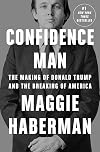
Haberman's enormous book is detailed, well-researched, and synthesizes other works on Trump, covering his entire life from birth to the end of his administration. So, obviously: that's amazing. However, the book is weakened by Haberman's career as a journalist. Sentences are crammed full of clauses in order to get more detail into them. Perhaps this is a necessity when writing for a newspaper, but in a book (especially a long one) it just made me feel slightly claustrophobic and complicated show more annotating the book. More importantly: Haberman clearly despises Trump and thinks he is a criminal, misogynist, racist, con man, etc. etc. but for legal and (I guess) journalistic-ethical-reasons can't actually say any of this explicitly. As a result, the book reads like some repressed, passive-aggressive jeremiad. So if you want details: Yes. This is it. But as a piece of literature? Neither judicious and impartial, nor unabashedly critical, Confidence Man ends up in the cracks between perspectives, becoming just a good book instead of a truly great one. show less
Awards


You May Also Like


Associated Authors
Statistics
- Works
- 3
- Members
- 779
- Popularity
- #32,679
- Rating
- 3.7
- Reviews
- 21
- ISBNs
- 24
- Languages
- 5
- Favorited
- 1