
Works by Julie Klausner
Associated Works
Tagged
Common Knowledge
- Birthdate
- 1978-07-03
- Gender
- female
Members
Reviews
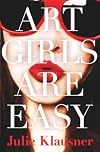
The first line of this book reads: “Indigo Hamlisch stared out of the window of her father’s gray Mercedes Coupe and thought about sex.”
Personally I find this opening tasteless, like it’s attempting to be shocking and edgy but failing miserably, kind of like the wannabe screaming vulgar things at an intimate concert in an attempt to be cool and being met with dead silence by the much classier crowd. However, after suffering through the whole book, I duly acknowledge the utter show more appropriateness of this opening line: it perfectly represents how unsuccessfully the book attempts to discuss issues of sexuality, body image, friendship, art, inspiration, and privilege. On top of that, ART GIRLS ARE EASY had a jumbled plot and weak character development. All in all, a hot mess.
ART GIRLS ARE EASY wants to be cool. It wants to be the hip new thing that people are talking about, the story that owns criticism and commerciality, the trend that turns people’s thinking upside-down. Unfortunately, it had no idea where to begin doing so. What is the focus of this book, anyway? The jacket synopsis claims that it’s about Indigo and Lucy’s changing best-friendship, but the complexities of this new chapter in their lives hardly appear. Every once in a while, Lucy deigns to come find Indy, they exchange sweet nothings for a few lines, and then Lucy dashes off, leaving Indy behind to feel inferior and insecure. In theory this is what friends drifting apart is like—but the drifting apart needs to be apparent in the harmful way they interact with each other, to show an unhealthy relationship. This book is so confused about whether or not Lucy is the villain that it tries to do a little of everything, with (predictably) poor results: for 90% of the book, we’re led to believe that Lucy is the bad and selfish friend who is just using the less attractive Indy to bolster her own self-esteem, but then apparently their misunderstandings are cleared up in a matter of a few pages at the end, Lucy’s attractiveness is balanced out by Indy’s far superior artistic talent, and Lucy and Indy go skipping off into the sunset. Huh? This is a fine ending ideally, but little exists in the book to convince readers of the strength and veracity of their friendship.
In fact, Indy and Lucy’s friendship rollercoaster takes a side-seat to the main spectacle that is Indy falling apart due to her insecurities. Scenes of Indy eating her feelings, lashing out at others, and even hurting herself could’ve been a moving reflection on adolescent self-esteem. I mean, this is serious stuff! But apparently Indy’s behavior is invalid because her perfect best friend never wavered in her loyalty. Um, what? Are we not going to discuss how, sadly, too many wonderful girls like Indigo will also have body image issues and thoughts of self-mutilation? Are you really going to send the message that as long as the insecure girl is loved by her attractive, nice, and perfect best friend, everything is going to be fine?
But perhaps most infuriating of all—if such a thing can be decided from the myriad choices we have—is how ART GIRLS ARE EASY makes no acknowledgment of the way privilege works in the characters’ lives. Silver Springs is a summer art camp that will make your university look like an overpriced homeless shelter. Throughout the book, characters continuously flaunt their privilege to get their way. They discuss how they’ll use their parents’ money to get the camp to fire a teacher, their parents’ connections to nab them a starring role in such-and-such production alongside Meryl Streep. They acknowledge how they only go to camp in order to make the connections that will get them the careers they want. It’s like Harvard for artsy high schoolers, and the book does not even try to comment on the disgusting excess that is the privilege here. No character is immune from the benefits of privilege—including Indigo. The most the book says about the glutton of privilege that exists in the book is a throwaway passage at the end:
“In no way did [Indigo’s] dad’s money talk negate the sense of accomplishment she felt around her piece. But, she figured, his donation was probably relevant to her Fairness Committee verdict. For the first time, she felt she had a better insight into the machine that kept this place running. This odd, terrible, wonderful place.”
That’s it. No lesson learned about privilege. The book totally passed on the opportunity to open readers’ eyes up to the existence of privilege in our lives and the extreme social stratification that results.
The very fact that ART GIRLS ARE EASY so desperately tries to be cool upends any promise it had of being a halfway decent story. Its faux-edginess is only outdone by its inexcusable misunderstanding of teenage thoughts and feelings. And its unquestioning attitude towards privilege—unacceptable in today’s socioeconomic situation—is the rotten cherry on top of a shapeless, flavorless cake with all the nutritional content of a vat of high fructose corn syrup. show less
Personally I find this opening tasteless, like it’s attempting to be shocking and edgy but failing miserably, kind of like the wannabe screaming vulgar things at an intimate concert in an attempt to be cool and being met with dead silence by the much classier crowd. However, after suffering through the whole book, I duly acknowledge the utter show more appropriateness of this opening line: it perfectly represents how unsuccessfully the book attempts to discuss issues of sexuality, body image, friendship, art, inspiration, and privilege. On top of that, ART GIRLS ARE EASY had a jumbled plot and weak character development. All in all, a hot mess.
ART GIRLS ARE EASY wants to be cool. It wants to be the hip new thing that people are talking about, the story that owns criticism and commerciality, the trend that turns people’s thinking upside-down. Unfortunately, it had no idea where to begin doing so. What is the focus of this book, anyway? The jacket synopsis claims that it’s about Indigo and Lucy’s changing best-friendship, but the complexities of this new chapter in their lives hardly appear. Every once in a while, Lucy deigns to come find Indy, they exchange sweet nothings for a few lines, and then Lucy dashes off, leaving Indy behind to feel inferior and insecure. In theory this is what friends drifting apart is like—but the drifting apart needs to be apparent in the harmful way they interact with each other, to show an unhealthy relationship. This book is so confused about whether or not Lucy is the villain that it tries to do a little of everything, with (predictably) poor results: for 90% of the book, we’re led to believe that Lucy is the bad and selfish friend who is just using the less attractive Indy to bolster her own self-esteem, but then apparently their misunderstandings are cleared up in a matter of a few pages at the end, Lucy’s attractiveness is balanced out by Indy’s far superior artistic talent, and Lucy and Indy go skipping off into the sunset. Huh? This is a fine ending ideally, but little exists in the book to convince readers of the strength and veracity of their friendship.
In fact, Indy and Lucy’s friendship rollercoaster takes a side-seat to the main spectacle that is Indy falling apart due to her insecurities. Scenes of Indy eating her feelings, lashing out at others, and even hurting herself could’ve been a moving reflection on adolescent self-esteem. I mean, this is serious stuff! But apparently Indy’s behavior is invalid because her perfect best friend never wavered in her loyalty. Um, what? Are we not going to discuss how, sadly, too many wonderful girls like Indigo will also have body image issues and thoughts of self-mutilation? Are you really going to send the message that as long as the insecure girl is loved by her attractive, nice, and perfect best friend, everything is going to be fine?
But perhaps most infuriating of all—if such a thing can be decided from the myriad choices we have—is how ART GIRLS ARE EASY makes no acknowledgment of the way privilege works in the characters’ lives. Silver Springs is a summer art camp that will make your university look like an overpriced homeless shelter. Throughout the book, characters continuously flaunt their privilege to get their way. They discuss how they’ll use their parents’ money to get the camp to fire a teacher, their parents’ connections to nab them a starring role in such-and-such production alongside Meryl Streep. They acknowledge how they only go to camp in order to make the connections that will get them the careers they want. It’s like Harvard for artsy high schoolers, and the book does not even try to comment on the disgusting excess that is the privilege here. No character is immune from the benefits of privilege—including Indigo. The most the book says about the glutton of privilege that exists in the book is a throwaway passage at the end:
“In no way did [Indigo’s] dad’s money talk negate the sense of accomplishment she felt around her piece. But, she figured, his donation was probably relevant to her Fairness Committee verdict. For the first time, she felt she had a better insight into the machine that kept this place running. This odd, terrible, wonderful place.”
That’s it. No lesson learned about privilege. The book totally passed on the opportunity to open readers’ eyes up to the existence of privilege in our lives and the extreme social stratification that results.
The very fact that ART GIRLS ARE EASY so desperately tries to be cool upends any promise it had of being a halfway decent story. Its faux-edginess is only outdone by its inexcusable misunderstanding of teenage thoughts and feelings. And its unquestioning attitude towards privilege—unacceptable in today’s socioeconomic situation—is the rotten cherry on top of a shapeless, flavorless cake with all the nutritional content of a vat of high fructose corn syrup. show less
I Don't Care About Your Band: What I Learned from Indie Rockers, Trust Funders, Pornographers, Felons, Faux-Sensitive Hipsters, and Other Guys I've Dated by Julie Klausner
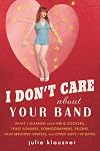
Julie Klausner is undeniably funny. Stop reading this right now and go check out "Mommy Time" on YouTube. It's five minutes of creepy hilarious brilliance. Klausner is funny on the page too. Her voice in I Don't Care About Your Band is smart, relaxed and fun. There are plenty of laugh-out-loud moments. Reading this book is like having a few cocktails with your funniest girlfriend while she dishes hilariously on all the losers she's dated.
The problem is, it's exactly like listening to your show more funniest girlfriend dish on all the losers she's dated–entertaining at first, but then it starts to make you sad. The anecdotes quickly fall into a pattern. Klausner wants something from a guy she's dating–more sex, less sex, commitment, space, whatever. Instead of asking for it, Klausner says nothing, and then starts to silently resent him for not being able to read her mind. The resentment builds until she can't stand it anymore, and another guy who seemed promising at first proves himself to be just another cad. In her defense, many of these guys do sound like cads, but a person only gets a pass for so many chance bad decisions. After that you have to start taking responsibility for your own life regardless of what the people you chose to keep near you are like.
The anecdote that gives the book it's title says it all. Klausner keeps dating guys in bands, and she hates feeling obliged to traipse around to clubs to watch them perform. But she never says to any of them, "I like you, but I don't care about your band. Why don't we get together on nights you're not performing?" Some guys wouldn't take this well, but other guys would probably understand. You never know unless you try.
Not knowing how to stand up for yourself is cute when you're a woman in your mid-twenties and everything you do is cute, but it loses its charm upon closer examination. And that's not me talking–that's my forty-something women friends who look back on their own it's-just-a-coincidence-that-all-my-boyfriends-suck periods with a shudder. I still think Klausner is hilarious, but I wouldn't want to date her. show less
The problem is, it's exactly like listening to your show more funniest girlfriend dish on all the losers she's dated–entertaining at first, but then it starts to make you sad. The anecdotes quickly fall into a pattern. Klausner wants something from a guy she's dating–more sex, less sex, commitment, space, whatever. Instead of asking for it, Klausner says nothing, and then starts to silently resent him for not being able to read her mind. The resentment builds until she can't stand it anymore, and another guy who seemed promising at first proves himself to be just another cad. In her defense, many of these guys do sound like cads, but a person only gets a pass for so many chance bad decisions. After that you have to start taking responsibility for your own life regardless of what the people you chose to keep near you are like.
The anecdote that gives the book it's title says it all. Klausner keeps dating guys in bands, and she hates feeling obliged to traipse around to clubs to watch them perform. But she never says to any of them, "I like you, but I don't care about your band. Why don't we get together on nights you're not performing?" Some guys wouldn't take this well, but other guys would probably understand. You never know unless you try.
Not knowing how to stand up for yourself is cute when you're a woman in your mid-twenties and everything you do is cute, but it loses its charm upon closer examination. And that's not me talking–that's my forty-something women friends who look back on their own it's-just-a-coincidence-that-all-my-boyfriends-suck periods with a shudder. I still think Klausner is hilarious, but I wouldn't want to date her. show less
I Don't Care About Your Band: What I Learned from Indie Rockers, Trust Funders, Pornographers, Felons, Faux-Sensitive Hipsters, and Other Guys I've Dated by Julie Klausner
I Don’t Care about Your Band delivers amusing, maddening, melancholy, and extremely relatable stories about her hook-ups and dates with complete honesty, self-effacing humor and rawness that make you want to be author Julie Klausner’s galpal. Julie, a writer [her writing has appeared at salon.com, in the New York Times, in New York Magazine on-line among others], actress, and comedian [who worked as a staff writer for VH1’s Best Week Ever] and has also performed with the Upright show more Citizens Brigade Theatre. Using her writing skill and comedic timing, she may have written the best break-up/relationship book I’ve ever read. Julie writes in a conversational style and throws in pop-culture references. I’m older than Julie and I was a late-bloomer sexually, but [I know my mom is reading this] I made up for lost time and it is okay for women to have fun sexually. Men have been doing it for decades. A woman is entitled to one-night-stands as much as men are but that does not mean that women also do not want to find caring, wonderful boyfriends. So how far is too far on a first date or when you first meet someone and want him to call again? It’s such a balancing act for women. For men, no problems. No rules. Because you know most guys will take advantage and push you as far as they can go. He’s got boobs and a vagina in front of him.
I Don’t Care about Your Band stands apart from other “relationship” books because Julie talks with few boundaries and many details about sex with every type of guy imaginable. Julie also dishes about what happens before and the aftermath and her feelings about the entire experience. She tells it like it is just like any good Jewish New York woman does. Yes, once you pick it up, settle in because you will not want to put this winning and refreshing memoir down. Julie discusses her childhood and how she was Daddy’s little girl and that he took her to Broadway shows. She also admires Miss Piggy’s gusto though was confused by Kermit’s rather lukewarm attraction to her [weren’t we all?]. She learned early that you give a guy a blow job and you aren’t getting anything in return [have we EVER heard of a case of boys going down on girls in the back of a school bus anywhere?]. We both found our gay friend. And she had a crush on Mike Nesmith [the turtleneck-wearing Monkee and not Davy Jones]. Check. We have SO much in common. She too strongly disliked the advice of The Rules [“that shrill creed designed to make women feel bad about their own desires…”]. And then we got the equally banal He’s Just Not That Into You [‘which provide women the tremendous relief of knowing that they were simply not terribly liked by the objects of their affections’], and to my appall, received an hour of attention on Oprah.
Some of the experiences chronicled in I Don’t Care About Your Band: Colin, the vegan heavy metal band guy who wants to do snowballing [see Clerks for clarification] for starters; Rob, the actor, who fears showing her his apartment so they spend all their time at hers [he’s nine years older than her] and he never wants to be seen in public with her; Greg, “the ugliest person” Julie has ever had sex with; Josh, the rather low-key porn-industry guy who used sex toys on her; another rocker named Jonathan, a fan of Julie’s [he made her meet her at his place in Brooklyn]; Alistair, an ex-con she met in an adult-ed writing class she was teaching. He made her split the check! ON HER BIRTHDAY! Tacky. And he had a small penis. Of course, Julie elaborates on all these guys in I Don’t Care About Your Band. I don’t want to give it away and spoil your reading. show less
I Don’t Care about Your Band stands apart from other “relationship” books because Julie talks with few boundaries and many details about sex with every type of guy imaginable. Julie also dishes about what happens before and the aftermath and her feelings about the entire experience. She tells it like it is just like any good Jewish New York woman does. Yes, once you pick it up, settle in because you will not want to put this winning and refreshing memoir down. Julie discusses her childhood and how she was Daddy’s little girl and that he took her to Broadway shows. She also admires Miss Piggy’s gusto though was confused by Kermit’s rather lukewarm attraction to her [weren’t we all?]. She learned early that you give a guy a blow job and you aren’t getting anything in return [have we EVER heard of a case of boys going down on girls in the back of a school bus anywhere?]. We both found our gay friend. And she had a crush on Mike Nesmith [the turtleneck-wearing Monkee and not Davy Jones]. Check. We have SO much in common. She too strongly disliked the advice of The Rules [“that shrill creed designed to make women feel bad about their own desires…”]. And then we got the equally banal He’s Just Not That Into You [‘which provide women the tremendous relief of knowing that they were simply not terribly liked by the objects of their affections’], and to my appall, received an hour of attention on Oprah.
Some of the experiences chronicled in I Don’t Care About Your Band: Colin, the vegan heavy metal band guy who wants to do snowballing [see Clerks for clarification] for starters; Rob, the actor, who fears showing her his apartment so they spend all their time at hers [he’s nine years older than her] and he never wants to be seen in public with her; Greg, “the ugliest person” Julie has ever had sex with; Josh, the rather low-key porn-industry guy who used sex toys on her; another rocker named Jonathan, a fan of Julie’s [he made her meet her at his place in Brooklyn]; Alistair, an ex-con she met in an adult-ed writing class she was teaching. He made her split the check! ON HER BIRTHDAY! Tacky. And he had a small penis. Of course, Julie elaborates on all these guys in I Don’t Care About Your Band. I don’t want to give it away and spoil your reading. show less
I Don't Care About Your Band: What I Learned from Indie Rockers, Trust Funders, Pornographers, Felons, Faux-Se nsitive Hipsters, and Other Guys I've Dated by Julie Klausner
In this collection of personal essays, Julie Klausner mistakes anecdotes for lessons and observations for insights. Despite a tacked on coda in which she professes that she's learned and grown from her experience of throwing herself at men that are either insane or not interested, she offers no evidence to support her supposed character growth. While she does have some pithy one-liners and observations about the way that men treat women (and her most poignant are actually about women and men show more in the workplace, not about sex), the purpose of this book is not to learn anything or reflect on her experiences. She wants her reader to commiserate, not engage, with her stories.
I would maybe be kinder to Klausner about this book in general if she weren't really down on other women. She makes a point of dismissing women who are mousy and not overtly feminine because they don't fit into her idea of what women should be like. I think she intends for this collection to be empowering, but all she manages to do is reveal how deeply she's internalized patriarchal expectations for who she should be, who other women should be, and what men should do.
Also, Klausner needs to come up with some other words to express her feelings besides "ruined panties." That phrase gets old quick.
If you do pick this up, don't read the Kindle volume. It's riddled with spelling and formatting errors. show less
I would maybe be kinder to Klausner about this book in general if she weren't really down on other women. She makes a point of dismissing women who are mousy and not overtly feminine because they don't fit into her idea of what women should be like. I think she intends for this collection to be empowering, but all she manages to do is reveal how deeply she's internalized patriarchal expectations for who she should be, who other women should be, and what men should do.
Also, Klausner needs to come up with some other words to express her feelings besides "ruined panties." That phrase gets old quick.
If you do pick this up, don't read the Kindle volume. It's riddled with spelling and formatting errors. show less
You May Also Like


Associated Authors
Statistics
- Works
- 4
- Also by
- 3
- Members
- 327
- Popularity
- #72,481
- Rating
- 3.3
- Reviews
- 14
- ISBNs
- 12
- Languages
- 1
- Favorited
- 1