
Mark Crick
Author of Kafka's Soup
About the Author
Image credit: Courtesy of Allen and Unwin
Works by Mark Crick
Tagged
Common Knowledge
- Gender
- male
Members
Reviews

An amusing collection of recipes, household and gardening tips. Crick has used the style of each of the featured writers to write each entry. Machiavelli on rebellious lawns, Mary Shelly on grafting, Edgar Allen Poe on putting a floor down in the attic.
This is much more enjoyable if you are familiar with the featured authors. The entries in the style of authors I was not familiar with were somewhat tedious and I skimmed or skipped most of them. A few however, were good stories in their own show more right, and so engaged me. The entries from authors I was familiar with were charming/hilarious. Many of the recipes, when you could suss them out of the story, sounded delicious. The household and gardening tips were sound, as with the recipes, when one pulled out the pertinent bits. show less
This is much more enjoyable if you are familiar with the featured authors. The entries in the style of authors I was not familiar with were somewhat tedious and I skimmed or skipped most of them. A few however, were good stories in their own show more right, and so engaged me. The entries from authors I was familiar with were charming/hilarious. Many of the recipes, when you could suss them out of the story, sounded delicious. The household and gardening tips were sound, as with the recipes, when one pulled out the pertinent bits. show less
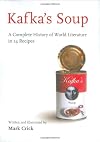
It's a book of recipes, each written in the style of a famous author, with a page of artwork in a different style included. So the title recipe is for quick miso soup written in the style of Kafka and featuring a Warhol-esque painting of a soup can with Kafka's face on the label. There's a coq au vin recipe inside a story of a priest watching his cook prepare the last meal for a man about to be executed, a la Gabriel Garcia Marquez, and a very good parody of The Caretaker by Pinter, with the show more young man forcing the older man to try an Italian version of cheese on toast. There are several recipes I'd like to try. show less
This is a delightful collection of recipes with stories written in the style of famous authors. The directions for the recipes are contained in the stories and all sound tasty and ate ertainly humorous and dead on. I can't wait to try Garcia Marquez's cow au vin or Chaucer's onion tart.
Kafka’s Soup is a cute little book which has been designed to celebrate 14 of the world’s most famous writers. The book contains real recipes written in a style that parodies the work of [b:Raymond Chandler|2052|The Big Sleep|Raymond Chandler|http://ecx.images-amazon.com/images/I/41AGA624Z5L._SL75_.jpg|1222673], Jane Austen, Franz Kafka, Irvine Welsh, Proust, Marquez, Steinbeck, Marquis de Sade, Woolf, Homer, Greene, Borges, Pinter and Chaucer. Jane Austin gives us Tarragon Eggs, Marquez show more provides a magical Coq au Vin. Homer cooks up Fenkata, and Graham Greene makes Vietnamese Chicken. The work is assured, and the prose style makes for a good pastiche which reflects the writers' most famous books. Austin’s eggs begin with a similar opening to Pride and Prejudice and focus heavily on the serving of the eggs and relationships between the guests. Kafka’s Miso Soup is infused with an underlying anxiety which is never clearly defined, and follows the outlines of The Metamorphosis. Irvine Welsh’s chocolate cake is written in slang-filled Scottish dialect full of gritty angst, though the actual cake is smooth and silky. Other recipes are similarly rich with the tenure and sense of the writer involved, and will give readers familiar with their work a good chuckle.The recipes are all real and tested, and are nicely designed, for classic food items. They are all easy to make and fun to serve and talk about with literary minded friends. But there is a rather jarring mismatch between the culinary concoction and the author it is assigned to. Surely Kafka would never have eaten Miso Soup, and Proust could have had the Coq Au Vin rather than Marquez. Many of the writers that Crick chooses write about food in their work, and the book could have been improved significantly by using a food item that actually appears in the work being chosen. The obvious choice for Proust would then be Madeleines, while for Chaucer, we could have Spicerye Sauce (from The Canterbury Tales) rather than Onion Tart and Rich Sultana Bread for Woolf (mentioned in The Waves). It is hard to enjoy a full sensual experience when the foods are so different from those that the writers would have eaten or described.That said, this is still a well-researched, fun book, with an original premise and the text is often very clever. A nice touch is that each recipe is illustrated by Crick with an accompanying picture – from the noir cartoons of Chandler, soft watercolour images for Austin, or the stained glass picture of Chaucer after his Onion Tart. The book is beautifully presented in hardcover format, and the accompanying images make it attractive enough to give to someone as a gift. Each recipe contains a hefty serving of humour, which is reflected in both the prose, and in the illustration. The recipes work, and so does the prose, though the sustenance it provides is relatively minor. show less
Lists
You May Also Like


Statistics
- Works
- 9
- Members
- 457
- Popularity
- #53,729
- Rating
- 3.8
- Reviews
- 16
- ISBNs
- 28
- Languages
- 12