
Margaret Thaler Singer (1921–2003)
Author of Cults in Our Midst
Works by Margaret Thaler Singer
Tagged
Common Knowledge
- Birthdate
- 1921
- Date of death
- 2003-11-23
- Gender
- female
- Education
- University of Denver (BA|speech)
University of Denver (MS|speech pathology)
University of Denver (PhD|Clinical psychology|1943) - Occupations
- clinical psychologist
psychology professor - Organizations
- University of California, Berkeley
American Family Foundation
American Psychological Association
American Psychosomatic Society (President, 1974) - Awards and honors
- Leo J. Ryan Memorial Award
Research Scientist Award, National Institute of Mental Health
Hofheimer Prize
Stanley R. Dean Award (American College of Psychiatrists)
McAlpine Award for Achievement in Research from the Mental Health Association of the United States
Margaret Singer Award (International Cultic Studies Association, award created in her honor) - Relationships
- Miller, Jesse S. (student)
Ford, Martin Z. (student) - Nationality
- USA
- Birthplace
- Denver, Colorado, USA
- Places of residence
- Denver, Colorado, USA (birthplace)
- Associated Place (for map)
- Denver, Colorado, USA
Members
Reviews
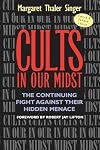
Margaret Singer has been studying cults and cult survivors for decades, and this book is a thorough overview of the many aspects of this complex subject. Written for the mainstream, the book is clearly written and very readable, although her detailed descriptions of the abuse suffered by some cult members can be disturbing.
I found the book to be very useful in helping me to better understand where a spiritual group crosses the line from something that benefits its members to something that show more exploits them. I found her detailed explanations of the sophisticated ways in which certain groups use deception and peer pressure to manipulate their members to be particularly educational. In addition, I felt the light bulb go off repeatedly as I read about things I’d personally experienced but had not yet fully recognized for what they were.
On of the main insights I got from reading this book was a recognition of how cults play on people’s desires to have meaning in their lives and feel that they are doing something important and special. Cults do an amazing PR job of convincing people that working to benefit the cult ultimately benefits the world. Yet in the vast majority of cases, members find themselves working long hours to do nothing more than help perpetuate the existence of the cult itself, while at the same time becoming more and more estranged from the world they wanted so much to help. It is sobering to consider how much society as a whole suffers from having so many of its talented and idealistic members siphoned off by cults. show less
I found the book to be very useful in helping me to better understand where a spiritual group crosses the line from something that benefits its members to something that show more exploits them. I found her detailed explanations of the sophisticated ways in which certain groups use deception and peer pressure to manipulate their members to be particularly educational. In addition, I felt the light bulb go off repeatedly as I read about things I’d personally experienced but had not yet fully recognized for what they were.
On of the main insights I got from reading this book was a recognition of how cults play on people’s desires to have meaning in their lives and feel that they are doing something important and special. Cults do an amazing PR job of convincing people that working to benefit the cult ultimately benefits the world. Yet in the vast majority of cases, members find themselves working long hours to do nothing more than help perpetuate the existence of the cult itself, while at the same time becoming more and more estranged from the world they wanted so much to help. It is sobering to consider how much society as a whole suffers from having so many of its talented and idealistic members siphoned off by cults. show less
Fine run-through of the various mind-altering and brainwashing techniques employed by modern cults. Also, I was pleased to see a section devoted to those crappy new-agey motivational programs which are forever being pushed on me by devotees. (I work in a store with a large metaphysical section in an area with a large number of actual cult members. They can be hard to avoid.) However, if you're actually interested in the history and development of modern cults, this book will be show more disappointing. It's mostly strings of anecdotes with identifying details edited out, relayed with an off-putting tinge of hysteria. Quite probably I would be hysterical too, if, like the author, I'd spent years being terrifyingly hounded by cult members. But the constant THEY ARE EVERYWHERE AND THEY ARE COMING FOR YOUUUUU, while possibly valid, was slightly less than helpful in a serious study. I also found the section on the dangers of meditation to be a little weird. Again, she provided a string of unattributed anecdotes, including one strange quote from a women who had found herself accidentally Hindu, to bolster her claim that meditation alone can produce permanent mental damage. It wasn't very scientific, is I guess where I'm going with that - did these people have underlying problems? Were there any other factors involved? Is it a bad thing to find oneself Hindu?
Bottom line: if you're a psych student interested in mind control, this is probably the book for you. If you're a white suburban Christian paranoid about weird asiatic cults stealing your children, ditto. If you're more into a sociological view of religious movements and the development of cults, you won't find what you're looking for here. show less
Bottom line: if you're a psych student interested in mind control, this is probably the book for you. If you're a white suburban Christian paranoid about weird asiatic cults stealing your children, ditto. If you're more into a sociological view of religious movements and the development of cults, you won't find what you're looking for here. show less
Do you know someone who suffered from cults in our modern culture? This book provides relevant background about cult methodology and cult recovery for survivors.
Here's my video review: http://www.youtube.com/watch?v=eKPhWaGXs...
Growing up in a cult, I felt that I turned my back upon God and religion when I left the group. I assumed my feelings were unique, the judgment of a higher power angered by my desertion. Through reading Cults in Our Midst, I discovered that every cult survivor feels show more these emotions. It's an inherent psychological repercussion.
I would highly recommend this book to the following groups:
1. Psychologists and Mental Health Professionals (especially those who work with ex-cult members, do exit counseling, and PTSD therapy)
2. Ex-cult members (especially those who are several months removed from their cult)
3. Church Ministers (to assess the ethics in their own strategies for evangelization)
4. Family and friends of ex-cult members (to provide guidance about loved one's psychological aftereffects)
5. Those fascinated by cults
This book answers these common questions:
- What is a cult?
- How do cults brainwash members?
- Why and how do people join cults?
- What happens to children within a cult?
- How to leave a cult?
After reading this book, I felt validated in calling my former religious extremist group a cult. Their practices synced up with nearly all of the cult characteristics. My group claimed to be a part of mainstream religion, but their actions and doctrine taught otherwise. I caution those within extremist groups to examine their methodologies carefully. It's not the brain-dead who join cults, but typically the intellectual geniuses.
Margaret Thaler Singer delivers on her promises to the reader. Her book is a resourceful tool to recover from religious trauma syndrome. show less
Here's my video review: http://www.youtube.com/watch?v=eKPhWaGXs...
Growing up in a cult, I felt that I turned my back upon God and religion when I left the group. I assumed my feelings were unique, the judgment of a higher power angered by my desertion. Through reading Cults in Our Midst, I discovered that every cult survivor feels show more these emotions. It's an inherent psychological repercussion.
I would highly recommend this book to the following groups:
1. Psychologists and Mental Health Professionals (especially those who work with ex-cult members, do exit counseling, and PTSD therapy)
2. Ex-cult members (especially those who are several months removed from their cult)
3. Church Ministers (to assess the ethics in their own strategies for evangelization)
4. Family and friends of ex-cult members (to provide guidance about loved one's psychological aftereffects)
5. Those fascinated by cults
This book answers these common questions:
- What is a cult?
- How do cults brainwash members?
- Why and how do people join cults?
- What happens to children within a cult?
- How to leave a cult?
After reading this book, I felt validated in calling my former religious extremist group a cult. Their practices synced up with nearly all of the cult characteristics. My group claimed to be a part of mainstream religion, but their actions and doctrine taught otherwise. I caution those within extremist groups to examine their methodologies carefully. It's not the brain-dead who join cults, but typically the intellectual geniuses.
Margaret Thaler Singer delivers on her promises to the reader. Her book is a resourceful tool to recover from religious trauma syndrome. show less
Reviewed Jan 2004
A wonderful detailed book written as if you are attending a lecture by Singer. I learned of this book by reading her obit in the San Jose Merc and I thought, "this looks interesting." This is a must read for anyone whose loved ones have been trapped in a cult. Possible students leaving for college should be given a copy. I am disappointed that she would not give out more names or documented examples until I noticed the chapter notes at the end of book. Singer stresses many show more times how litigious many of these groups are, some cults may even become violent to outsiders. i was hoping to see how cuts could be combated and destroyed but not to be drawn in. The other thing I would like to have seen mentioned is what ex-members are supposed to do once out? I was most interested to learn that cults are not always religious - some are health clubs, therapy cults, even money making ventures. her chapter on the history of cults that have become mainstream companies is very informative. I would have also liked to learn what happens to people who commit crimes while under a cults influence. I learned so much while reading this and will keep it for reference in the future.
1-2004 show less
A wonderful detailed book written as if you are attending a lecture by Singer. I learned of this book by reading her obit in the San Jose Merc and I thought, "this looks interesting." This is a must read for anyone whose loved ones have been trapped in a cult. Possible students leaving for college should be given a copy. I am disappointed that she would not give out more names or documented examples until I noticed the chapter notes at the end of book. Singer stresses many show more times how litigious many of these groups are, some cults may even become violent to outsiders. i was hoping to see how cuts could be combated and destroyed but not to be drawn in. The other thing I would like to have seen mentioned is what ex-members are supposed to do once out? I was most interested to learn that cults are not always religious - some are health clubs, therapy cults, even money making ventures. her chapter on the history of cults that have become mainstream companies is very informative. I would have also liked to learn what happens to people who commit crimes while under a cults influence. I learned so much while reading this and will keep it for reference in the future.
1-2004 show less
Lists
You May Also Like


Associated Authors
Statistics
- Works
- 2
- Members
- 243
- Popularity
- #93,556
- Rating
- 3.6
- Reviews
- 5
- ISBNs
- 6
- Languages
- 2