
Thomas R. Henry
Author of The white continent: The story of Antarctica
About the Author
Works by Thomas R. Henry
Tagged
Common Knowledge
- Gender
- male
Members
Reviews

Dnf. I gave up on this book after a few chapters. It was interesting, and the writing was ok, but it was the section on penguins that got to me.
According to the author and two scientists, penguins (I think it was emperor penguins, but this review has been delayed by a few months so I’m not 100% sure) protect their eggs by standing on one leg and holding the egg with their other leg and pressing it against their breast. They do this for the entire time the egg is being incubated.
Now I show more don’t know what anyone else thinks about this, but for me the idea of a penguin standing on one short leg, with the other short leg being held against its breast for months is utterly ridiculous. The image is so ridiculous that I couldn’t continue reading.
The book was written quite a while ago, so I wasn’t expecting wholly accurate information. But even without accurate knowledge about penguins, you only have to see a picture of a penguin to know that there’s no way that poor stumpy legged bird is going to be holding anything against its breast.
I couldn’t trust anything the author said after that. show less
According to the author and two scientists, penguins (I think it was emperor penguins, but this review has been delayed by a few months so I’m not 100% sure) protect their eggs by standing on one leg and holding the egg with their other leg and pressing it against their breast. They do this for the entire time the egg is being incubated.
Now I show more don’t know what anyone else thinks about this, but for me the idea of a penguin standing on one short leg, with the other short leg being held against its breast for months is utterly ridiculous. The image is so ridiculous that I couldn’t continue reading.
The book was written quite a while ago, so I wasn’t expecting wholly accurate information. But even without accurate knowledge about penguins, you only have to see a picture of a penguin to know that there’s no way that poor stumpy legged bird is going to be holding anything against its breast.
I couldn’t trust anything the author said after that. show less

Published in 1950, this is an overview of Antarctic history, exploration, geology, flora and fauna. The author was a journalist who accompanied a large U.S. Navy fleet commanded by Admirals Byrd and Cruzen in their Antarctic "High Jump" expedition of 1946-47. Although unsourced otherwise, the book quotes from and refers throughout to past accounts by explorers and to observations made by the author and others on the High Jump mission.
Henry's information is sometimes inaccurate (for show more instance, he claims that fur seals are extinct, which even in 1950 was known not to be true), but his descriptions of human interactions with animals encountered on the expedition are evocative and sure to encourage further reading. So are his depictions of visual and weather phenomena and ice coloring. The chapters on geology are a bit slow-going, but these are more than made up for in the remaining chapters on mid-century air exploration, early assumptions about the far south (it was warmer because it was further south, and was therefore a tropical paradise; the earth is hollow and an opening into the center would be found in Antarctica); and, most intriguingly, Henry's thoughts on how Antarctica might be of use to the rest of the world, as
- a food freezer in case of famine
- a health resort (the air is pure)
- fertile land (after melting the ice with plutonium bombs)
So, well-written, entertaining and informative, but not to be taken too seriously without checking more recent sources. Definitely enjoyable for the enthusiast of all things Antarctica, though. show less
Henry's information is sometimes inaccurate (for show more instance, he claims that fur seals are extinct, which even in 1950 was known not to be true), but his descriptions of human interactions with animals encountered on the expedition are evocative and sure to encourage further reading. So are his depictions of visual and weather phenomena and ice coloring. The chapters on geology are a bit slow-going, but these are more than made up for in the remaining chapters on mid-century air exploration, early assumptions about the far south (it was warmer because it was further south, and was therefore a tropical paradise; the earth is hollow and an opening into the center would be found in Antarctica); and, most intriguingly, Henry's thoughts on how Antarctica might be of use to the rest of the world, as
- a food freezer in case of famine
- a health resort (the air is pure)
- fertile land (after melting the ice with plutonium bombs)
So, well-written, entertaining and informative, but not to be taken too seriously without checking more recent sources. Definitely enjoyable for the enthusiast of all things Antarctica, though. show less
The Strangest Things in the World - A Book About Extraordinary Manisfestations of Nature by Thomas R. Henry
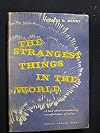
Looks like Amazon has some printed new copies (facsimiles)
Statistics
- Works
- 7
- Members
- 87
- Popularity
- #211,167
- Rating
- 4.0
- Reviews
- 3
- ISBNs
- 5