
Series
Works by Amy Gopp
Split Ticket: Independent Faith in a Time of Partisan Politics (WTF: Where's the Faith?) (2010) 25 copies, 9 reviews
Tagged
Common Knowledge
- Gender
- female
Members
Reviews
Split Ticket: Independent Faith in a Time of Partisan Politics (WTF: Where's the Faith?) by Amy Gopp
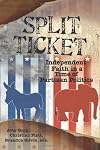
When I saw the title for this book-- and the design of the cover-- I was expecting some kind of book that would promote some kind of understanding among "liberals" and "conservatives," perhaps some attempt to transcend political boundaries to advance the common causes of Christ.
That assumption was entirely wrong, and I do not want anyone else to labor under any such misapprehension. This is a book that seeks to advance progressive, social justice causes among mainline Protestants and show more Evangelicals. The closest to "conservative" this book gets is when one author rejects voting so as to not participate in the advancement of the worldliness of the system, when another author remains pro-choice but develops greater sympathy for the pro-life cause when seeing an ultrasound of his unborn daughter, and when a third moves from conservative to liberal in ideology because of his experiences in the inner city. The "elephant" on the cover and within the book is entirely disingenuous.
The book represents a collection of essays from religious professionals and/or Christian activists in their 20s and 30s, divided into three sections: activism (poverty, gay rights, etc.), politics and faith (to vote or not to vote, politics in the church, etc.), and "issues" (abortion, justice, the media, etc.). While there are some divergences in some views among the authors, most are solidly in the "progressive" wing of "greater Evangelicalism."
While I grant that the essay by the individual who moved to a more holistic sense of justice and thus embraced social justice causes should be widely read, along with perhaps the essay on the challenge of the "priests of the media" and the one on the importance of hearing from all sides, on the whole, the acceptance of this book is going to be based, for better or worse, on where you stand. Those sympathetic to "progressive Christianity" will love this book. Those who would identify themselves more with "conservative values" will probably barely be able to get past the second chapter.
While one can sympathize with the goals of greater justice and benefits for the downtrodden and oppressed, there is much that is concerning in this book. Whatever civil rights should be granted to homosexuals does not change the Bible's condemnation of homosexuality and there is no Biblical excuse for being "inclusive" of practicing homosexuals. Furthermore, to believe that political processes are the way to advance God's purposes is short-sighted and naive; the Gospel, and not legislation, advances God's purposes (Romans 1:16). We should not sacrifice the greater good for the lesser good despite what many in the book might say.
This book is quite disappointing; it leaves moderates in the lurch (as usual), its title and marketing is disingenuous, and it does not make it any better that it seems to be published by a press associated with the Christian Church (Disciples of Christ). This body has all but abandoned the Restoration call of its originator, and a book like this proves the warning of what happens when unity based in the Bible is rejected in order to advance the institutions and ideologies of men. show less
That assumption was entirely wrong, and I do not want anyone else to labor under any such misapprehension. This is a book that seeks to advance progressive, social justice causes among mainline Protestants and show more Evangelicals. The closest to "conservative" this book gets is when one author rejects voting so as to not participate in the advancement of the worldliness of the system, when another author remains pro-choice but develops greater sympathy for the pro-life cause when seeing an ultrasound of his unborn daughter, and when a third moves from conservative to liberal in ideology because of his experiences in the inner city. The "elephant" on the cover and within the book is entirely disingenuous.
The book represents a collection of essays from religious professionals and/or Christian activists in their 20s and 30s, divided into three sections: activism (poverty, gay rights, etc.), politics and faith (to vote or not to vote, politics in the church, etc.), and "issues" (abortion, justice, the media, etc.). While there are some divergences in some views among the authors, most are solidly in the "progressive" wing of "greater Evangelicalism."
While I grant that the essay by the individual who moved to a more holistic sense of justice and thus embraced social justice causes should be widely read, along with perhaps the essay on the challenge of the "priests of the media" and the one on the importance of hearing from all sides, on the whole, the acceptance of this book is going to be based, for better or worse, on where you stand. Those sympathetic to "progressive Christianity" will love this book. Those who would identify themselves more with "conservative values" will probably barely be able to get past the second chapter.
While one can sympathize with the goals of greater justice and benefits for the downtrodden and oppressed, there is much that is concerning in this book. Whatever civil rights should be granted to homosexuals does not change the Bible's condemnation of homosexuality and there is no Biblical excuse for being "inclusive" of practicing homosexuals. Furthermore, to believe that political processes are the way to advance God's purposes is short-sighted and naive; the Gospel, and not legislation, advances God's purposes (Romans 1:16). We should not sacrifice the greater good for the lesser good despite what many in the book might say.
This book is quite disappointing; it leaves moderates in the lurch (as usual), its title and marketing is disingenuous, and it does not make it any better that it seems to be published by a press associated with the Christian Church (Disciples of Christ). This body has all but abandoned the Restoration call of its originator, and a book like this proves the warning of what happens when unity based in the Bible is rejected in order to advance the institutions and ideologies of men. show less
 This review was written for LibraryThing Early Reviewers.
Split Ticket: Independent Faith in a Time of Partisan Politics (WTF: Where's the Faith?) by Amy Gopp
When I requested this book I was intrigued by the idea of how those who considered themselves as having an independent faith responded to partisan political situations. I was hoping to read of persons who straddle the line between the extremes of faith in very partisan political situations. This series of essays was not that, but it did give a perspective different from the very conservative faith which is what I usually hear expressed.
The essays are written by those who would be considered show more progressive or liberal, which is more my own bent. They are presented in a group study-friendly format and are targeted to an age group younger than my own. Yet, I did find the personal expressions of faith and the actions taken in response to their faith interesting and would encourage those who are tired of hearing the same old conservative talking points and arguments to consider reading it. show less
The essays are written by those who would be considered show more progressive or liberal, which is more my own bent. They are presented in a group study-friendly format and are targeted to an age group younger than my own. Yet, I did find the personal expressions of faith and the actions taken in response to their faith interesting and would encourage those who are tired of hearing the same old conservative talking points and arguments to consider reading it. show less
This review was written for LibraryThing Early Reviewers.This book seeks to set (protestant, evangelical, Christian) faith in the context of politics... non-partisan does not equal apolitical. The 'independent' and 'non-partisan' descriptors in the title are largely borne out by the essays, which encourage one to think about issues that have been politicized in the context of one's faith, but not in a simplistic way that may be promoted by political or religious organizations. It tries to show that any form of acting out one's faith in the public show more sphere becomes a political act, and even not participating in voting (for example) is both a political and a spiritual statement. However, one should be aware that for most of the young essayists, their views on sociopolitical issues are progressive, and their faith is heavily influenced by the social justice stream of Christianity. Some of the essays felt redundant or repetitive, and the partitioning of the essays into three distinct sections felt arbitrary. Overall, however, it provides a contemporary voice for progressive Christianity in the realm of social activism. show less
This review was written for LibraryThing Early Reviewers.Split Ticket: Independent Faith in a Time of Partisan Politics (WTF: Where's the Faith?) by Amy Gopp
Gopp, Amy, Christian Piatt, and Brandon Gilvin, eds. Split Ticket: Independent Faith in a Time of Partisan Politics. St. Louis: Chalice Press, 2010.
Split Ticket is a book of essays regarding the intersection of faith and politics. The essays discuss a variety of issues from the decision to vote to various social issues. The writing style is conversational and informal. The book's audience is people in their 20's and 30's, which is the age of the authors of the essays. However, any person show more with an interest in this subject can find the book profitable.
The author's positions are those that are represented within the mainline tradition of Protestant churches. In some ways, this aspect of the book was a bit surprising, in that the cover and title suggested that it would represent a variety of views. Perhaps the idea of the book was to represent a Christian reflection on social issues that are not reported by the mainstream media.
The essays, as a whole, were of high quality. The authors had an opinion and used the various sources for Christian theology in explaining their point. However, it should be said that the Scripture/Experience part took precedence over the reason/tradition part. While I found the essays to be engaging and well thought out, in an edited work there always seems to be that essay that is the exception to the rule. The essay by Garrison was rather sophomoric. For a satirist it was not good satire, not even funny. So my recommendation is to read the book, I think you would get something out of it, but skip the Garrison essay. show less
Split Ticket is a book of essays regarding the intersection of faith and politics. The essays discuss a variety of issues from the decision to vote to various social issues. The writing style is conversational and informal. The book's audience is people in their 20's and 30's, which is the age of the authors of the essays. However, any person show more with an interest in this subject can find the book profitable.
The author's positions are those that are represented within the mainline tradition of Protestant churches. In some ways, this aspect of the book was a bit surprising, in that the cover and title suggested that it would represent a variety of views. Perhaps the idea of the book was to represent a Christian reflection on social issues that are not reported by the mainstream media.
The essays, as a whole, were of high quality. The authors had an opinion and used the various sources for Christian theology in explaining their point. However, it should be said that the Scripture/Experience part took precedence over the reason/tradition part. While I found the essays to be engaging and well thought out, in an edited work there always seems to be that essay that is the exception to the rule. The essay by Garrison was rather sophomoric. For a satirist it was not good satire, not even funny. So my recommendation is to read the book, I think you would get something out of it, but skip the Garrison essay. show less
This review was written for LibraryThing Early Reviewers.Statistics
- Works
- 1
- Members
- 25
- Popularity
- #508,560
- Rating
- 2.5
- Reviews
- 9
- ISBNs
- 3
