
A. L. Lloyd (1908–1982)
Author of The Penguin book of English folk songs
About the Author
Works by A. L. Lloyd
Dances of Argentina 2 copies
Folk Music of Albania 1 copy
Associated Works
Lament for the Death of a Bullfighter and Other Poems (1977) — Translator, some editions — 12 copies
Tagged
Common Knowledge
- Canonical name
- Lloyd, A. L.
- Legal name
- Lloyd, Albert Lancaster
- Birthdate
- 1908-02-29
- Date of death
- 1982-09-29
- Gender
- male
- Occupations
- folklorist
folk song collector - Nationality
- UK
- Associated Place (for map)
- UK
Members
Reviews

What is National Music? I know I wasn't sure when I picked up this book. As Ralph Vaughan Williams uses the term, it is not the music played at, say, the Olympics or other national competitions. It's the music that the people of a nation hold to themselves. So Finns might indeed consider "Finlandia" national music, but people in a Communist country probably wouldn't have much personal use for their national anthems. National music may be orchestral, or "classical," or pop, but it is also a show more nation's folk music, and the music that defines its history.
This is a book that Vaughan Williams was uniquely qualified to write. It's true that classical composers, from Bartók to Copland, have incorporated folk themes into their compositions -- but, in the process, they often change them utterly. (Aa a folk musician, I'd say Copland, at least, killed them, but others obviously disagree.) I don't enjoy listening to "Appalachian Spring," I find myself thinking, "How could you do that?" For pop fans, perhaps try imagining playing Taylor Swift on a kazoo. It sounds both wrong and disrespectful.
Vaughan Williams was different. He actually collected folk music himself, and steeped himself in it. The "English Folk Song Suite" doesn't sound disordered, like a harpsichord player struggling to play an organ; it sounds like folk music. So what he says deserves respect.
And what Vaughan Williams says is that each nation -- or perhaps we should say "ethnicity" or some such -- has its characteristic style and idiom and formulae -- almost like the "Homeric epithets" that let ancient poets more easily remember the Greek epics.
This book was originally a lecture series, and Vaughan Williams was able to have his musical examples performed for the audience. This must have been an immense help. Even with a folk music background, I couldn't always hear in my head what Vaughan Williams was describing, because it was generally dependent on knowing the exact version of the original piece. But I'll give you an analogy: There's a pretty good chance, if you hear a Yiddish folk song, that it will sound "Jewish" to you. That's because Yiddish music is strongly minor, often natural minor, and uses characteristically minor harmonizations. Even "Hatikvah," the Israeli national anthem, is in natural minor, a very rare thing for an anthem.
Such modal characteristics won't distinguish English from French from Germany music; all are basically "major." But Vaughan Williams suggests the music of those nations are different anyway. And I think he's probably right. The details are trickier than my Yiddish music example. This is a fairly technical book (a reissue with companion musical recordings would really help). But I think the points it makes are very useful. show less
This is a book that Vaughan Williams was uniquely qualified to write. It's true that classical composers, from Bartók to Copland, have incorporated folk themes into their compositions -- but, in the process, they often change them utterly. (Aa a folk musician, I'd say Copland, at least, killed them, but others obviously disagree.) I don't enjoy listening to "Appalachian Spring," I find myself thinking, "How could you do that?" For pop fans, perhaps try imagining playing Taylor Swift on a kazoo. It sounds both wrong and disrespectful.
Vaughan Williams was different. He actually collected folk music himself, and steeped himself in it. The "English Folk Song Suite" doesn't sound disordered, like a harpsichord player struggling to play an organ; it sounds like folk music. So what he says deserves respect.
And what Vaughan Williams says is that each nation -- or perhaps we should say "ethnicity" or some such -- has its characteristic style and idiom and formulae -- almost like the "Homeric epithets" that let ancient poets more easily remember the Greek epics.
This book was originally a lecture series, and Vaughan Williams was able to have his musical examples performed for the audience. This must have been an immense help. Even with a folk music background, I couldn't always hear in my head what Vaughan Williams was describing, because it was generally dependent on knowing the exact version of the original piece. But I'll give you an analogy: There's a pretty good chance, if you hear a Yiddish folk song, that it will sound "Jewish" to you. That's because Yiddish music is strongly minor, often natural minor, and uses characteristically minor harmonizations. Even "Hatikvah," the Israeli national anthem, is in natural minor, a very rare thing for an anthem.
Such modal characteristics won't distinguish English from French from Germany music; all are basically "major." But Vaughan Williams suggests the music of those nations are different anyway. And I think he's probably right. The details are trickier than my Yiddish music example. This is a fairly technical book (a reissue with companion musical recordings would really help). But I think the points it makes are very useful. show less

You won't read this often from me, but this LP is one of the dozen best recordings I've ever encountered, of any music in any genre. Truly, a "grab-on-the-way-out-of-the-burning-house" item (may God forbid that such a test is ever set to me).

The late Bert Lloyd was an important figure in the English Folk Revival of the Sixties - and earlier - and later!
I first encountered his whimsical and individual style in a Radio 3 programme (it may even still have been
The Third Programme!), entitled 'Albanian Folk Music' which I listened to out of curiosity. The music wasn't
for me, but the style of the presenter was!
A few years later, I became interested in 'folk music' (and in the beer which was almost invariably served at
such venues), and show more I was privileged to see Bert perform on a couple of occasions. Wonderful stuff!
When 'Folk Song In England' was published a few years later, I bought a copy and it was so good that when
I started playing the concertina recently, I realised that I needed the book to refresh my memory on modal
tunes. I am not an expert in musical theory, but a slight working knowledge of modes is very handy for a
budding folk musician.
Disaster! I couldn't find the book so I had to buy a second-hand copy, and re-reading it the second time around
merely confirms what a first rate book this is. show less
I first encountered his whimsical and individual style in a Radio 3 programme (it may even still have been
The Third Programme!), entitled 'Albanian Folk Music' which I listened to out of curiosity. The music wasn't
for me, but the style of the presenter was!
A few years later, I became interested in 'folk music' (and in the beer which was almost invariably served at
such venues), and show more I was privileged to see Bert perform on a couple of occasions. Wonderful stuff!
When 'Folk Song In England' was published a few years later, I bought a copy and it was so good that when
I started playing the concertina recently, I realised that I needed the book to refresh my memory on modal
tunes. I am not an expert in musical theory, but a slight working knowledge of modes is very handy for a
budding folk musician.
Disaster! I couldn't find the book so I had to buy a second-hand copy, and re-reading it the second time around
merely confirms what a first rate book this is. show less
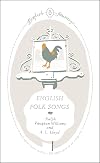
This collection is filled with songs that tell of the pleasures and pains of love, the patterns of the countryside and the lives of ordinary people. Here are unfaithful soldiers, ghostly lovers, whalers on stormy seas, cuckolds and tricksters. By turns funny, plain-speaking and melancholic, these songs evoke a lost world and, with their melodies provided, record a vital musical tradition. Generations of inhabitants have helped shape the English countryside - but it has profoundly shaped us show more too.It has provoked a huge variety of responses from artists, writers, musicians and people who live and work on the land - as well as those who are travelling through it.English Journeys celebrates this long tradition with a series of twenty books on all aspects of the countryside, from stargazey pie and country churches, to man's relationship with nature and songs celebrating the patterns of the countryside (as well as ghosts and love-struck soldiers).
Ralph Vaughan Williams (1872-1958) was one of England's greatest composers, and among the first people to travel the countryside to collect folk songs and preserve them for future generations. A. L. Lloyd (1908-1982), usually known as Bert, was a folk singer and folklorist who grew up listening to his mother singing gypsy songs, and eventually wrote them down. Together with Vaughan Williams, he helped rescue traditional English music from extinction. show less
Ralph Vaughan Williams (1872-1958) was one of England's greatest composers, and among the first people to travel the countryside to collect folk songs and preserve them for future generations. A. L. Lloyd (1908-1982), usually known as Bert, was a folk singer and folklorist who grew up listening to his mother singing gypsy songs, and eventually wrote them down. Together with Vaughan Williams, he helped rescue traditional English music from extinction. show less
You May Also Like
Associated Authors
Statistics
- Works
- 17
- Also by
- 6
- Members
- 298
- Popularity
- #78,714
- Rating
- 4.1
- Reviews
- 7
- ISBNs
- 17