
Jane McGonigal
Author of Reality Is Broken: Why Games Make Us Better and How They Can Change the World
About the Author
Jane McGonigal was born in 1977. She is a graduate of Fordham University and the University of California, Berkeley. She is currently the Director of Game Research and Development at the Institute for the Future. She is the author of Reality Is Broken and SuperBetter. (Bowker Author Biography)
Works by Jane McGonigal
Reality Is Broken: Why Games Make Us Better and How They Can Change the World (2011) 1,228 copies, 39 reviews
SuperBetter: A Revolutionary Approach to Getting Stronger, Happier, Braver and More Resilient, Powered by the Science of Games (2015) 343 copies, 7 reviews
Imaginable: How to See the Future Coming and Feel Ready for Anything, Even Things That Seem Impossible Today (2022) 133 copies, 5 reviews
Game Change 1 copy
Associated Works
Second Person: Role-Playing and Story in Games and Playable Media (2007) — Contributor — 113 copies, 1 review
Tagged
Common Knowledge
- Birthdate
- 1977-10-21
- Gender
- female
- Organizations
- Institute for the Future (Director of Game Research and Development)
- Relationships
- McGonigal, Kelly (sister)
- Nationality
- USA
- Birthplace
- Philadelphia, Pennsylvania, USA
- Associated Place (for map)
- Pennsylvania, USA
Members
Reviews
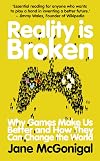
Reality is certainly broken. Leave aside the big problems like climate change, peak oil, political instability, and economic collapse, on a day to day basis, people are feeling alienated from their jobs, their communities, their very lives, and are fleeing into virtual worlds. Jane McGonigal makes the claim that this is not as bad as it appears, that in fact, games might save the world. Unfortunately, the book falls into the what I might call the Malcolm Gladwell (sorry, Malcolm) trap of show more thinking that an interesting idea and a bunch of anecdotes somehow adds up to a well-supported thesis.
McGonigal breaks the book into three sections. The first is about why we game. She brings into two unusual emotions, fiero, which is triumphant pride in victory, and naches the pleasure of helping someone else become accomplished to explain we find games fun. Games provide ample opportunities to experience these otherwise rare emotions. Games also help us bond, socially, in that they can be a shared interest, but also help us feel like part of a larger project. Just walking around World of Warcraft feels like being part of a community. The second and third part focus on Alternate Reality Games (ARG), which can be used to get people to help with everything from household chores (Chore Wars) to urban decay (Groundcrew.us). Another side of games is developing long term thinking, whether it be a World Without Oil, or SUPERSTRUCT.
Now, I'm going to be a little critical. One important question that McGonigal drops are if forms of community fostered actually as meaningful as 'traditional communities'. It's one thing if people are replacing watching Jerry Springer with gaming, it's another if it's replacing the traditional institutions of cohesion. My D&D group are some of my closest friends on campus, but it's not because we play D&D, it's because we sit around the table for four hours a week and talk, face to face (and as my players will tell you, I'm the worst for letting table talk interrupt the game.) I can't say that the virtual communities I've belong to have felt event a little bit as real.
On a related note, can games create valuable behavior? There are certainly lessons to be learned from game design about making boring tasks like work and school more interesting and intrinsically rewarding, but a fundamental facet of games is the freedom to leave. Can games replace other forms of organization with the going gets tough, or boring? Bruce Sterling said something like, "Good luck getting these twitterhead neterati to pay attention to anything long enough to govern it," in relation to the recent uprising in the Middle East. The same likely applies to game. Chapter 11, on the Engagement Economy, is one of the better ones in the book, but really deserves somebody with an economics PhD to flesh it out. Translating value between the game and the cash economy will be a perennial problem for serious game designers, and is one that McGonigal sidesteps.
Finally, there is the idea that games can reprogram us, to be be nicer, more collaborative, or wiser. Certainly, gamers have created immense things, after Wikipedia, most of the the large wikis on the web are about videogames, but questions of external value still apply. Futurism is hard work, and while you can say "crowd-sourced many-eyes good-results", I'm not sure if these kind of open scenario exercises actually inspire true reflection or wisdom, or merely reinforce pre-existing biases.
I wanted to like this book. Games are important, as the ever increasing number of game players demonstrates, but we need to have a clearer conception of what they can and cannot do. Uncritical cheerleading doesn't help; the topic deserves a better book. show less
McGonigal breaks the book into three sections. The first is about why we game. She brings into two unusual emotions, fiero, which is triumphant pride in victory, and naches the pleasure of helping someone else become accomplished to explain we find games fun. Games provide ample opportunities to experience these otherwise rare emotions. Games also help us bond, socially, in that they can be a shared interest, but also help us feel like part of a larger project. Just walking around World of Warcraft feels like being part of a community. The second and third part focus on Alternate Reality Games (ARG), which can be used to get people to help with everything from household chores (Chore Wars) to urban decay (Groundcrew.us). Another side of games is developing long term thinking, whether it be a World Without Oil, or SUPERSTRUCT.
Now, I'm going to be a little critical. One important question that McGonigal drops are if forms of community fostered actually as meaningful as 'traditional communities'. It's one thing if people are replacing watching Jerry Springer with gaming, it's another if it's replacing the traditional institutions of cohesion. My D&D group are some of my closest friends on campus, but it's not because we play D&D, it's because we sit around the table for four hours a week and talk, face to face (and as my players will tell you, I'm the worst for letting table talk interrupt the game.) I can't say that the virtual communities I've belong to have felt event a little bit as real.
On a related note, can games create valuable behavior? There are certainly lessons to be learned from game design about making boring tasks like work and school more interesting and intrinsically rewarding, but a fundamental facet of games is the freedom to leave. Can games replace other forms of organization with the going gets tough, or boring? Bruce Sterling said something like, "Good luck getting these twitterhead neterati to pay attention to anything long enough to govern it," in relation to the recent uprising in the Middle East. The same likely applies to game. Chapter 11, on the Engagement Economy, is one of the better ones in the book, but really deserves somebody with an economics PhD to flesh it out. Translating value between the game and the cash economy will be a perennial problem for serious game designers, and is one that McGonigal sidesteps.
Finally, there is the idea that games can reprogram us, to be be nicer, more collaborative, or wiser. Certainly, gamers have created immense things, after Wikipedia, most of the the large wikis on the web are about videogames, but questions of external value still apply. Futurism is hard work, and while you can say "crowd-sourced many-eyes good-results", I'm not sure if these kind of open scenario exercises actually inspire true reflection or wisdom, or merely reinforce pre-existing biases.
I wanted to like this book. Games are important, as the ever increasing number of game players demonstrates, but we need to have a clearer conception of what they can and cannot do. Uncritical cheerleading doesn't help; the topic deserves a better book. show less
The arguement in McGonigal's Reality is Broken is a rather simple one: we slake our miseries with imagined worlds. In the case of the 21st Century, the imagine worlds are electronic games and they have the potential to not only produce happiness but to also change the world. Video games, on-line games are not merely escapists means of ignoring reality but one that is more satisfying and has the capabilities to make us a better species. I'm not sure if I busy her optimistic narrative of show more digital gameplay. The fact that hard work at activities that provide their own reward (such as electronic games) can deliver real happiness is a contentious one. What happens when a game ends? Do we truly feel satisfied? Furthermore do they make us ethically better (take for instance, violent video games)?
According to McGonigal, electronic games, seen in this light, are not just a medium or even an art form. They are potent engines for creating and enhancing emotional experience: for making our lives "better". But are they?
We crave, she argues, "satisfying work" (which I agree with) that allows us to be "optimistic about our own chances for success"; that involves "social connection"; and that allows us to feel "curiosity, awe and wonder". I agree wholeheartedly with this. I am just not sure if electronic gameplay has reached an era where the good (psychologically speaking) outweighs the bad but I admire McGonigal's vision.
This book does a great job at describing various types of game play but sort of rambles on. I sped read most of the book as many of her conclusions felt simplistic to me and easy to grasp. show less
According to McGonigal, electronic games, seen in this light, are not just a medium or even an art form. They are potent engines for creating and enhancing emotional experience: for making our lives "better". But are they?
We crave, she argues, "satisfying work" (which I agree with) that allows us to be "optimistic about our own chances for success"; that involves "social connection"; and that allows us to feel "curiosity, awe and wonder". I agree wholeheartedly with this. I am just not sure if electronic gameplay has reached an era where the good (psychologically speaking) outweighs the bad but I admire McGonigal's vision.
This book does a great job at describing various types of game play but sort of rambles on. I sped read most of the book as many of her conclusions felt simplistic to me and easy to grasp. show less
SuperBetter: A Revolutionary Approach to Getting Stronger, Happier, Braver and More Resilient--Powered by the Science of Games by Jane McGonigal
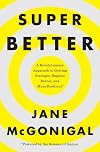
When I picked this up, I didn't realize it was a self-help book. I was interested in how gaming can be harnessed to improve daily life, and the book is definitely full of interesting information (all backed by reputable scientific studies) about how various aspects of gaming can improve one's mental state. The book describes a self-help regimen, which is basically a game called SuperBetter, that lets you gamify real life to improve your resilience, happiness, and general mental well-being. show more Whether you play SuperBetter or not, the science behind it is really fascinating, and the book is full of interesting information. show less
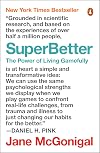
You don't have to be a gamer of any kind to find value in this book. Quite possibly the best self-help book I've ever read, but confessedly haven't helped myself with it yet. Well written and researched, McGonigal shows you how you can turn your challenges into a game. Strategies for winning at life can be drawn from how you play, making the daunting, the insurmountable, the overwhelming seem manageable. If you watch her TED talk "The Game that can give you Ten Extra Years of Life" you'll show more get a good sense of her approach. The book is in three parts: (1) why games make us "SuperBetter", which provides the research background on how games/gaming can improve aspects of life, (2) How to be Gameful, or how to apply gaming strategies to real challenges, and (3) Adventures, which are three generic challenges all laid out so you can see how it works over a series of days. I'm working my way through the pre-cooked adventures before I start building my own and I can already see the value. Highly recommend, even if you think you have everything under control! show less
Lists
Awards


You May Also Like


Associated Authors
Statistics
- Works
- 6
- Also by
- 1
- Members
- 1,707
- Popularity
- #15,030
- Rating
- 3.8
- Reviews
- 51
- ISBNs
- 51
- Languages
- 7