
Josef von Sternberg (1894–1969)
Author of Fun in a Chinese Laundry
About the Author
Sternberg was born to a middle-class Jewish family in Vienna and emigrated to the United States at the age of 17. During World War I, he produced training films for the U.S. Army Signal Corps. After the war ended, he worked in various menial positions in the film industry before becoming an show more assistant director in 1921 and a director a few years later. At that time, the aristocratic von was attached to his name by a producer who thought it would add class. His directorial debut was in 1925, with the low-budget but very successful Salvation Hunters; however, Sternberg only really made a name for himself with Underworld (1926), the first of several gangster films featuring George Bancroft. These were especially remarkable for their cinematography and lighting, which revealed the influence of expressionism in their play with light and dark. Sternberg never made a color film, but he exploited the medium of black and white to create textured spaces of light and shadow, smoke and mist, and screens and veils, which were symbolically and emotionally resonant. Although critics have sometimes found his narratives thin, they have agreed that his visuals are stunning. While Sternberg was considered one of Hollywood's most important directors in his own day, he is now remembered chiefly for his seven films with Marlene Dietrich. He discovered her in a cabaret in Berlin, where he had gone to film The Blue Angel (1930), Germany's first sound production; she was cast as the provocative singer Lola-Lola, a role that made her a star. Sternberg carefully managed her screen image in the six other films that he made with her: Morocco (1930), Dishonored (1931), Shanghai Express (1932), Blonde Venus (1932), The Scarlet Empress (1934), and The Devil Is a Woman (1935). Sternberg was notoriously imperious and autocratic, with a fondness for jodhpurs and riding boots, and was thought of as something of a caricature of the Hollywood director. The role he envisioned for Dietrich was that of the femme fatale, the desirable but enigmatic and even dangerous lady who seems to symbolize the "eternal feminine" and the attraction, mystery, and threat that that image holds for men. Feminist film theorists have suggested that Sternberg's visual style, as well as Dietrich's acting style, work to expose and critique the sexism of this archetype of femininity. Sternberg's difficulties with I, Claudius I, Claudius (unfinished, 1937) damaged his reputation in Hollywood, and he worked irregularly thereafter. His last film---his favorite project---was natahan (1953), about Japanese soldiers isolated on an island at the close of World War II. Although he traveled to international film festivals and occasionally lectured in the years that followed, he never made another film. (Bowker Author Biography) show less
Image credit: Image © ÖNB/Wien
Series
Works by Josef von Sternberg
Morocco and Shanghai Express: Two Films by Josef von Sternberg (Classic Film Scripts) (1973) 8 copies, 1 review
Universal Hollywood Icons Collection: Marlene Dietrich (Blonde Venus / Desire / Angel / Seven Sinners) (2016) — Director — 4 copies
livro fisico com dvd coleco folha grandes biografias no cinema v 27 a imperatriz vermelha (1900) 2 copies, 1 review
The Scarlet Empress 1 copy
Associated Works
John Wayne: War (Sands of Iwo Jima / Back to Bataan / Flying Tigers / Jet Pilot) — Director — 2 copies
Marlene Dietrich & Josef von Sternberg at Paramount, 1930-1935 : Booklet (Indicator Series, 130-135) (2019) — Contributor — 1 copy
Tagged
Common Knowledge
- Canonical name
- Sternberg, Josef von
- Other names
- Sternberg, Jonas (birth)
- Birthdate
- 1894-05-29
- Date of death
- 1969-12-22
- Gender
- male
- Occupations
- filmmaker
film director - Relationships
- Dietrich, Marlene (lover)
- Short biography
- Josef von Sternberg was born Jonas Sternberg to an Austrian Jewish family in Vienna. From age two, his childhood was spent partly in New York City. He was forced by poverty to drop out of Jamaica High School and went to work in a Manhattan retail store. By 1915, he was working at a new job cleaning and repairing movie prints. It provided an entrée to the World Film Company, based in Fort Lee, New Jersey, where the new film industry was flourishing. He served as an apprentice filmmaker from around 1916 to the early 1920s (when he added the "von" to his surname). In 1923, he moved to Hollywood, and made his directorial debut with The Salvation Hunters in 1925. It became a critical and box office hit. Underworld (1927), an early gangster film, was his first big break. With The Last Command (1928), von Sternberg began almost 10 years as one of the most celebrated film directors in the world. In 1930, both his career and his personal life were transformed by the making of The Blue Angel. Chosen by star Emil Jannings and producer Erich Pommer to make Germany's first major sound picture, von Sternberg cast the young Marlene Dietrich as Lola Lola, the sexy nightclub dancer. Their love affair became legendary and von Sternberg directed Dietrich in six more films. However, after The Devil Is a Woman (1935), von Sternberg never again had the creative control he needed. Film historians today consider von Sternberg's greatest contributions to have been to the new language of film, particularly his handling of lighting and cinematography. His autobiography, Fun in a Chinese Laundry, was published in 1973.
- Nationality
- Austria-Hungary (birth)
USA - Birthplace
- Vienna, Austria
- Places of residence
- New York, New York, USA
- Place of death
- Hollywood, California, USA
- Burial location
- Westwood Village Memorial Park Cemetery, Los Angeles, California, USA
- Map Location
- Austria
Members
Reviews
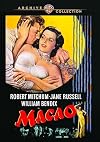
Despite its detractors, and its troubled production history, this is an entertaining Robert Mitchum film. This crime caper in exotic surroundings is a real winner. A lot was working against this film, however. Gloria Grahame hated RKO's Howard Hughes and was in the process of divorcing producer Nicholas Ray at the time Macao was made. The starting script was an indecipherable mess, and the director was an overbearing egoist who nearly provoked Mitchum to violence. The lead female role should show more have been Grahame’s, with Russell, taking the secondary role. The fact that the end results are still so utterly entertaining is a sheer miracle.
Mitchum's character, Nick Cochran, ends up in Macao and is mistaken for Lawrence Trumble (William Bendix), who might or might not be a cop looking to extradite casino owner Vincent Halloran (Brad Dexter). Margie (Gloria Grahame) is the sensuous and abused ingenue tangled up with Halloran, and would steal every scene she’s in were she not equaled by Mitchum. Though she isn’t a favorite of mine, Russell and Mitchum had an easy rapport on and off screen apparently, but the film still would have been better with Gloria Grahame in her role and Russell taking over Gloria’s part.
Mitchum and Russell both had tremendous difficulties working with Joseph von Sternberg, and teamed up to against his dictatorial manner. Mitchum not only rewrote some of the convoluted script, but when Nicholas Ray had to step in, he reportedly helped direct some scenes as well. Everyone is a bit of a mystery in this film as to their motives and actions, spicing things up. The cops need to get Halloran out of Macao to nab him, but since everyone seems to be a bit on the shady side, it's hard to know who to trust.
Thomas Gomez rounds out the great cast as Lt. Sebastian. The exotic locale and attractive players makes for fine Hollywood escapism. That said, it's best not to think about this one too hard, and just sit back and enjoy it. A lot of fun. show less
Mitchum's character, Nick Cochran, ends up in Macao and is mistaken for Lawrence Trumble (William Bendix), who might or might not be a cop looking to extradite casino owner Vincent Halloran (Brad Dexter). Margie (Gloria Grahame) is the sensuous and abused ingenue tangled up with Halloran, and would steal every scene she’s in were she not equaled by Mitchum. Though she isn’t a favorite of mine, Russell and Mitchum had an easy rapport on and off screen apparently, but the film still would have been better with Gloria Grahame in her role and Russell taking over Gloria’s part.
Mitchum and Russell both had tremendous difficulties working with Joseph von Sternberg, and teamed up to against his dictatorial manner. Mitchum not only rewrote some of the convoluted script, but when Nicholas Ray had to step in, he reportedly helped direct some scenes as well. Everyone is a bit of a mystery in this film as to their motives and actions, spicing things up. The cops need to get Halloran out of Macao to nab him, but since everyone seems to be a bit on the shady side, it's hard to know who to trust.
Thomas Gomez rounds out the great cast as Lt. Sebastian. The exotic locale and attractive players makes for fine Hollywood escapism. That said, it's best not to think about this one too hard, and just sit back and enjoy it. A lot of fun. show less

This is a ghost-written memoir, but Sternberg is honest enough to give credit to his writers. The story is very much about immigrant boy makes good, first in the experimental cinema of Weimar Germany, and again, in Hollywood of the Thirties. It is readable and predictable, with no startling insights.

C (Indifferent).
A gangster's girl falls in love with his friend. It's a tedious story, but I guess it would have seemed less so to people in 1927 who had never seen a gangster movie before. Good for them.
(Jun. 2024)
A gangster's girl falls in love with his friend. It's a tedious story, but I guess it would have seemed less so to people in 1927 who had never seen a gangster movie before. Good for them.
(Jun. 2024)

2025 movie #74. 1927. Clara Bow is delightful as the poor shopgirl with a crush on the wealthy store manager. A frothy silent era rom-com. She was the original "It" girl and this movie made her a big star.
Lists
Awards


You May Also Like


Associated Authors
Statistics
- Works
- 40
- Also by
- 5
- Members
- 604
- Popularity
- #41,610
- Rating
- 3.3
- Reviews
- 17
- ISBNs
- 63
- Languages
- 6