
Porfirio (234–305)
Author of Porphyry's Against the Christians
About the Author
Works by Porfirio
Porphyry's Letter to His Wife: Concerning the Life of Philosophy and the Ascent to the Gods (1816) 41 copies, 1 review
Select Works Of Porphyry: Containing His Four Books On Abstinence From Animal Food, His Treatise On The Homeric Cave Of The Nymphs (1823) (1994) 25 copies, 1 review
Porphyry's Launching-Points to the Realm of the Mind An Introduction to the Neoplatonic Philosophy of Plotinus (1988) 21 copies, 1 review
Filosofia rivelata dagli oracoli. Con tutti i frammenti di magia, stregoneria, teosofia e teurgia. Testi greci e latini a fronte (2011) 6 copies
Contro i cristiani: nella raccolta di Adolf von Harnack con tutti i nuovi frammenti in appendice (2009) 5 copies
Porphyry, the Philosopher, to Marcella : text and translation with introduction and notes (1987) 4 copies
Porphyrii sententiae ad intelligibilia ducentes (Bibliotheca scriptorum Graecorum et Romanorum Teubneriana) (Ancient Greek Edition) (1975) 3 copies
Porphyrios, "Contra Christianos" : neue Sammlung der Fragmente, Testimonien und Dubia (2015) 3 copies
Porphyry's Commentary on Ptolemy's Harmonics: A Greek Text and Annotated Translation (2015) 3 copies
Porphyrii Isagoge et in Aristotelis Categorias commentarium ... Volume 4 Part. 1 (Latin Edition) (2011) 2 copies
carmi 1 copy
L'antro delle ninfe 1 copy
Commentarium in Horatium 1 copy
De l'abstinence 1 copy
Porfirio: Sullo Stige 1 copy
Lettera ad Anebo 1 copy
Pros Markellam 1 copy
_Porphyrius_ 1 copy
Associated Works
Tagged
Common Knowledge
- Canonical name
- Porphyry
- Birthdate
- 234
- Date of death
- 305
- Gender
- male
- Occupations
- philosopher
- Nationality
- Roman Empire
- Places of residence
- Athens, Rome, Sicily
- Associated Place (for map)
- Athens, Rome, Sicily
Members
Reviews
Porphyry's letter to his wife Marcella concerning the life of philosophy and the ascent to the gods by Porfirio
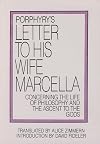
I didn't find this work all that interesting. Firstly, Thomas Taylor, in his Select Works of Porphyry, noted several cases of Porphyry simply quoting from the Sentences of Sextus and the Sentences of Demophilus in this supposedly personal letter. Secondly, and on top of that, this polemicist towards Christianity didn't mind shamefully and unabashedly stealing ideas and terms from the religion he was a noted opponent of. You can search in vain in Plato's writings for terms like faith, hope show more and love, and you won't find them. Plato did talk about love as the Greek "eros", but it is very different than Christian notions of love (i.e. as phileo and agape) and he never tied eros to faith (pistis) and hope (elpis). You will also search in vain for that trinity of terms in Hellenistic pagan literature. Porphyry could have only got it from one source. He also speaks of "evil spirits" in here; such an idea cannot be supported in Neo-Platonist theology; indeed, it's inadequate approach to evil is one of my criticisms of Neo-Platonism.
I wouldn't care that Porphyry plagiarized in a period when that was acceptable, but given his reputation as a pioneer of textual criticism, I can only consider him to be a bit of a hypocrite. He criticized Origen for borrowing from Plato whilst being a Christian, but I guess he thought the same rule shouldn't be applied to him with regards to Christianity.
Porphyry was considered to be an important Neo-Platonist. If it was to be gauged on this work solely, I could only find that appraisal puzzling. Of course, most of his works are no longer extant, so it would be unfair to reach any absolute conclusions as to his philosophical merits based only on what remains, but I have no problem judging what's left to judge. He has to be given credit for collecting and publishing Plotinus' writings at least, but his own merits are so far indeterminate. show less
I wouldn't care that Porphyry plagiarized in a period when that was acceptable, but given his reputation as a pioneer of textual criticism, I can only consider him to be a bit of a hypocrite. He criticized Origen for borrowing from Plato whilst being a Christian, but I guess he thought the same rule shouldn't be applied to him with regards to Christianity.
Porphyry was considered to be an important Neo-Platonist. If it was to be gauged on this work solely, I could only find that appraisal puzzling. Of course, most of his works are no longer extant, so it would be unfair to reach any absolute conclusions as to his philosophical merits based only on what remains, but I have no problem judging what's left to judge. He has to be given credit for collecting and publishing Plotinus' writings at least, but his own merits are so far indeterminate. show less
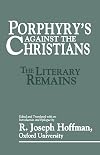
Porphyry (3rd c. A.D.) occupied an important place in the lineage of Neoplatonism; as student, editor and biographer of Plotinus and then a prolific philosopher in his own right, he did much to bring Neoplatonic ideas and beliefs into pagan religion. You'd think his most famous work, Against The Christians, would be a serious appraisal of one system vs. another. You would be wrong. ATC survives only in fragments, but what remains shows a Porphyry mostly arguing on the basis of mostly petty show more inconsistencies among the Gospels narratives. It's a low-grade style of debate that suggests to me that on the philosophy of religion level where he should have excelled he was largely ignorant of what he was attacking.
Somewhat reminiscent of Internet trolls today. show less
Somewhat reminiscent of Internet trolls today. show less
Select Works Of Porphyry: Containing His Four Books On Abstinence From Animal Food, His Treatise On The Homeric Cave Of The Nymphs (1823) by Porfirio
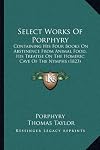
Porphyry was one of the notable Neo-Platonists. Indeed, he was the immediate successor to Plotinus. I have now read most of the philosophically important works that still survive of his. I don't think Porphyry was all that original. He seems to have stuck pretty close to what was taught by Plotinus. I would hate to sum him up as a second rate Plotinus, but he lacks a lot of the profundity and originality of his teacher. There are some exceptions (I follow this up below), but not many. One show more must acknowledge that Plotinus was at least somewhat dependent on Numenius--if we take seriously some of his detractors, and compare what survives of Numenius. I think it could hardly be denied to Plotinus his overall originality though.
Porphyry's treatise on abstinence from meat is what heads up this collection. It's an interesting work. Porphyry does have a tendency to go off on tangents--sometimes irrelevant and occasionally semi-relevant; some of the irrelevant tangents are interesting though and give us further insight into his philosophy; so it is probably good that he didn't stay entirely on topic. I've been a pescetarian for almost 20 years; 2 of those a complete vegetarian, so I don't take issue with the subject and agree with it to a large degree. It is a bit puzzling that a philosopher who was concerned enough about the treatment of animals, wrote a treatise to alleviate their suffering, while also composing a treatise that contributed to the suffering of a human community that was violently opposed at the time. Like I said in my review to his Letter to Marcella, Porphyry was a bit of a hypocrite.
The second treatise is devoted to the philosophic/allegorical interpretation of a passage in Homer regarding the cave of the Nymphs. This is an interesting work to a degree as well. It contains some intriguing anecdotes regarding mythical and zodiacal lore and arcana. One can note some traces of the preceding in alchemical tradition. I could detect some corresponding elements in Boehme. Thomas Taylor adds an appendix where he gives his own interpretation of Homer.
With "Auxiliaries to The Perception of Intelligible Natures" (also referred to as the "Sentences" or "Sententiae"), the last work (which I read first), Porphyry indicates his merits as a philosopher in his own right to some degree. He hasn't solved the problems that face the Neo-Platonists in their approach to evil, but he does provide a more nuanced position in regards to it.
He basically makes the problem of evil a problem of composition and not a problem with matter qua matter. Porphyry places soul (psuche) in between the intelligible realm and the realm of matter. Soul can either rise to the intellectual realm, or sink into the realm of matter. Soul, in this scheme, is composite. It combines tendencies of upward and downward drives. This seems to be in contrast to Plato's view in the Timaeus, where there is an evil soul and a good soul. Plotinus, as far as I could tell in the Enneads, does not attribute to soul any negative duplicity. Porphyry, apparently, wants to hold on to Plotinus' views regarding the purity of the cosmic soul, so he places this duplicity in the individual soul. The preceding relates in some way to the degradation that exists between the sub-lunar and supra-lunar cosmos.
Porphyry retains the view that the intelligible realm is One, static and free from evil; and that matter is transient, dyadic and the source of evil in some manner. Matter essentially has no being (Greek: to on), so how soul can be a composite between non-being and being is not explained. One is left to assume that there is a distinction between non-being and non-existence in Neo-Platonist thought, but this is not addressed in the early sources directly. Porphyry attributes to passion the drive that sends the soul sinking into the material realm. The problem is that now evil no longer is found in matter but desire becomes the culprit, more or less. Desire can only exist in an entity that possesses mind and will, so instead of freeing the intelligible realm from any implication of evil, he really does the opposite. Soul is a composite of minds driven by disparate motivations. Soul is driven by a desire for the pseudo-being of matter, while also retaining some memory and desire for the intelligible realm.
Porphyry is worth reading if one is interested in Platonism and Neo-Platonism. I don't think he was all that original and where he was original, I'm not sure his Neo-Platonic views are valid; but he is one of the important links leading up to Proclus. show less
Porphyry's treatise on abstinence from meat is what heads up this collection. It's an interesting work. Porphyry does have a tendency to go off on tangents--sometimes irrelevant and occasionally semi-relevant; some of the irrelevant tangents are interesting though and give us further insight into his philosophy; so it is probably good that he didn't stay entirely on topic. I've been a pescetarian for almost 20 years; 2 of those a complete vegetarian, so I don't take issue with the subject and agree with it to a large degree. It is a bit puzzling that a philosopher who was concerned enough about the treatment of animals, wrote a treatise to alleviate their suffering, while also composing a treatise that contributed to the suffering of a human community that was violently opposed at the time. Like I said in my review to his Letter to Marcella, Porphyry was a bit of a hypocrite.
The second treatise is devoted to the philosophic/allegorical interpretation of a passage in Homer regarding the cave of the Nymphs. This is an interesting work to a degree as well. It contains some intriguing anecdotes regarding mythical and zodiacal lore and arcana. One can note some traces of the preceding in alchemical tradition. I could detect some corresponding elements in Boehme. Thomas Taylor adds an appendix where he gives his own interpretation of Homer.
With "Auxiliaries to The Perception of Intelligible Natures" (also referred to as the "Sentences" or "Sententiae"), the last work (which I read first), Porphyry indicates his merits as a philosopher in his own right to some degree. He hasn't solved the problems that face the Neo-Platonists in their approach to evil, but he does provide a more nuanced position in regards to it.
He basically makes the problem of evil a problem of composition and not a problem with matter qua matter. Porphyry places soul (psuche) in between the intelligible realm and the realm of matter. Soul can either rise to the intellectual realm, or sink into the realm of matter. Soul, in this scheme, is composite. It combines tendencies of upward and downward drives. This seems to be in contrast to Plato's view in the Timaeus, where there is an evil soul and a good soul. Plotinus, as far as I could tell in the Enneads, does not attribute to soul any negative duplicity. Porphyry, apparently, wants to hold on to Plotinus' views regarding the purity of the cosmic soul, so he places this duplicity in the individual soul. The preceding relates in some way to the degradation that exists between the sub-lunar and supra-lunar cosmos.
Porphyry retains the view that the intelligible realm is One, static and free from evil; and that matter is transient, dyadic and the source of evil in some manner. Matter essentially has no being (Greek: to on), so how soul can be a composite between non-being and being is not explained. One is left to assume that there is a distinction between non-being and non-existence in Neo-Platonist thought, but this is not addressed in the early sources directly. Porphyry attributes to passion the drive that sends the soul sinking into the material realm. The problem is that now evil no longer is found in matter but desire becomes the culprit, more or less. Desire can only exist in an entity that possesses mind and will, so instead of freeing the intelligible realm from any implication of evil, he really does the opposite. Soul is a composite of minds driven by disparate motivations. Soul is driven by a desire for the pseudo-being of matter, while also retaining some memory and desire for the intelligible realm.
Porphyry is worth reading if one is interested in Platonism and Neo-Platonism. I don't think he was all that original and where he was original, I'm not sure his Neo-Platonic views are valid; but he is one of the important links leading up to Proclus. show less
I read the translation by Octavius Freire Owen, M. A. of Christ Church, Oxford. It might as well be in the original greek. It served only to complicate things. I feel like it was begging for an illustrated version, or one in which hierarchy could be better illustrated, for the words were legible, but their combinations were not.
I get the usefulness of the document and its historical importance, but holy shit was this translation confusing.
I get the usefulness of the document and its historical importance, but holy shit was this translation confusing.
You May Also Like


Associated Authors
Statistics
- Works
- 77
- Also by
- 2
- Members
- 560
- Popularity
- #44,619
- Rating
- 3.7
- Reviews
- 12
- ISBNs
- 101
- Languages
- 11
- Favorited
- 1
