
E. R. Dodds (1893–1979)
Author of The Greeks and the Irrational
About the Author
E.R. Dodds (1893-1979) was born in Belfast and educated at Campbell College, Belfast, and Balliol College, Oxford. He was Regius Professor of Greek at Oxford from 1936 to 1960 and President of the Society for Psychical Research from 1961 to 1963.
Works by E. R. Dodds
Pagan and Christian in an Age of Anxiety: Some Aspects of Religious Experience from Marcus Aurelius to Constantine (1965) 271 copies, 4 reviews
The Ancient Concept of Progress and Other Essays on Greek Literature and Belief (Clarendon Paperbacks) (1973) 53 copies, 1 review
Proclus: The elements of theology ; a revised text with translation, introduction and commentary 3 copies
The Elements of Theology 2 copies
Associated Works
Literature: An Introduction to Fiction, Poetry, and Drama (1995) — Contributor, some editions — 1,017 copies, 7 reviews
The Elements of Theology: A Revised Text with Translation, Introduction, and Commentary (1963) — Editor, some editions — 135 copies
Tagged
Common Knowledge
- Legal name
- Dodds, Eric Robertson
- Birthdate
- 1893-07-26
- Date of death
- 1979-03-08
- Gender
- male
- Education
- University of Oxford (University College ∙ BA ∙ 1917)
Campbell College, Belfast, Northern Ireland, UK - Organizations
- Society for Psychical Research, President from 1961 to 1963.
- Nationality
- Ireland
- Places of residence
- Dublin, Ireland
Birmingham, Warwickshire, England, UK
Oxford, Oxfordshire, England, UK - Associated Place (for map)
- England, UK
Members
Reviews

Another necessary corrective to the historiography of Western civilization. The view since at least the 17th c. of a distinctive Western civilization marked by rationalism counted on an autochthonous, rational, classical Greek foundation.
Dodds—drawing on the works of Homer through to the last pagan neoplatonists—points out that the Greeks themselves were careful not to neglect the superstitious, the impulsive, or the reactionary in human experience and behavior. And, Greek thought show more exhibited too many congruencies with Mesopotamian, Egyptian, Persian, and Brahman mentalities to support later interpretations of an ancient East-West divide.
First appearing in lecture form in 1949, The Greeks and the Irrational is a pleasure to read (because of the original lecture form, or despite the lecture form, I can’t decide), and one need not be a devotee of Ancient History to find much worthwhile in the discussion here. For those wanting to go further, the chapter notes constitute a rich and instructive bibliographical essay in their own right. show less
Dodds—drawing on the works of Homer through to the last pagan neoplatonists—points out that the Greeks themselves were careful not to neglect the superstitious, the impulsive, or the reactionary in human experience and behavior. And, Greek thought show more exhibited too many congruencies with Mesopotamian, Egyptian, Persian, and Brahman mentalities to support later interpretations of an ancient East-West divide.
First appearing in lecture form in 1949, The Greeks and the Irrational is a pleasure to read (because of the original lecture form, or despite the lecture form, I can’t decide), and one need not be a devotee of Ancient History to find much worthwhile in the discussion here. For those wanting to go further, the chapter notes constitute a rich and instructive bibliographical essay in their own right. show less
Pagan and Christian in an Age of Anxiety: Some Aspects of Religious Experience from Marcus Aurelius to Constantine (Wiles Lectures Given at the Queens University, Belfast) by E. R. Dodds
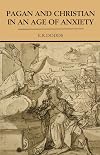
An interesting and quite well-written, though ultimately unconvincing, work, Pagan and Christian in an Age of Anxiety brings together a series of four lectures given by E.R. Dodds on the subject of religious experience between about 161 and 312CE. That Dodds was writing in the 1960s is readily apparent—he draws almost exclusively on literary material in order to make a case about religious experience (ignoring what is surely a wealth of epigraphic material!), and he interprets the evidence show more largely through a Freudian lens. He elucidates beautifully the ways in which Christian and polytheist Neo-Platonists influenced and drew on one another, but in the light of more recent scholarship which has reassessed the nature and the vigour of polytheism in the Later Roman Empire, Dodds' thesis (that an enervated polytheism couldn't resist Christianity's innovations and energy) is ultimately unconvincing. show less
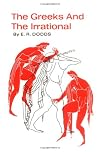
While Ancient Greeks are most known for the triumph of rationalism over superstition and magic, E.R. Dodds presents an alternate history which demonstrates that, despite the intellectual advancements in the direction of reason, the Greeks (particularly Plato) of the Golden Age fundamentally retained certain pre-5th century magical (read: irrational) thinking within their traditions. Dodds thinks this is a good thing, since we are not merely thinking but also *feeling* agents--a fact that show more Socrates and Aristotle understood well. Dodds argues that the progressive excision of "irrationality" in the Stoic and Epicurean traditions turns out to be a regression--a failure to appreciate the affective elements of living a human life. He sees this failure culminate in medieval Christianity's devaluation of earthly life.
This book is essential and utterly fascinating. Because it was first delivered as a series of lectures (each chapter is relatively short--approx 15-20 pages), it is eminently digestible and suitable for any audience. But boy, does he pack a lot of detail in: on average there are about 100 footnotes a chapter. This makes this a great bibliographical source in addition to being a spectacular read. show less
This book is essential and utterly fascinating. Because it was first delivered as a series of lectures (each chapter is relatively short--approx 15-20 pages), it is eminently digestible and suitable for any audience. But boy, does he pack a lot of detail in: on average there are about 100 footnotes a chapter. This makes this a great bibliographical source in addition to being a spectacular read. show less

This is a classic. Although at points it sounds dated, written as it was in an age dominated by Freud, the central thesis holds up well and is an important corrective to the predominant view of the Greeks as rational. Doods brings into question the view that religion is rational which I believe is an even more important, and long-lasting contribution. The earliest Age of Reason is more complex according to Dodds and he quite effectively surveys the counter irrational tradition coursing show more through Greek myths and philosophy. The more typical view of the Greeks overemphasizes the Ionian Enlightenment while Dodds wants us to see a more complex view including Pythagoran sounds, hints of Indian religion and mysticism, reincarnation associated with the cultic mysteries, and the polytheism denatured by later monotheism. Dodds reviews later European thought of Hegel and Nietzsche and others while expounding on the richness of the Greek artistic tradition as with Euripides' 'rationalizing.' Dodds, along with Gilbert Murray, points out that the Greek 'irrational' is not all that far removed from Indian culture during the Axial Age. Greek literary tradition is more akin to Indian thought than many care to consider. We may know less about rational Enlightenment, after Kant, than many thinkers care to admit.
The text is clear with a plethora of lengthy and fascinating sidelights contained in the copious notes. Composed originally as a series of lectures the text is academic but stimulating.
It is widely acclaimed such as in Robin Lane Fox's The Classical World. show less
The text is clear with a plethora of lengthy and fascinating sidelights contained in the copious notes. Composed originally as a series of lectures the text is academic but stimulating.
It is widely acclaimed such as in Robin Lane Fox's The Classical World. show less
Lists
Antigua Grecia (1)
Reading list (1)
Awards


You May Also Like


Associated Authors
Statistics
- Works
- 16
- Also by
- 8
- Members
- 1,533
- Popularity
- #16,782
- Rating
- 3.9
- Reviews
- 19
- ISBNs
- 51
- Languages
- 10
- Favorited
- 3