
Werner Jaeger (1888–1961)
Author of Paideia: The Ideals of Greek Culture: Volume I: Archaic Greece: The Mind of Athens
About the Author
Series
Works by Werner Jaeger
Paideia: The Ideals of Greek Culture: Volume I: Archaic Greece: The Mind of Athens (1939) 391 copies, 2 reviews
Paideia: The Ideals of Greek Culture Volume II: In Search of the Divine Center (1943) 243 copies, 2 reviews
Paideia: The Ideals of Greek Culture Volume III: The Conflict of Cultural Ideals in the Age of Plato (1944) 230 copies, 2 reviews
The Theology of the Early Greek Philosophers: The Gifford Lectures, 1936 (1947) 149 copies, 8 reviews
Gods and Heroes of Ancient Greece 2 copies
Associated Works
Tagged
Common Knowledge
- Canonical name
- Jaeger, Werner
- Birthdate
- 1888-07-30
- Date of death
- 1961-10-09
- Gender
- male
- Occupations
- university professor at Harvard and Director of the Institute for Classical Studies
- Nationality
- Germany
- Associated Place (for map)
- Germany
Members
Reviews

Jaeger's brilliant insight was to explore the growth of Hellenic culture by emphasizing the role of education. It is a profound perspective that links the earliest Archaic poetry to the sophisticated philosophy of Plato. After reading more than a thousand pages, when one finishes the chapter on Demosthenes and the triumph of Macedonia, one's understanding of Greek civilization hasn't been transformed so much as it has been broadened through a deep synthesis which connects desperate elements show more into an illuminating whole. show less

Greatly written resource on theological shifts in structure of ideas in the Hellenic world. I've started with an idea that "in an indivisible cosmos, the divine reveals itself" in sages, philosophers, mystai, logioi interpret it (hermeneuien). Those few that experienced the world of the Divine and weren't left in their speculations without this support of convinction, understanding and experience. Thinking that any thought that lifted the theological narration in a different direction in show more this days was a heroic, titanic move by those few mystai and physikoi acknowledging the Divine, or those seeking the reasons for natural religion forged in fear managed by a political order to have a "bigger, greater man" in the sky to be feared. This reading helped me reconcile the neoplatonic ideas of Iamblichus with the Pythagorean Tetractys, I needed plenty of philosophical glue to solve the progression from apeiron and monadic generator and further generation of the mutually reflecting world of descending and ascending coil-like (transmigrative) powers. This personal exploration attempts to reconcile a superstructure of theological grand vision with the various worldviews of the Hellenic philosophers, as well as building bridges to Chaldean, Egyptian and Hindi ones. They weren't the same, however, they picked differect aspects of categories of human and religious experience, different practices and mystagogy, but there are points of reference among the models and measuring rods that greatly improve one's personal epiphany, apocalypsis (revealing), by knowing where to put the accentuation in order to interpret them through each other. show less
Greatly written resource on theological shifts in structure of ideas in the Hellenic world. I've started with an idea that "in an indivisible cosmos, the divine reveals itself" in sages, philosophers, mystai, logioi interpret it (hermeneuien). Those few that experienced the world of the Divine and weren't left in their speculations without this support of convinction, understanding and experience. Thinking that any thought that lifted the theological narration in a different direction in show more this days was a heroic, titanic move by those few mystai and physikoi acknowledging the Divine, or those seeking the reasons for natural religion forged in fear managed by a political order to have a "bigger, greater man" in the sky to be feared. This reading helped me reconcile the neoplatonic ideas of Iamblichus with the Pythagorean Tetractys, I needed plenty of philosophical glue to solve the progression from apeiron and monadic generator and further generation of the mutually reflecting world of descending and ascending coil-like (transmigrative) powers. This personal exploration attempts to reconcile a superstructure of theological grand vision with the various worldviews of the Hellenic philosophers, as well as building bridges to Chaldean, Egyptian and Hindi ones. They weren't the same, however, they picked differect aspects of categories of human and religious experience, different practices and mystagogy, but there are points of reference among the models and measuring rods that greatly improve one's personal epiphany, apocalypsis (revealing), by knowing where to put the accentuation in order to interpret them through each other. show less
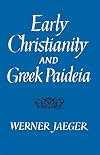
Amazon : This small book, the last work of a world-renowned scholar, has established itself as a classic. It provides a superb overview of the vast historical process by which Christianity was Hellenized and Hellenic civilization became Christianized.
Jaeger shows that without the large post classical expansion of Greek culture the rise of a Christian world religion would have been impossible. He explains why the Hellenization of Christianity was necessary in apostolic and postapostalic show more times; points out similarities between Greek philosophy and Christian belief; discuss such key figures as Clement, Origen, and Gregory of Nyssa; and touches on the controversies that led to the ultimate complex synthesis of Greek and Christian thought. show less
Jaeger shows that without the large post classical expansion of Greek culture the rise of a Christian world religion would have been impossible. He explains why the Hellenization of Christianity was necessary in apostolic and postapostalic show more times; points out similarities between Greek philosophy and Christian belief; discuss such key figures as Clement, Origen, and Gregory of Nyssa; and touches on the controversies that led to the ultimate complex synthesis of Greek and Christian thought. show less
Lists
Antigua Grecia (1)
You May Also Like


Associated Authors
Statistics
- Works
- 37
- Also by
- 6
- Members
- 1,986
- Popularity
- #12,948
- Rating
- 4.0
- Reviews
- 24
- ISBNs
- 89
- Languages
- 11
- Favorited
- 2
