
Leo Rosten (1907–1997)
Author of The Joys of Yiddish
About the Author
He was the author of The Return of H*Y*M*A*N K*P*L*A*N, Captain Newman, M.D., and countless other books, articles, and screenplays. (Bowker Author Biography)
Series
Works by Leo Rosten
A guide to the religions of America; the famous Look magazine series on religion, plus facts, figures, tables, charts, articles, and comprehensive reference material on churches… (1955) — Editor — 156 copies
The strangest places 2 copies
Adventure in Washington 1 copy
Pan Kaplan má třídu rád 1 copy
Religions in America; the famous Look magazine series on religion, plus facts, figures, tables, char 1 copy
Die Tochter des Millionärs / Schönheit schützt vor Rache nicht. 2 Silky Pincus- Kriminalromane. (1987) 1 copy
oy oy oy! 1 copy
The Bathroom Reader 1 copy
Associated Works
Fierce Pajamas: An Anthology of Humor Writing from The New Yorker (2001) — Contributor — 787 copies, 5 reviews
Reader's Digest Best Sellers 1965: Captain Newman, M.D. | When the Cheering Stopped | Spy Who Came in From the Cold | Song of Sixpence (1965) — Author — 13 copies
Kapitein Newman, psychiater in oorlogstijd; In de schoenen van een visser; Ik sprak met viervoeters, vogels en vissen; Sluipvaart in de Pacific 1 copy, 1 review
The Ethnic Image in Modern American Literature, 1900-1950, Volumes 1-2 (1984) — Contributor — 1 copy
Tagged
Common Knowledge
- Canonical name
- Rosten, Leo
- Legal name
- Rosten, Leo Calvin
- Other names
- Ross, Leonard Q.
- Birthdate
- 1907-04-11
- Date of death
- 1997-02-19
- Gender
- male
- Education
- University of Chicago (Ph.B|1930|Ph.D|1937)
London School of Economics - Occupations
- teacher
screenwriter
lexicographer
novelist
humorist
journalist - Organizations
- Look
Rand Corporation
Office of War Information (WWII) - Relationships
- Rosten, Carrie (granddaughter)
Mead, Margaret (sister-in-law)
Steig, William (brother-in-law)
Bateson, Mary Catherine (niece) - Short biography
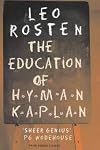
- Leo Rosten was born in Łódź, Poland, and emigrated to the USA at age three, settling in Chicago. He graduated from the University of Chicago in 1930 and earned a Ph.D. in 1937, followed by postgraduate study at the London School of Economics. During the Great Depression, he worked as a screenwriter and held a series of government information jobs during World War II. In 1949, he joined the staff of Look magazine, where he worked until 1971. As Leonard Q. Ross, he began his publishing career with the novel The Education of H*Y*M*A*N K*A*P*L*A*N (1937), based on his experiences teaching English to new immigrants. He edited a series of articles for Look that became the basis of A Guide to the Religions of America (1955) and The Story Behind the Painting (1962). Rosten enjoyed instant success with The Joys of Yiddish (1968), a comic lexicon that introduced millions of Americans to Yiddish words and idioms such as chutzpah and nosh that are now widely used. He followed it with The Joys of Yinglish (1989). He produced dozens of other works over more than 60 years of writing.
- Nationality
- Russian Empire (birth)
USA - Birthplace
- Łódź, Russian Empire
- Places of residence
- Lodz, Russian Empire (now Poland)
New York, New York, USA
Chicago, Illinois, USA - Place of death
- New York, New York, USA
- Associated Place (for map)
- USA
Members
Reviews
"Mr Parkhill read what some unknown Muse in secret visitation had whispered to Hyman Kaplan"
By sally tarbox on 4 August 2018
Format: Kindle Edition
Probably *3.5 for this highly entertaining little novel, set in an English language class for immigrants to the US in 1937. Mr Parkhill is the harrassed teacher; the students primarily Italian and Jewish. Although the action is all based around classroom exchanges, we nonetheless get an insight into the main personalities, headed by Yiddish speaker show more Hyman Kaplan.
"In his forties, a plump, red-faced gentleman, with wavy blond hair, TWO fountain pens in his outer pocket and a perpetual smile. It was a strange smile, Mr Parkhill remarked, vague, bland and consistent in its monotony."
Hyman Kaplan is an unforgettable character, who reminded me of Hasek's 'Good Soldier Schweik'- either a complete fool or- we come to believe- singularly clever, always leaving the authorities with egg on their face. Thus when corrected for the phrasing of his advice to a relative: "if your eye falls on a bargain, please pick it up", Kaplan emerges victorious with his explanation "Mine oncle has a gless eye."
There is a somewhat combative relationship between Kaplan and his fellow students, notably the quiet but more linguistically adept Miss Minick. But little hints from his class work suggest a logical and warm hearted individual.
The humour hinges on the vagaries of the English language: Kaplan conjugates 'to bite': "If is write 'write, wrote, written', so vy isn't 'bite, bote, bitten?" He gives "a fervent speech extolling the D'Oyley Carte Company's performance of an operetta by two English gentlemen referred to as 'Goldberg and Solomon." He gleefully participates in correcting Miss Mitnick's composition on her job: "Aha! Vaitress!", he cried out."Should be a' V' in vaitress!"
Rosten writes a convincing Yiddish acent; very funny. show less
By sally tarbox on 4 August 2018
Format: Kindle Edition
Probably *3.5 for this highly entertaining little novel, set in an English language class for immigrants to the US in 1937. Mr Parkhill is the harrassed teacher; the students primarily Italian and Jewish. Although the action is all based around classroom exchanges, we nonetheless get an insight into the main personalities, headed by Yiddish speaker show more Hyman Kaplan.
"In his forties, a plump, red-faced gentleman, with wavy blond hair, TWO fountain pens in his outer pocket and a perpetual smile. It was a strange smile, Mr Parkhill remarked, vague, bland and consistent in its monotony."
Hyman Kaplan is an unforgettable character, who reminded me of Hasek's 'Good Soldier Schweik'- either a complete fool or- we come to believe- singularly clever, always leaving the authorities with egg on their face. Thus when corrected for the phrasing of his advice to a relative: "if your eye falls on a bargain, please pick it up", Kaplan emerges victorious with his explanation "Mine oncle has a gless eye."
There is a somewhat combative relationship between Kaplan and his fellow students, notably the quiet but more linguistically adept Miss Minick. But little hints from his class work suggest a logical and warm hearted individual.
The humour hinges on the vagaries of the English language: Kaplan conjugates 'to bite': "If is write 'write, wrote, written', so vy isn't 'bite, bote, bitten?" He gives "a fervent speech extolling the D'Oyley Carte Company's performance of an operetta by two English gentlemen referred to as 'Goldberg and Solomon." He gleefully participates in correcting Miss Mitnick's composition on her job: "Aha! Vaitress!", he cried out."Should be a' V' in vaitress!"
Rosten writes a convincing Yiddish acent; very funny. show less

Is it a dictionary with illustrative jokes, or a joke-book with a veneer of scholarship? Either way, this charming volume works very well in getting across the mysteries and fun of Yiddish, a language whose lexicon has entered into the English language via immigrants. Rosten has a very deft touch in picking his jokes; sometimes, the joke is only tangential to the word it (allegedly) illustrates, and one suspects it's been put in there because it made the author laugh. A lot of fun to have.
This is a re-read for me, but since I read it somewhere between 30-37 years ago it's more nostalgic than anything else. I have had H*Y*M*A*N K*A*P*L*A*N on my mind for several weeks as I read books that evoke him. Hyman, an immigrant, takes beginner's night English classes and speaks like your immigrant forebearers did if they were Ashkenazi Jews in New York or New Jersey before 1950. Hyman is an earnest yet immovable object. Reading this as a child, I saw him as the bane of his teacher's show more existence. Reading it now, having taught or worked in educational settings for most of the intervening years, I took in that Hyman's teacher, Mr. Parkhill, understands that Hyman is both a burden and a genius. This, I think, is something that differentiates this episodic comedy from others that rely exclusively on the trope of the dumb greenhorn's hilarious mispronunciation and mangled grammar. Hyman's misunderstandings provide a fresh vision of English, revealing hitherto unseen facets of the language and forging fresh connections. For me, the shining and ineffable utterance, the pinnacle of Jewish philosophy's efflorescence, is Hyman's assertion, "Mine oncle has a gless eye." You'll have to read the story to see why this simple (and untrue) statement is such a hilarious emblem of Talmudic reasoning paired with the Jewish stubbornness necessary to survive in world that seeks to quash the Jewish spirit.
I read The Education of H*Y*M*A*N K*A*P*L*A*N at my grandparents' house, at about the same time as I read Roth's [b:Portnoy's Complaint|43945|Portnoy's Complaint|Philip Roth|http://photo.goodreads.com/books/1170240551s/43945.jpg|911489] and Idries Shah's [b:Mulla Nasrudin|667145|The Exploits of the Incomparable Mulla Nasrudin / The Subtleties of the Inimitable Mulla Nasrudin|Idries Shah|http://photo.goodreads.com/books/1176936303s/667145.jpg|653194] tales. Leaving aside an early adolescent's profound embarrassment at having her mother ask, "Have you gotten to the liver yet?", this is a useful trio, of which Ross/Rosten is the fulcrum. Hyman brings Yiddishkeit to the New World, not just through his language, but in his attitude, world view, and exuberance. His is the optimism of the Jew in the promised land. While he bears the burdens of tsars and World War I, his is not the generation of Hitler's particular horrors. Portnoy holds the angst of post-Holocaust American Jewry that must wrestle with how much to accept and how much to reject the pessimism of such active anti-Semitism. Portnoy would find Kaplan naive, but see this as contemptible, whereas the Mullah Nasrudin might find him companionable, another blessed fool whose nonsense makes reasonable sense, if one is willing to really hear it. show less
I read The Education of H*Y*M*A*N K*A*P*L*A*N at my grandparents' house, at about the same time as I read Roth's [b:Portnoy's Complaint|43945|Portnoy's Complaint|Philip Roth|http://photo.goodreads.com/books/1170240551s/43945.jpg|911489] and Idries Shah's [b:Mulla Nasrudin|667145|The Exploits of the Incomparable Mulla Nasrudin / The Subtleties of the Inimitable Mulla Nasrudin|Idries Shah|http://photo.goodreads.com/books/1176936303s/667145.jpg|653194] tales. Leaving aside an early adolescent's profound embarrassment at having her mother ask, "Have you gotten to the liver yet?", this is a useful trio, of which Ross/Rosten is the fulcrum. Hyman brings Yiddishkeit to the New World, not just through his language, but in his attitude, world view, and exuberance. His is the optimism of the Jew in the promised land. While he bears the burdens of tsars and World War I, his is not the generation of Hitler's particular horrors. Portnoy holds the angst of post-Holocaust American Jewry that must wrestle with how much to accept and how much to reject the pessimism of such active anti-Semitism. Portnoy would find Kaplan naive, but see this as contemptible, whereas the Mullah Nasrudin might find him companionable, another blessed fool whose nonsense makes reasonable sense, if one is willing to really hear it. show less

I'm not really quite sure what I thought this book was going to be. The intorduction was really good and I think is closer to what I was expecting, more of a story/history about Yiddish in the U.S. He speaks of how most linguists harrumph at the use of Yiddish in the States as an accent to the primary language, and with most Jews now living in either the U.S. or Isreal (where Hebrew, not Yiddish, is the default tongue) Yiddish as a language is dying. But the author thinks the way it has show more worked its way into the general lexicon is actually great. After the intro it becomes, more-or-less, a dictionary of Yiddish words that are heard in American (what the author calls Ameridish or Yinglish) and what they mean, occasionally with a history of its use, either in the old world or the new, and often with a story, that claims to be numerous, about its use. Very dry, not that funny. Eventually I stopped reading each one and just skimmed ahead to words I've actually used or heard others use. show less
Lists
Awards


You May Also Like


Associated Authors
Statistics
- Works
- 48
- Also by
- 32
- Members
- 3,970
- Popularity
- #6,357
- Rating
- 3.7
- Reviews
- 53
- ISBNs
- 104
- Languages
- 5
- Favorited
- 3