
James Poniewozik
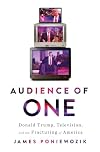
Author of Audience of One: Donald Trump, Television, and the Fracturing of America
About the Author
James Poniewozik has been the chief television critic of the New York Times since 2015. He was previously the television and media critic for Time magazine and a media columnist for Salon. He lives in Brooklyn.
Works by James Poniewozik
Audience of One: Donald Trump, Television, and the Fracturing of America (2019) 122 copies, 8 reviews
Associated Works
Tagged
Common Knowledge
There is no Common Knowledge data for this author yet. You can help.
Members
Reviews

James Poniewozik was one of the first writers whose columns I actively followed on the Web, back in the 1990s when he wrote for Salon. Since then, I had lost view of his work as he graduated to more prestigious positions at Time magazine and The New York Times. I was happy to return to his punchy prose and incisive observations in this book on the symbiosis between Donald J. Trump and the American media landscape.
Poniewozik treats Trump's long history as a media figure as central, not show more incidental, to his electoral identity and success. Trump was coeval with television itself, and neither of them have been unchanging. The author protests that he is not writing a biography of the human being Trump so much as a history of the character generated and inhabited by Trump as a television personality. The larger thesis and structure of the book he eventually sums up thus: Trump "watched TV, and then he courted TV, and then he starred on TV, and then he became TV. He achieved a psychic bond with the creature, and it lowered its head, let him climb on its back, and carried him to the White House" (236). The narrative of this progress through "businessman" celebrity, reality TV hosting, cable news pugilism, and Twitter demagoguery is filled with astonishing anecdotes that tie the whole thing into a single hyperreal composition.
This book is not about policy, and it is about politics only in the broad cultural sense. Alas, no one today can afford not to give a damn about Donald Trump, and that is the measure of his crowning achievement to date. "To live in America post-2016 was to live inside the rattled mind of a septuagenarian insomniac cable-news junkie" (270). Stories of regulatory capture and accelerating ecocide, concentration camps for refugees, egocentric foreign policy, and evisceration of Constitutional norms (beyond the long-abused Bill of Rights) are strangely outside the scope of the present treatment, which--like its subject--sees them mostly as means to an end. That end is an agonistic hypostasis: the "gorilla channel" where every actual problem is just fodder for the virtual conflict that ravenously consumes mass attention.
I recommend Audience of One as a fast, nearly compulsive, read, holding up an unflattering mirror to our reality-TV political culture. show less
Poniewozik treats Trump's long history as a media figure as central, not show more incidental, to his electoral identity and success. Trump was coeval with television itself, and neither of them have been unchanging. The author protests that he is not writing a biography of the human being Trump so much as a history of the character generated and inhabited by Trump as a television personality. The larger thesis and structure of the book he eventually sums up thus: Trump "watched TV, and then he courted TV, and then he starred on TV, and then he became TV. He achieved a psychic bond with the creature, and it lowered its head, let him climb on its back, and carried him to the White House" (236). The narrative of this progress through "businessman" celebrity, reality TV hosting, cable news pugilism, and Twitter demagoguery is filled with astonishing anecdotes that tie the whole thing into a single hyperreal composition.
This book is not about policy, and it is about politics only in the broad cultural sense. Alas, no one today can afford not to give a damn about Donald Trump, and that is the measure of his crowning achievement to date. "To live in America post-2016 was to live inside the rattled mind of a septuagenarian insomniac cable-news junkie" (270). Stories of regulatory capture and accelerating ecocide, concentration camps for refugees, egocentric foreign policy, and evisceration of Constitutional norms (beyond the long-abused Bill of Rights) are strangely outside the scope of the present treatment, which--like its subject--sees them mostly as means to an end. That end is an agonistic hypostasis: the "gorilla channel" where every actual problem is just fodder for the virtual conflict that ravenously consumes mass attention.
I recommend Audience of One as a fast, nearly compulsive, read, holding up an unflattering mirror to our reality-TV political culture. show less
This was interesting for me because, in addition to looking at how Trump's career and political ascendance is interwoven with the ways that television has changed and also influenced American culture, it's also a sociological overview of TV itself. I haven't read much of that kind of thing, so I can't tell if it's going over old ground, but I found it absorbing—particularly as someone who basically stopped watching television in the late '70s, other than a run of The Sopranos in its last show more few seasons. At the same time I knew OF everything he mentioned—living proof of the fact that even if you don't watch the stuff, it creeps into your general cultural consciousness—and it was neat to see it all put together in a timeline and appraised as a thing. I'm guessing if you're a Cultural Studies person this might be old hat, but I'm not so it was an interesting read. And it made me dislike Trump even more, which I didn't think was even possible. show less
i had said that I would not read another Donald Trump book but this one came highly reccommended and it was worth it. Instead of the politics and scandals, it was much more about the television culture and creation of the Trump character. Fascinating, if terrifying. I really enjoyed the cultural history of television and the rise of reality TV. There were large chunks that had no Trump and that was a bit of a respite but the last few chapters were scary and sobering.
A fascinating work that places the rise and experience of Donald Trump within the culture of American television. The only thing that really hinders the work is the author's clear bias against Trump - but the structure and placement of Trump within the work can be appreciated by all.
Recommended to those interested in American politics, American culture, television, or Trumpism.
Recommended to those interested in American politics, American culture, television, or Trumpism.
Awards


You May Also Like
Associated Authors
Statistics
- Works
- 1
- Also by
- 3
- Members
- 122
- Popularity
- #163,288
- Rating
- 3.7
- Reviews
- 8
- ISBNs
- 6