
David Reynolds (5) (1948–)
Author of Swan River
For other authors named David Reynolds, see the disambiguation page.
About the Author
David Reynolds was one of the founders of Bloomsbury Publishing. He is the author of Swan River: Memoir of a Family Mystery. He lives in London, England.
Works by David Reynolds
Tagged
Common Knowledge
- Legal name
- Reynolds, David Alan Clifton
- Birthdate
- 1948-10-13
- Gender
- male
Members
Reviews

I grew up in the Swan River Valley about half-way between Swan River and Durban, the two towns the author visited in search of clues about his grandfather. I remember this book caused quite a stir in the Valley when it came out as it was probably the first mass marketed book about our locale. Heck, it was even reviewed in The Guardian.
The author grew up in England after World War II so he and I are probably about the same age. His father was quite old by the time of his birth but he spent show more quite a bit of time with David, even taking him on his trips selling fertilizer to farmers. During these car trips the two would converse about diverse topics, such as free will and philosophy, with his father asking his opinion, not just lecturing. His father had another side though; he was verbally abusive to David's mother. Eventually, his mother had enough and went to live in London. David had long been interested in his father's family history. A great-uncle who lived in a home nearby sparked this interest by telling David he must go to Swan River when he grew up. His father's father had ended up there in the early 1900s after being forced to leave the marital home by his wife's father and brothers. He was an alcoholic who lost his responsible job as an accountant due to his drinking and could not find another job in that profession or any other. He was provided with the funds to take passage to Canada where he was directed to Manitoba which was looking for men of any quality to help open the West. The grandfather walked from Swan River to Durban where he got taken on working on the railroad. He wrote home a number of times but David's father didn't see the letters until after his mother had died. He learned that his father had died in that remote place not long after he had settled there. David was given access to the journals his grandmother kept for most of her life and those gave him some insight into her life but she seldom wrote about what she was feeling, just what she was doing. Meanwhile, life is going on for David--he goes to a boarding school meaning he loses touch with his childhood friends but he gains new friends and he continues to see them after they graduate. He is living in London during the Swinging Sixties and experiences all that life has to offer including sex, drugs and rock and roll. He volunteers with a magazine that espouses the new ethos and on one assignment he reconnects with his childhood friend, Deborah. He is thrilled to have found her again but he learns that she has gotten hooked on heroin. After a while, they lose touch again. It is not until 1998 that David made it to Swan River. Is it an anti-climax? Not really as it completes a quest that had started decades earlier.
I suspect that I found this book more interesting than the average reader but there is still a lot to entertain and inform someone who doesn't know the Swan River area. show less
The author grew up in England after World War II so he and I are probably about the same age. His father was quite old by the time of his birth but he spent show more quite a bit of time with David, even taking him on his trips selling fertilizer to farmers. During these car trips the two would converse about diverse topics, such as free will and philosophy, with his father asking his opinion, not just lecturing. His father had another side though; he was verbally abusive to David's mother. Eventually, his mother had enough and went to live in London. David had long been interested in his father's family history. A great-uncle who lived in a home nearby sparked this interest by telling David he must go to Swan River when he grew up. His father's father had ended up there in the early 1900s after being forced to leave the marital home by his wife's father and brothers. He was an alcoholic who lost his responsible job as an accountant due to his drinking and could not find another job in that profession or any other. He was provided with the funds to take passage to Canada where he was directed to Manitoba which was looking for men of any quality to help open the West. The grandfather walked from Swan River to Durban where he got taken on working on the railroad. He wrote home a number of times but David's father didn't see the letters until after his mother had died. He learned that his father had died in that remote place not long after he had settled there. David was given access to the journals his grandmother kept for most of her life and those gave him some insight into her life but she seldom wrote about what she was feeling, just what she was doing. Meanwhile, life is going on for David--he goes to a boarding school meaning he loses touch with his childhood friends but he gains new friends and he continues to see them after they graduate. He is living in London during the Swinging Sixties and experiences all that life has to offer including sex, drugs and rock and roll. He volunteers with a magazine that espouses the new ethos and on one assignment he reconnects with his childhood friend, Deborah. He is thrilled to have found her again but he learns that she has gotten hooked on heroin. After a while, they lose touch again. It is not until 1998 that David made it to Swan River. Is it an anti-climax? Not really as it completes a quest that had started decades earlier.
I suspect that I found this book more interesting than the average reader but there is still a lot to entertain and inform someone who doesn't know the Swan River area. show less
Annoying. A latter day Mrs. Frances Trollope, this carefully PC Englishman seems to have come to America with his mind thoroughly made up as to what he would find here, and sure enough, he found it. The blurb on the back cover describes him as "open eyed and adventurous". This is ludicrous. I'd call him blinkered and timid. At one point he is invited to church but is afraid to go. That pretty much sums up this author.
Of course I don't suppose that any reasonably intelligent and literate show more person who makes a slow trip from Canada to Mexico could fail to write a book with at least some interesting observations, but in this case one must put up with a great deal of condescending. show less
Of course I don't suppose that any reasonably intelligent and literate show more person who makes a slow trip from Canada to Mexico could fail to write a book with at least some interesting observations, but in this case one must put up with a great deal of condescending. show less
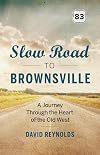
Slow Road to Brownsville: A Journey Through the Heart of the Old West by David Reynolds is a recommended nonfiction account of an Englishman's travels and personal reflections as he journeys down Highway 83.
While visiting Swan River, Manitoba, where his grandfather lived from 1905-1910, Reynold's learns that Highway 83 goes all the way across the middle of the USA to Brownsville, Texas. This planted the idea of traveling the route. He is curious what lies along Highway 83. What are the Great show more Plains and Middle American towns and cities like today? He wants to examine the history and current conditions of the Native Americans as he explores what he comes across on the highway. He also examines the history of the various cities, attractions, and areas he travels through. Reynolds grew up watching Westerns and road movies so this trip seemed like the perfect way to see the country he fantasized about as a child and compare the reality today to various other road trips that have been written about over the years.
"Whether 83 is the longest is contentious. One source says it is the fifth longest, but takes into account only the 1,894 miles within the United States. Only two other U.S. Highways still continue up into Canada (Highways 1 and 59). Neither reaches as far north as 83. Going south, once it leaves Manitoba and enters the United States, 83 travels through six states: North Dakota, South Dakota, Nebraska, Kansas, a narrow strip of Oklahoma known as the Panhandle, and Texas. From Swan River to Brownsville on 83 is 2,271 miles. "
The start of Reynold's book gave all indications that Slow Road to Brownsville was going to be a rather charming account of an Englishman exploring the sights along Highway 83, which it is to some extent, but it lost some of that charm for me when numerous people he encountered were seemingly always described by their enormous girth and as he repeatedly managed to tune into a talk radio program that espouse beliefs contrary to his own. I'm fine with accurately describing people and certainly weight is a factor, but it did grow rather tiring to consistently have weight alone as a main description. As for the rather strident talk radio host he intensely dislikes... One mention, fine, two is enough. Beyond that it became annoying for me and I just wanted to say, "It is in your power to turn to another radio station."
Setting those annoyances aside, I really appreciated the inclusion of quotes from and pertinent descriptions mentioned in the numerous road trip books written over the years whose authors explored the same areas. As is my wont, I also always appreciate the inclusion of a bibliography and maps showing his route. The discography of music is a nice touch.
Disclosure: My Kindle edition was courtesy of Greystone Books for review purposes. show less
While visiting Swan River, Manitoba, where his grandfather lived from 1905-1910, Reynold's learns that Highway 83 goes all the way across the middle of the USA to Brownsville, Texas. This planted the idea of traveling the route. He is curious what lies along Highway 83. What are the Great show more Plains and Middle American towns and cities like today? He wants to examine the history and current conditions of the Native Americans as he explores what he comes across on the highway. He also examines the history of the various cities, attractions, and areas he travels through. Reynolds grew up watching Westerns and road movies so this trip seemed like the perfect way to see the country he fantasized about as a child and compare the reality today to various other road trips that have been written about over the years.
"Whether 83 is the longest is contentious. One source says it is the fifth longest, but takes into account only the 1,894 miles within the United States. Only two other U.S. Highways still continue up into Canada (Highways 1 and 59). Neither reaches as far north as 83. Going south, once it leaves Manitoba and enters the United States, 83 travels through six states: North Dakota, South Dakota, Nebraska, Kansas, a narrow strip of Oklahoma known as the Panhandle, and Texas. From Swan River to Brownsville on 83 is 2,271 miles. "
The start of Reynold's book gave all indications that Slow Road to Brownsville was going to be a rather charming account of an Englishman exploring the sights along Highway 83, which it is to some extent, but it lost some of that charm for me when numerous people he encountered were seemingly always described by their enormous girth and as he repeatedly managed to tune into a talk radio program that espouse beliefs contrary to his own. I'm fine with accurately describing people and certainly weight is a factor, but it did grow rather tiring to consistently have weight alone as a main description. As for the rather strident talk radio host he intensely dislikes... One mention, fine, two is enough. Beyond that it became annoying for me and I just wanted to say, "It is in your power to turn to another radio station."
Setting those annoyances aside, I really appreciated the inclusion of quotes from and pertinent descriptions mentioned in the numerous road trip books written over the years whose authors explored the same areas. As is my wont, I also always appreciate the inclusion of a bibliography and maps showing his route. The discography of music is a nice touch.
Disclosure: My Kindle edition was courtesy of Greystone Books for review purposes. show less
Lists
Statistics
- Works
- 2
- Members
- 58
- Popularity
- #284,345
- Rating
- 3.0
- Reviews
- 3
- ISBNs
- 205
- Languages
- 11