
Donald MacKenzie (1) (1950–)
Author of An Engine, Not a Camera: How Financial Models Shape Markets
For other authors named Donald MacKenzie, see the disambiguation page.
Donald MacKenzie (1) has been aliased into Donald A. Mackenzie.
About the Author
Image credit: Donald MacKenzie
Works by Donald MacKenzie
Works have been aliased into Donald A. Mackenzie.
Associated Works
Works have been aliased into Donald A. Mackenzie.
The Social Construction of Technological Systems: New Directions in the Sociology and History of Technology (1987) — Contributor — 159 copies, 1 review
Tagged
Common Knowledge
- Birthdate
- 1950-05-03
- Gender
- male
Members
Reviews
Inventing Accuracy: A Historical Sociology of Nuclear Missile Guidance (Inside Technology) by Donald MacKenzie
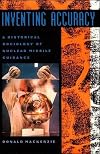
This is an exhaustive account of the development of nuclear missile guidance technology in the US and the USSR. It is mostly dry, and (unless this is your area of interest) exceedingly detailed. However, the last couple of chapters are worth plowing through the details: MacKenzie explains, with solid data, how "the social" and "the technical" are part of the same web, how facts are constructed in science; and how institutions and the people that conform them navigate through political and show more technological issues. show less

This is a book that is, while very interesting, also incredibly dry. This was not a book that I eagerly anticipated opening up, yet I made sure to stick with it because it was so informative.
I am young enough that all of my historical memory is post-Cold War (although I was born before it ended, I didn't understand what was happening until well after the fall of the Berlin Wall). This book is therefore a fascinating look into nuclear politics and technology before the Cold War ended. The show more author has a short epilogue explaining that the Cold War ended pretty much as the book went to press.
The technology pre-MEMS and pre-really good GPS is fascinating. I found the interplay between accuracy and nuclear strategy fascinating (you can't take out a missile silo if you can't guarantee that an ICBM will actually hit within a mile or so of the silo). The book also emphasizes that politics cannot be disconnected from technology (something that I wish Enrico Fermi had understood before taking the genie out of the bottle, assuming that science for its own sake would be enough of a motivation to invent the nuclear weapon to begin with).
I would not recommend this book unless you find any of these topics very interesting, as the book takes a lot of effort to get through. It is very exhaustive, which is both its strength and its weakness. show less
I am young enough that all of my historical memory is post-Cold War (although I was born before it ended, I didn't understand what was happening until well after the fall of the Berlin Wall). This book is therefore a fascinating look into nuclear politics and technology before the Cold War ended. The show more author has a short epilogue explaining that the Cold War ended pretty much as the book went to press.
The technology pre-MEMS and pre-really good GPS is fascinating. I found the interplay between accuracy and nuclear strategy fascinating (you can't take out a missile silo if you can't guarantee that an ICBM will actually hit within a mile or so of the silo). The book also emphasizes that politics cannot be disconnected from technology (something that I wish Enrico Fermi had understood before taking the genie out of the bottle, assuming that science for its own sake would be enough of a motivation to invent the nuclear weapon to begin with).
I would not recommend this book unless you find any of these topics very interesting, as the book takes a lot of effort to get through. It is very exhaustive, which is both its strength and its weakness. show less
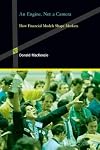
Both the science and the art and practice of finance have experienced phenomenal growth since the 1970s.
As a science, finance has evolved from a descriptive outpost on the economic frontiers to become of that discipline’s central topics. During the same period, the financial markets changed from what often seems today like sleepy outposts of liquidity into dynamic centers for financial engineering. In the 1970s, the world was being introduced to commodity hedging and options trading. By show more the early part of the 21st century, derivatives contracts totaling more than $273 trillion were outstanding worldwide.
Donald MacKenzie, a sociology professor at the University of Edinburgh, argues in An Engine, Not a Camera, the trends are connected. Paraphrasing Milton Friedman, he argues the emergence of economic models were an engine of inquiry rather than a camera to reproduce empirical facts. As the science of finance became authoritative, the markets were altered. These new, Nobel Prize-winning theories, elegant mathematical markets models, were more than external analyses. They evolved into intrinsic parts of the financial process.
Beginning with a discussion of the work of Franco Modigliani and Merton Miller, the Capital Asset Pricing Model and Random Walk, MacKenzie takes the reader on a journey through the development of the Black-Scholes-Merton model, The Crash of 1987, Long-Term Capital Management and the Russian government’s default in 1998 to bind the threads of his thesis.
Detailed, astute, well-written, and with much of the technical detail relegated to the appendices, this book weaves economics, financial theory, economic sociology and science and technology studies into an essential read for anyone with a serious interest in the financial markets.
Penned by the Pointed Pundit
December 18, 2006
10:53:30 AM show less
As a science, finance has evolved from a descriptive outpost on the economic frontiers to become of that discipline’s central topics. During the same period, the financial markets changed from what often seems today like sleepy outposts of liquidity into dynamic centers for financial engineering. In the 1970s, the world was being introduced to commodity hedging and options trading. By show more the early part of the 21st century, derivatives contracts totaling more than $273 trillion were outstanding worldwide.
Donald MacKenzie, a sociology professor at the University of Edinburgh, argues in An Engine, Not a Camera, the trends are connected. Paraphrasing Milton Friedman, he argues the emergence of economic models were an engine of inquiry rather than a camera to reproduce empirical facts. As the science of finance became authoritative, the markets were altered. These new, Nobel Prize-winning theories, elegant mathematical markets models, were more than external analyses. They evolved into intrinsic parts of the financial process.
Beginning with a discussion of the work of Franco Modigliani and Merton Miller, the Capital Asset Pricing Model and Random Walk, MacKenzie takes the reader on a journey through the development of the Black-Scholes-Merton model, The Crash of 1987, Long-Term Capital Management and the Russian government’s default in 1998 to bind the threads of his thesis.
Detailed, astute, well-written, and with much of the technical detail relegated to the appendices, this book weaves economics, financial theory, economic sociology and science and technology studies into an essential read for anyone with a serious interest in the financial markets.
Penned by the Pointed Pundit
December 18, 2006
10:53:30 AM show less
Material Markets: How Economic Agents are Constructed (Clarendon Lectures in Management Studies) by Donald MacKenzie
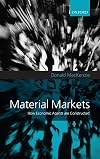
Here is a very interesting and relevant book, if you're into this kind of thing. It is well-researched and well-written, if not exactly bulging with empirical practice. That might be a somewhat unfair criticism, and the driver of the author was always to set out a framework for research, not to catalogue it.
Lists
Awards


You May Also Like
Associated Authors
Statistics
- Works
- 9
- Also by
- 1
- Members
- 528
- Popularity
- #47,120
- Rating
- 4.0
- Reviews
- 9
- ISBNs
- 146
- Languages
- 6