
Christine Shaw (1)
Author of The Italian Wars 1494-1559: War, State and Society in Early Modern Europe (Modern Wars In Perspective)
For other authors named Christine Shaw, see the disambiguation page.
About the Author
Christine Shaw is an Associate Member of the Faculty of History, University of Oxford. Among her many publications on Renaissance Italy are Popular Government and Oligarchy in Renaissance Italy (Brill, 2006), and (with Michael Mallett), The Italian Wars 1494-1559 (2012).
Works by Christine Shaw
The Italian Wars 1494-1559: War, State and Society in Early Modern Europe (Modern Wars In Perspective) (2012) 63 copies, 4 reviews
Tagged
Common Knowledge
- Gender
- female
Members
Reviews
The Italian Wars 1494-1559: War, State and Society in Early Modern Europe (Modern Wars In Perspective) by Michael Edward Mallett
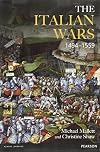
While the previous review of this book here is absolutely correct that this is more of a straight-forward narrative history of events in Italy for the time in question than the subtitle might suggest, I don't see that as a disappointment. I found it very useful to have a concise examination of how alliances and loyalties shifted over time, once Charles VIII decided that the time had come to assert what he saw as his rights in Italy, only for the ultimate end being for the French crown to show more mostly give up on seeking predominance in Italy, for the Italian city-states to be drawn into a larger international system where they were marginalized, and for the Austrian and Spanish monarchs to discover that, even if they did have predominance, they had to tread carefully when it came to Italian politics.
Actually, another thing that the authors do well is to explain how the art of war changed tactically from battles between noble men-at-arms on horseback that medieval military men would have understood to the system where infantry predominated (these were the glory days of the Swiss pikeman and German Landsknecht). show less
Actually, another thing that the authors do well is to explain how the art of war changed tactically from battles between noble men-at-arms on horseback that medieval military men would have understood to the system where infantry predominated (these were the glory days of the Swiss pikeman and German Landsknecht). show less

Mallett was originally commissioned to write this book for a series called "Modern Wars in Perspective" - when it become clear he would die before being able to finish it, Shaw was given the task to complete it. The end result is essentially a narrative history written by Shaw with a pair of thematic chapters written by Mallett inserted in the middle.
The book deals only with the Italian Wars in Italy, other theatres of the wars, which in the later part of the period were often the more show more important ones, being addressed only to the extent they impacted Italian affairs.
The narrative chapters go through 65 years' politico-military history* in considerable detail and within a relatively low pagecount (366pp total in the paperback) - accordingly, the writing is compressed and thin on analysis: you can learn a great deal of what happened, less about why it happened. Keeping all the personages and places that pass by straight takes some work. The thematic chapters are easier reading, focusing on the big picture rather than myriad details.
I wouldn't say I'm unhappy with the book, but I'm not ecstatic either. It's solid rather than brilliant.
* The ad copy at Amazon etc suggests the book concentrates on analysis of military technology and socio-economic contexts - don't believe it. There's such analysis here, but the bulk of the text is narrative history of armies marching about, kings deliberating policy, and popes machinating to make their nephews into dukes. The subtitle similarly may be considered a bit off the mark; there's not very much about "society" here. show less
The book deals only with the Italian Wars in Italy, other theatres of the wars, which in the later part of the period were often the more show more important ones, being addressed only to the extent they impacted Italian affairs.
The narrative chapters go through 65 years' politico-military history* in considerable detail and within a relatively low pagecount (366pp total in the paperback) - accordingly, the writing is compressed and thin on analysis: you can learn a great deal of what happened, less about why it happened. Keeping all the personages and places that pass by straight takes some work. The thematic chapters are easier reading, focusing on the big picture rather than myriad details.
I wouldn't say I'm unhappy with the book, but I'm not ecstatic either. It's solid rather than brilliant.
* The ad copy at Amazon etc suggests the book concentrates on analysis of military technology and socio-economic contexts - don't believe it. There's such analysis here, but the bulk of the text is narrative history of armies marching about, kings deliberating policy, and popes machinating to make their nephews into dukes. The subtitle similarly may be considered a bit off the mark; there's not very much about "society" here. show less
The Italian Wars 1494-1559: War, State and Society in Early Modern Europe (Modern Wars In Perspective) by Michael Edward Mallett
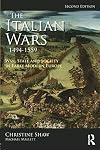
Informative but the writing is very dry. Also, since there were many historical personalities and places involved, having more maps and a list of historical personalities complete with short summaries of who they were, would have been very useful.
The Italian Wars 1494-1559: War, State and Society in Early Modern Europe (Modern Wars In Perspective) by Michael Edward Mallett
Dit boek van Mallett en Shaw brengt een erg gedetailleerd overzicht van de Italiaanse oorlogen met veel aandacht voor de militaire gebeurtenissen, ontwikkelingen in oorlogsvoering en evoluties in de opbouw van legermachten, maar ook (zij het in mindere mate) oog voor de economische en staatkundige gevolgen ervan. Hun teksten staan geregeld bol van details over aantallen voetsoldaten, ruiters, dragers van vuurwapens en kanonnen, en dat maakt het boek een bij momenten taaie en soms saaie brok. show more Het feit dat zij legeraanvoerders en andere personages nu eens aanduiden met hun familienaam, dan weer met hun titel en dan weer enkel met hun voornaam maakt het houden van enig overzicht niet echt makkelijk. Het boek kon ook best wat meer en duidelijker kaarten gebruiken. Als lezer raak je vlug verstrikt in de opeenvolgende gebeurtenissen waarbij een chronologie soms wat wazig wordt en het even niet meer duidelijk is in welk jaartal we zitten. En het feit dat bondgenootschappen ook veelvuldig wijzigden, dat wie vandaag nog vrienden waren daags nadien vijanden bleken, illustreert enkel de chaos die doorheen deze jaren uitwaaierde. Dorpen en steden wisselden meermaals van bezetter. Zo wordt er een kroniekschrijver uit deze jaren geciteerd die berekende dat de stad Vicenza tussen 1509 en 1517 in het totaal 36 keer van regime veranderde.
Het oog voor details door de auteurs gaat dus geregeld ten koste aan een helder overzicht. Daarbij kunnen enkele YouTube filmpjes dan weer erg helpend zijn. Maar ondanks mijn kritische noten ben ik blij dit boek te hebben gelezen al was het maar omdat hij mij ervan behoedde om in simplistische termen te kijken naar de Italiaanse Oorlogen, zijn voornaamste exponenten en de impact ervan op de verdere geschiedenis van Italië en bij uitbreiding Europa. show less
Het oog voor details door de auteurs gaat dus geregeld ten koste aan een helder overzicht. Daarbij kunnen enkele YouTube filmpjes dan weer erg helpend zijn. Maar ondanks mijn kritische noten ben ik blij dit boek te hebben gelezen al was het maar omdat hij mij ervan behoedde om in simplistische termen te kijken naar de Italiaanse Oorlogen, zijn voornaamste exponenten en de impact ervan op de verdere geschiedenis van Italië en bij uitbreiding Europa. show less
Lists
Statistics
- Works
- 9
- Members
- 139
- Popularity
- #147,350
- Rating
- 3.8
- Reviews
- 4
- ISBNs
- 46
- Languages
- 2
- Favorited
- 1