

Shirley Williams (1) (1930–2021)
Author of Climbing the Bookshelves
For other authors named Shirley Williams, see the disambiguation page.
About the Author
Image credit: Shirley Williams (1930-2021).
Works by Shirley Williams
Associated Works
The Home Front: A Mirror to Life in England During the First World War (1987) — Foreword, some editions — 19 copies, 1 review
Tagged
Common Knowledge
- Other names
- Catlin, Shirley Vivian Teresa Brittain (birth name)
- Birthdate
- 1930-07-27
- Date of death
- 2021-04-12
- Gender
- female
- Education
- Talbot Heath School
University of Oxford (Somerville College)
Columbia University
St Paul's Girls' School, London - Occupations
- journalist
politician - Organizations
- House of Commons
House of Lords
Labour Party
Social Democratic Party
Liberal Democrats
Harvard University, Kennedy School of Government (show all 13)
Comite des Sages
Ditchley Foundation
Institute for Public Policy Research
Council on Foreign Relations
Chatham House
Twentieth Century Fund
Nuclear Threat Initiative - Awards and honors
- Life Peerage
Privy Councilor - Relationships
- Williams, Bernard (husband|1955|divorced|1974)
Neustadt, Richard E. (second husband|1987|his death|2003)
Brittain, Vera (mother)
Catlin, John (brother) - Short biography
- Five boxes of Shirley Williams's archive were donated to the British Library in 2023.
- Nationality
- UK
- Birthplace
- London, England, UK
- Places of residence
- Minnesota, USA
London, England, UK
New York, New York, USA
Members
Reviews
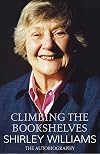
Now in her 80s, a British politician looks back over her long political career.
Shirley Williams is perhaps most famous for being one of the Gang of Four, a group of MPs who broke away from the Labour Party in 1981 to found the Social Democratic Party (SDP). They were dismayed that what they saw as a hard left was wrecking the party. The SDP later merged with the Liberal Party to form the Liberal Democratic Party, so this provides some history of the junior partner in our new government show more coalition.
My own political sympathies are with that hard left, but I was drawn to reading this book for a number of reasons. Williams' mother was Vera Brittain, a writer and socialist and feminist political activist best known for her memoir of the First World War, Testament of Youth, and I was interested in reading more about the family. I heard some of this serialised on the radio when it first came out last year. I liked the title - Williams' father allowed her to climb up his shelves as a child - and I think she uses it to convey her enthusiasm and willingness to take on a challenge, rather than being a fanatical bookworm, but it's still a great title for a book.
Shirley Williams was brought up in a political atmosphere and was active from student days at Oxford onwards. She worked as a journalist for a while but entered Parliament quite early, when there were far fewer female MPs than now. There are lots of references to her conversations with other female MPs from all parties - one significant contemporary was Margaret Thatcher, Conservative Prime Minister from 1979 to 1991. There are some amusing anecdotes such about cross party collaboration to take action against sexual harassment.
I don't really agree with her views about the 1970s, trade unions and so on, but I found it really useful to read this account of how her political thinking developed and was influenced. She is interestingly candid about her views of other members of the SDP, not always flattering. There are some quite critical remarks about the late Roy Jenkins and about David Owen, although a young Charles Kennedy is praised for his perceptiveness and charm.
The hardback book includes 3 sets of photographic plates, comprising 24 pages and over 40 photos in all, including politicians, friends, her two husbands (her first marriage ended in divorce, the second with his death) and family of all generations.
Williams is thought to be one of the Liberal Democrats who is uneasy about the new coalition, and I will be interested to see if there is any update in the paperback edition of this book this autumn. show less
Shirley Williams is perhaps most famous for being one of the Gang of Four, a group of MPs who broke away from the Labour Party in 1981 to found the Social Democratic Party (SDP). They were dismayed that what they saw as a hard left was wrecking the party. The SDP later merged with the Liberal Party to form the Liberal Democratic Party, so this provides some history of the junior partner in our new government show more coalition.
My own political sympathies are with that hard left, but I was drawn to reading this book for a number of reasons. Williams' mother was Vera Brittain, a writer and socialist and feminist political activist best known for her memoir of the First World War, Testament of Youth, and I was interested in reading more about the family. I heard some of this serialised on the radio when it first came out last year. I liked the title - Williams' father allowed her to climb up his shelves as a child - and I think she uses it to convey her enthusiasm and willingness to take on a challenge, rather than being a fanatical bookworm, but it's still a great title for a book.
Shirley Williams was brought up in a political atmosphere and was active from student days at Oxford onwards. She worked as a journalist for a while but entered Parliament quite early, when there were far fewer female MPs than now. There are lots of references to her conversations with other female MPs from all parties - one significant contemporary was Margaret Thatcher, Conservative Prime Minister from 1979 to 1991. There are some amusing anecdotes such about cross party collaboration to take action against sexual harassment.
I don't really agree with her views about the 1970s, trade unions and so on, but I found it really useful to read this account of how her political thinking developed and was influenced. She is interestingly candid about her views of other members of the SDP, not always flattering. There are some quite critical remarks about the late Roy Jenkins and about David Owen, although a young Charles Kennedy is praised for his perceptiveness and charm.
The hardback book includes 3 sets of photographic plates, comprising 24 pages and over 40 photos in all, including politicians, friends, her two husbands (her first marriage ended in divorce, the second with his death) and family of all generations.
Williams is thought to be one of the Liberal Democrats who is uneasy about the new coalition, and I will be interested to see if there is any update in the paperback edition of this book this autumn. show less
I like Shirley Williams, always have done. My first sojourn into party politics was with the SDP but, I am afraid that I broke away when the party merged with the Liberal Party.
Shirley touches upon an important aspect of her career, quite near to the end of this book: she was, I always felt, better than the roles that she took on: challenging for the deputy leadership of the party, not the leadership.
In many ways, the political careers of the 'gang of four', the Labour politicians who broke show more away to form the SDP could be considered wasted; they all had much more than we saw but, without their sacrifice, it is highly unlikely that the Labour Party would have seen common sense. Without Williams, Owen, Jenkins and Rogers we would, almost certainly not have had Blair.
This book, rightly, concentrates upon Shirley Williams political exploits, but does cover her 'ordinary life' too. Unquestionably, the most significant aspects of this work are her insights into the politicians with whom she served. She is not vindictive and, unlike certain political memoirs, there is no sense of 'wrongs righted'. This book has added to my knowledge of Harold Wilson, David Owen, and Tony Blair, to name but a few.
Thank you Shirley Williams for your sacrifice and for this book which has enough good sense and insight to hide any lack of literary genius. show less
Shirley touches upon an important aspect of her career, quite near to the end of this book: she was, I always felt, better than the roles that she took on: challenging for the deputy leadership of the party, not the leadership.
In many ways, the political careers of the 'gang of four', the Labour politicians who broke show more away to form the SDP could be considered wasted; they all had much more than we saw but, without their sacrifice, it is highly unlikely that the Labour Party would have seen common sense. Without Williams, Owen, Jenkins and Rogers we would, almost certainly not have had Blair.
This book, rightly, concentrates upon Shirley Williams political exploits, but does cover her 'ordinary life' too. Unquestionably, the most significant aspects of this work are her insights into the politicians with whom she served. She is not vindictive and, unlike certain political memoirs, there is no sense of 'wrongs righted'. This book has added to my knowledge of Harold Wilson, David Owen, and Tony Blair, to name but a few.
Thank you Shirley Williams for your sacrifice and for this book which has enough good sense and insight to hide any lack of literary genius. show less
You May Also Like
Associated Authors
Statistics
- Works
- 9
- Also by
- 3
- Members
- 149
- Popularity
- #139,412
- Rating
- 4.1
- Reviews
- 2
- ISBNs
- 28
- Languages
- 1
- Favorited
- 1
