
Erskine Childers (1) (1870–1922)
Author of The Riddle of the Sands
For other authors named Erskine Childers, see the disambiguation page.
Works by Erskine Childers
Associated Works
Tagged
Common Knowledge
- Legal name
- Childers, Robert Erskine
- Birthdate
- 1870-06-25
- Date of death
- 1922-11-24
- Gender
- male
- Education
- University of Cambridge (Trinity College)
Haileybury and Imperial Service College - Occupations
- editor
politician
soldier - Organizations
- British Army (Boer War)
Royal Navy (WWI)
T.D. for Kildare-Wicklow (1921) - Awards and honors
- Distinguished Service Cross
- Relationships
- Childers, Erskine B. (grandson)
Figgis, Darrell (Co-conspirator)
Childers, Erskine C. (great-grandson) - Cause of death
- execution
- Nationality
- UK
Ireland - Birthplace
- Mayfair, St George Hanover Square, Middlesex, England, UK
- Places of residence
- London, England, UK
Dublin, Ireland - Place of death
- Dublin, Ireland
- Burial location
- Glasnevin Cemetery, Dublin, Ireland
- Associated Place (for map)
- Dublin, Ireland
Members
Reviews
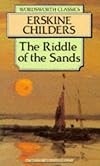
"Germany's a thundering great nation....I wonder if we shall ever fight her."
Erskine Childers’s novel was first published in 1903 and was set against the Anglo-German Great Naval Race, it has been widely regarded as the first modern spy story. It opens during the first week of September, presumably a year or two before 1903, with Carruthers working for the Foreign Office. He’s been stuck all summer in London whilst his friends have gone off to the country on their holidays and is feeling show more somewhat left out. He is unsure where to go for his own holiday when he unexpectedly receives a letter from a former university acquaintance, Davies, who invites him to go sailing around the Baltic. After some dithering, he decides to go.
Carruthers has done some sailing previously and arrives expecting a pleasure cruise on a crewed yacht and so has naturally brought along proper yachting clothes. What he discovers is a cramped thirty-foot flat-bottomed boat, the Dulcibella. Davies admits that he can actually sail her alone, though finds life more pleasant with a companion.
Childers initially pokes fun at Carruthers’s early days aboard the Dulcibella but gradually as his seamanship improves so the reader is introduced to the intricacies of sailing a small vessel in tidal estuaries, amid shifting sand bars.By modern standards "The Riddle of the Sands" develops very slowly. The first third in fact seems to be mainly an account of in-shore sailing, with an odd storm to spice things up but through shared experiences the two young men's friendship grows.
One day, when they are confined to port due of fog, they are visited by a German barge captain who casually recounts how he saved Davies's life during a gale when the Dulcibella had run aground.Davies finally opens up about this incident to Carruthers and reveals that he got in to this perilous position whilst being guided by a more powerful yacht captained by an Englishman masquerading as a German. Davies believes that this was deliberate attempt on his life but why? As the two young men try to find out, so the action quickens.
As I stated at the beginning of this review this book was written against the backdrop of great a naval build up by both Britain and Germany so this book cannot be seen simply as a spy story. In fact despite its almost instant popularity this was the only novel that Childers ever wrote, instead he spent his career writing naval manuals. What Childers wanted to do was to bring the book’s warning message to a far wider audience, he believed that the British Government was either ignoring or reacting far too slowly to the threat of invasion that Germany posed. As Carruthers ominously says: “She grows, and strengthens, and waits.”
In this regard, "The Riddle of the Sands" may be viewed as an example of contemporary novels that imagined a great war in the near future. It is almost disconcerting, then, that Davies frequently expresses his admiration for the Germans as a people and even praises the kaiser. Yet despite this by the end, both he and Carruthers will risk their lives to alert the Admiralty to a realistic threat.
As I stated earlier this is a slow burner by modern standards but has many of the ingredients found in modern spy stories, a daring journey by night, having to decipher a few enigmatic clues, unmask a traitor and rescue a beautiful young woman all whilst trying to shake off enemy agents, all written at a time when hardened professionals are no match for plucky amateurs. Even today this book still has an immense influence on the genre and for that reason alone deserves to be read. show less
Erskine Childers’s novel was first published in 1903 and was set against the Anglo-German Great Naval Race, it has been widely regarded as the first modern spy story. It opens during the first week of September, presumably a year or two before 1903, with Carruthers working for the Foreign Office. He’s been stuck all summer in London whilst his friends have gone off to the country on their holidays and is feeling show more somewhat left out. He is unsure where to go for his own holiday when he unexpectedly receives a letter from a former university acquaintance, Davies, who invites him to go sailing around the Baltic. After some dithering, he decides to go.
Carruthers has done some sailing previously and arrives expecting a pleasure cruise on a crewed yacht and so has naturally brought along proper yachting clothes. What he discovers is a cramped thirty-foot flat-bottomed boat, the Dulcibella. Davies admits that he can actually sail her alone, though finds life more pleasant with a companion.
Childers initially pokes fun at Carruthers’s early days aboard the Dulcibella but gradually as his seamanship improves so the reader is introduced to the intricacies of sailing a small vessel in tidal estuaries, amid shifting sand bars.By modern standards "The Riddle of the Sands" develops very slowly. The first third in fact seems to be mainly an account of in-shore sailing, with an odd storm to spice things up but through shared experiences the two young men's friendship grows.
One day, when they are confined to port due of fog, they are visited by a German barge captain who casually recounts how he saved Davies's life during a gale when the Dulcibella had run aground.Davies finally opens up about this incident to Carruthers and reveals that he got in to this perilous position whilst being guided by a more powerful yacht captained by an Englishman masquerading as a German. Davies believes that this was deliberate attempt on his life but why? As the two young men try to find out, so the action quickens.
As I stated at the beginning of this review this book was written against the backdrop of great a naval build up by both Britain and Germany so this book cannot be seen simply as a spy story. In fact despite its almost instant popularity this was the only novel that Childers ever wrote, instead he spent his career writing naval manuals. What Childers wanted to do was to bring the book’s warning message to a far wider audience, he believed that the British Government was either ignoring or reacting far too slowly to the threat of invasion that Germany posed. As Carruthers ominously says: “She grows, and strengthens, and waits.”
In this regard, "The Riddle of the Sands" may be viewed as an example of contemporary novels that imagined a great war in the near future. It is almost disconcerting, then, that Davies frequently expresses his admiration for the Germans as a people and even praises the kaiser. Yet despite this by the end, both he and Carruthers will risk their lives to alert the Admiralty to a realistic threat.
As I stated earlier this is a slow burner by modern standards but has many of the ingredients found in modern spy stories, a daring journey by night, having to decipher a few enigmatic clues, unmask a traitor and rescue a beautiful young woman all whilst trying to shake off enemy agents, all written at a time when hardened professionals are no match for plucky amateurs. Even today this book still has an immense influence on the genre and for that reason alone deserves to be read. show less

I'm always surprised that I like this book as I'm not at all interested in boats, sailing or espionage, but I do enjoy a good Ripping Yarn from time to time and the reading, by Anton Lesser, is excellent. It is of its time - early 20th century - and class, but, if you can set that aside, it's an enjoyable read.
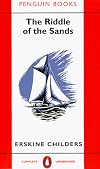
This book, Childers’s only novel, is said to be the model for all later thrillers from Eric Ambler to John Le Carre. Davies, an oddball friend from university, invites Carruthers to join him cruising on a yacht with perhaps a little duck hunting. The first portion of the book is dedicated to that cruise in language that reeks of upper-crust England. The reader begins to wonder exactly where the story is going when Davies explains that he is searching for someone who nearly killed him and show more whom he believes is a traitor. Thus begins a cat-and-mouse game packed to the gills with nautical minutiae and terms (many of which were incomprehensible to me). It is a tribute to Childers’s abilities that I kept reading, despite the frequency with which the detailed nautical words and sentences appeared. The story itself, published in 1903, imagines a possible German invasion of England by sea and some of the writing dealing with contemporary politics and contemplating this is fascinating. (Fascinating postscript: Childers, born an Englishman, became involved in Irish politics before and during World War One, eventually using his yacht to bring arms and ammunition to the Irish, arms later later used in the Easter Rising in 1916. He was caught and executed by a firing squad. Said Winston Churchill: "No man has done more harm or done more genuine malice or endeavoured to bring a greater curse upon the common people of Ireland than this strange being, actuated by a deadly and malignant hatred for the land of his birth." In 1973 Erskine Hamilton Childers Jr. was elected the fourth president of Ireland.) show less
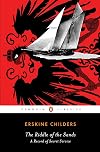
I read this book while travelling to the Eaton Collection to read science fiction from 1890-1910 during with future war/revolution. This turned out to be something of a coincidence, as The Riddle of the Sands is pretty much a member of the same genre-- except that it's not science fiction. It's about a planned German invasion of Britain, but the invasion is thwarted during the trial stages, meaning there's no counterfactual or future history proposed. Yet the book is clearly responding to show more the same concerns that drive contemporary science fiction novels like The Three Days' Terror and The Stolen Submarine: Britain's supremacy is under threat, but Your Humble Author knows how to rectify that, both in reality (some policy changes) and in fiction (plucky amateurism, which is the supreme skill of the fin-de-siècle Englishman).
If ever you wanted to know how difficult yachting in sandy waters was, this is the book for you. I mean that both facetiously and seriously: I never even thought about it before, but Childers really makes you the reader feel as though you're lost in an unnavigable fog. Hard going sometimes, but fun, and worth it. (The film adaptation is decent, too, though I think my wife mostly liked it for Michael York in tight trousers.) show less
If ever you wanted to know how difficult yachting in sandy waters was, this is the book for you. I mean that both facetiously and seriously: I never even thought about it before, but Childers really makes you the reader feel as though you're lost in an unnavigable fog. Hard going sometimes, but fun, and worth it. (The film adaptation is decent, too, though I think my wife mostly liked it for Michael York in tight trousers.) show less
Lists
Read in 2013 (1)
Folio Society (1)
My TBR (1)
Backlisted (1)
Best Beach Reads (1)
Best Spy Fiction (1)
Out of Copyright (1)
Favourite Books (1)
Best Sea Stories (1)
Awards


You May Also Like


Associated Authors
Statistics
- Works
- 10
- Also by
- 6
- Members
- 2,935
- Popularity
- #8,727
- Rating
- 3.6
- Reviews
- 74
- ISBNs
- 253
- Languages
- 10
- Favorited
- 4
