
Gerald Hammond (1) (1926–2015)
Author of Dog in the Dark
For other authors named Gerald Hammond, see the disambiguation page.
About the Author
Gerald Hammond was born in 1926. He was an architect for thirty years before retiring in 1982. He has written over thirty mystery novels and is the creator of John Cunningham, dog breeder in Scotland, and Keith Calder, gunsmith. He also writes under the pseudonyms Arthur Douglas and Dalby Holden. show more (Bowker Author Biography) show less
Series
Works by Gerald Hammond
Associated Works
Tagged
Common Knowledge
- Legal name
- Hammond, Gerald Arthur Douglas
- Other names
- Douglas, Arthur (pseudonym)
Holden, Dalby (pseudonym) - Birthdate
- 1926-03-07
- Date of death
- 2015
- Gender
- male
- Occupations
- architect
writer - Nationality
- Scotland
- Birthplace
- Scotland, UK
- Places of residence
- Scotland, UK
- Associated Place (for map)
- Scotland, UK
Members
Reviews

This second book in the Three Oaks series is enjoyable, but I liked the previous book more. Although published in 1991, it still has a different time and place feeling to it as it is set in the UK. The summary gives more away than I like to talk about of the details in the book. John Cunningham and his new wife are on a wildfowling expedition, which sounds so much cooler than a duck hunt.
‘Not much of a return for getting out of bed before the crack of dawn, driving umpteen miles, show more staggering more miles through a howling gale in the dark and then squishing around in the freezing mud.’
‘Good for the complexion,’ I said, ‘Keep telling yourself that it’s fun, fun, fun.’
They find a dead body:
Ten yards upstream of us, the body of a man was grounded face-down at the edge of the mud. Not much more showed than a hump of shoulder and the line of a leg but there was no doubting what it was. Below the water, lank hair of indeterminate colour floated as if raised in fear and the wavelets caused his hips to rise and fall in an obscene parody of the sexual act.
A Springer Spaniel is found and is associated with the dead man which starts the line of clues and actions to carry the story along. They could identify the dog because of Isobel who works for them. “She could forget a face, an appointment or a good resolution but her memory for dogs was always phenomenal.”
The reason for the dog’s importance was a little obvious to me. I guess if I had followed that logic better maybe I would have figured out more, but I am not that good at solving mysteries. It also seemed to me that rather than leaving enough clues along the way, they had to give out a lot of info later in the book to introduce pieces to fit together. I leave it for more experienced mystery reviewers to confirm or deny the books true rating from a mystery standpoint, but from mine it made for a weaker mystery and one reason for me to rate the book slightly lower.
The book is a little rough and tumble, with a stabbing and some shooting, but I guess death is to be expected in a murder mystery. I did chuckle at a statement relating to women and Texan’s:
‘‘The gun then,’ I said. She was a woman but she was Texan. She would know about shotguns. ‘You must have given that more than a glance. You had it in your hands for most of the day.’
I also found interesting were references in the book to the expense of long-distance phone bills like this one; ‘But the proprietor’s wife was a very garrulous lady and our last phone-bill had been almost indistinguishable from the national debt.’ I remember when long distance was expensive, then when cellphone minutes were very expensive, and now have just settled into a monthly expense most of us bear.
I didn’t seem to find any great passages or quotes that would stand up well outside of the confines of the book to add to my person list of favorite quotes but I will provide a few more to get a feel for the flavor of the book.
‘They don’t shoot ground game in his neck of the woods and the last thing he wanted was a dog which would take off after a gopher or a squirrel. And he said that bum-punching quail over pointers was no more interesting than shooting clays down-the-line – the same going-away bird every time.’
The Sergeant changed his ground. ‘Would you jalouse,’ he said, ‘that your caller was after that particular dog? The wee bitch that belonged to the dead man?’
‘You read too many of those detective stories,’ said the woman who I thought wasn’t his wife.
So, in summary, love Gerald Hammond’s books, but need to give it 4 stars to distinguish it from others. I am trying to read just book 1 of all the mystery + dog series, of which I have identified 52 series so far but only read about 20, but like his books so much I skipped ahead to his book 2 and will probably read his book 3 soon as well. Love to hear others’ opinions on his books, on what mystery + dog book series are ‘the best’ and if all Texan’s, including the women, know about shotguns. show less
‘Not much of a return for getting out of bed before the crack of dawn, driving umpteen miles, show more staggering more miles through a howling gale in the dark and then squishing around in the freezing mud.’
‘Good for the complexion,’ I said, ‘Keep telling yourself that it’s fun, fun, fun.’
They find a dead body:
Ten yards upstream of us, the body of a man was grounded face-down at the edge of the mud. Not much more showed than a hump of shoulder and the line of a leg but there was no doubting what it was. Below the water, lank hair of indeterminate colour floated as if raised in fear and the wavelets caused his hips to rise and fall in an obscene parody of the sexual act.
A Springer Spaniel is found and is associated with the dead man which starts the line of clues and actions to carry the story along. They could identify the dog because of Isobel who works for them. “She could forget a face, an appointment or a good resolution but her memory for dogs was always phenomenal.”
The reason for the dog’s importance was a little obvious to me. I guess if I had followed that logic better maybe I would have figured out more, but I am not that good at solving mysteries. It also seemed to me that rather than leaving enough clues along the way, they had to give out a lot of info later in the book to introduce pieces to fit together. I leave it for more experienced mystery reviewers to confirm or deny the books true rating from a mystery standpoint, but from mine it made for a weaker mystery and one reason for me to rate the book slightly lower.
The book is a little rough and tumble, with a stabbing and some shooting, but I guess death is to be expected in a murder mystery. I did chuckle at a statement relating to women and Texan’s:
‘‘The gun then,’ I said. She was a woman but she was Texan. She would know about shotguns. ‘You must have given that more than a glance. You had it in your hands for most of the day.’
I also found interesting were references in the book to the expense of long-distance phone bills like this one; ‘But the proprietor’s wife was a very garrulous lady and our last phone-bill had been almost indistinguishable from the national debt.’ I remember when long distance was expensive, then when cellphone minutes were very expensive, and now have just settled into a monthly expense most of us bear.
I didn’t seem to find any great passages or quotes that would stand up well outside of the confines of the book to add to my person list of favorite quotes but I will provide a few more to get a feel for the flavor of the book.
‘They don’t shoot ground game in his neck of the woods and the last thing he wanted was a dog which would take off after a gopher or a squirrel. And he said that bum-punching quail over pointers was no more interesting than shooting clays down-the-line – the same going-away bird every time.’
The Sergeant changed his ground. ‘Would you jalouse,’ he said, ‘that your caller was after that particular dog? The wee bitch that belonged to the dead man?’
‘You read too many of those detective stories,’ said the woman who I thought wasn’t his wife.
So, in summary, love Gerald Hammond’s books, but need to give it 4 stars to distinguish it from others. I am trying to read just book 1 of all the mystery + dog series, of which I have identified 52 series so far but only read about 20, but like his books so much I skipped ahead to his book 2 and will probably read his book 3 soon as well. Love to hear others’ opinions on his books, on what mystery + dog book series are ‘the best’ and if all Texan’s, including the women, know about shotguns. show less
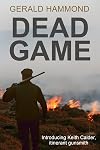
Great characters, great story, and you learn a bit about guns and dogs and poaching ...
I first read this series when it was originally published and I’m delighted to find the books are just as enjoyable decades later. There is no sense of the stories being dated, perhaps because they focus on country pursuits where you are not conscious that there are no computers, no mobile phones... The important thing is that the characters are fully developed real people that you care about.
The lead show more character is Keith Calder, itinerant gunsmith and shooting instructor. He is a bit of a lad, is Keith. Never mind a girl in every port - he has one in every town. And while he has to keep on the windy side of the law, he’s not above the odd bit of poaching, not to mention other dubious pursuits.
Keith is one of a shooting party which ends in tragedy when a man dies. He is called in to help the defence when a local man is charged with murder. This proves to be a bit tricky as the accused and he are at daggers drawn, and Keith has a few secrets of his own to keep.
A very satisfying read. show less
I first read this series when it was originally published and I’m delighted to find the books are just as enjoyable decades later. There is no sense of the stories being dated, perhaps because they focus on country pursuits where you are not conscious that there are no computers, no mobile phones... The important thing is that the characters are fully developed real people that you care about.
The lead show more character is Keith Calder, itinerant gunsmith and shooting instructor. He is a bit of a lad, is Keith. Never mind a girl in every port - he has one in every town. And while he has to keep on the windy side of the law, he’s not above the odd bit of poaching, not to mention other dubious pursuits.
Keith is one of a shooting party which ends in tragedy when a man dies. He is called in to help the defence when a local man is charged with murder. This proves to be a bit tricky as the accused and he are at daggers drawn, and Keith has a few secrets of his own to keep.
A very satisfying read. show less

I looked at reviews from others out there and several seem to be better summaries of the good and of things that are peeves of some people. I will write about what I liked in the book.
The writer is Scottish and setting is in the UK and the book was published in 1989 so it has a nice ‘different’ feel to me. Some attitudes or references of women probably are not PC by today’s standards. There is a dash of adultery in the book and the way the husband reacted I thought had a 1970’s feel show more to it. The main character in the book breeds and trains hunting dogs, and hunting can be a trigger for some people nowadays. I liked the specifics of the mystery but agree with others the ending felt a bit rushed. Now that I have those details out of the way, I can talk about aspects of the book that I would like to talk about.
In the author’s note before the book starts, G.H. writes ‘My own fancy is for Labradors, but Labs are too predictable for such a story as this.’ So he turns it over to spaniels. Then in the book, there is some fun sparring between a Lab breeder and the main character of the book, John Cunningham, a Falklands war veteran, who chooses to open a breeding and training kennel for Springer Spaniels. (I seriously thought of getting a Springer but glad my wife steered me to a cockapoo.) I have enjoyed sparring over the merits of other hunting breeds in other books, most recently between setters and pointers, and the argument often is good fun to me. Here is a couple of excerpts from this book:
Joe showed me his neat kennels and his complement of Labradors, and I met Mr and Mrs Fettle, the elderly couple who looked after the daily management. Joe seemed to have plenty of time to spare. ‘But,’ he said with a sideways glance, ‘you can fully train a Labrador while a spaniel’s still scratching itself.’ He was waiting for me to point out that the Labrador, being a retriever and therefore expected to do no more than wait beside his master until there was quarry to be fetched, had little to learn beyond what a puppy did naturally, while a spaniel had to hunt without chasing, distinguish wounded game from that which was sitting tight and resist the constant temptation to chase. There was even a vestige of truth in what he said. Because of their eagerness and sheer joie de vivre, spaniels can be hard work.
And in another passage, there is:
Joe said. ‘He could certainly do the training if you could look after the rest. It’s my experience that you can teach a puppy the rudiments of retrieving without getting out of your armchair.’
‘Training a spaniel to quest without chasing takes a little more application,’ Mrs Kitts said severely. ‘You’re a lazy devil, Joe. I think that that’s why you stick to Labradors.’
Joe laughed and nearly choked on his food. ‘Anybody who chooses to work with spaniels,’ he said, wiping his eyes, ‘would make love standing up in a hammock, just to make life difficult.’
And another from someone who has had to much to drink:
For a moment his voice stilled the hubbub in the room. Dogs can arouse grander passions then love. ‘A retriever’s s’posed to retrieve what’s shot yes? ‘Sall right for you. Spaniels only have to rampage around the bushes, scaring out anything that’s stupid enough to pay attention to them. They can’t retrieve worth a damn anyway.’
The idea of having a kennel on a good sized property is appealing so it is fun to feel a part of that. I don’t like the thought of leaving dogs alone in kennels though and I know it would be a ton of work as this excerpt refers to:
‘There’s no such word as “finish” in the vocabulary of a working kennel,’ I said. ‘By then, it’ll be feeding time. It’s always feeding time or cleaning-out time or walking time.’
‘Or singing them to sleep time?’
‘Now you’re getting it.’ I said.
I also enjoyed the scuffling in the book over the topic of working dogs and show dogs with the attitude of the main character (and probably the author) reflected in this part:
'As I told the Sergeant, I never sold my pups to non-shooting homes. It would have been like selling a favourite daughter into a harem. A dog is happiest doing what it is bred for, and very few breeds were intended to be pets.'
In the book there is talk about guns and adaptors forced on them because of the strict gun laws in the UK. I learned there is a rifled adaptor tube you can put into a shotgun to fire two-two rifle cartridges or blanks out of it.
As far as the mystery goes, I almost never figure them out on my own. This one seemed plausible when things are explained to me in the end. I would be interested if the ‘true’ mystery book fans are able to figure it out before told in the end. I know that some of those ‘true’ mystery book fans would find too much space is taken up in this book about kennels and training, but as I am a ‘mystery + dog’ book fan, I loved all those type of details.
I would really like to read more in this series, but my first goal is to eventually read book 1 of all the ‘mystery + dog’ series. So far, I have only read book 1 of about 12 of the 44 ‘mystery + dog’ book series I have identified. In my quest to find the ‘best’ dog books, I am still on the hunt for the best ‘mystery + dog’ books and would love to hear from others on their vote in this category.
To finish up this review I would say I enjoyed the book and would recommend it. show less
The writer is Scottish and setting is in the UK and the book was published in 1989 so it has a nice ‘different’ feel to me. Some attitudes or references of women probably are not PC by today’s standards. There is a dash of adultery in the book and the way the husband reacted I thought had a 1970’s feel show more to it. The main character in the book breeds and trains hunting dogs, and hunting can be a trigger for some people nowadays. I liked the specifics of the mystery but agree with others the ending felt a bit rushed. Now that I have those details out of the way, I can talk about aspects of the book that I would like to talk about.
In the author’s note before the book starts, G.H. writes ‘My own fancy is for Labradors, but Labs are too predictable for such a story as this.’ So he turns it over to spaniels. Then in the book, there is some fun sparring between a Lab breeder and the main character of the book, John Cunningham, a Falklands war veteran, who chooses to open a breeding and training kennel for Springer Spaniels. (I seriously thought of getting a Springer but glad my wife steered me to a cockapoo.) I have enjoyed sparring over the merits of other hunting breeds in other books, most recently between setters and pointers, and the argument often is good fun to me. Here is a couple of excerpts from this book:
Joe showed me his neat kennels and his complement of Labradors, and I met Mr and Mrs Fettle, the elderly couple who looked after the daily management. Joe seemed to have plenty of time to spare. ‘But,’ he said with a sideways glance, ‘you can fully train a Labrador while a spaniel’s still scratching itself.’ He was waiting for me to point out that the Labrador, being a retriever and therefore expected to do no more than wait beside his master until there was quarry to be fetched, had little to learn beyond what a puppy did naturally, while a spaniel had to hunt without chasing, distinguish wounded game from that which was sitting tight and resist the constant temptation to chase. There was even a vestige of truth in what he said. Because of their eagerness and sheer joie de vivre, spaniels can be hard work.
And in another passage, there is:
Joe said. ‘He could certainly do the training if you could look after the rest. It’s my experience that you can teach a puppy the rudiments of retrieving without getting out of your armchair.’
‘Training a spaniel to quest without chasing takes a little more application,’ Mrs Kitts said severely. ‘You’re a lazy devil, Joe. I think that that’s why you stick to Labradors.’
Joe laughed and nearly choked on his food. ‘Anybody who chooses to work with spaniels,’ he said, wiping his eyes, ‘would make love standing up in a hammock, just to make life difficult.’
And another from someone who has had to much to drink:
For a moment his voice stilled the hubbub in the room. Dogs can arouse grander passions then love. ‘A retriever’s s’posed to retrieve what’s shot yes? ‘Sall right for you. Spaniels only have to rampage around the bushes, scaring out anything that’s stupid enough to pay attention to them. They can’t retrieve worth a damn anyway.’
The idea of having a kennel on a good sized property is appealing so it is fun to feel a part of that. I don’t like the thought of leaving dogs alone in kennels though and I know it would be a ton of work as this excerpt refers to:
‘There’s no such word as “finish” in the vocabulary of a working kennel,’ I said. ‘By then, it’ll be feeding time. It’s always feeding time or cleaning-out time or walking time.’
‘Or singing them to sleep time?’
‘Now you’re getting it.’ I said.
I also enjoyed the scuffling in the book over the topic of working dogs and show dogs with the attitude of the main character (and probably the author) reflected in this part:
'As I told the Sergeant, I never sold my pups to non-shooting homes. It would have been like selling a favourite daughter into a harem. A dog is happiest doing what it is bred for, and very few breeds were intended to be pets.'
In the book there is talk about guns and adaptors forced on them because of the strict gun laws in the UK. I learned there is a rifled adaptor tube you can put into a shotgun to fire two-two rifle cartridges or blanks out of it.
As far as the mystery goes, I almost never figure them out on my own. This one seemed plausible when things are explained to me in the end. I would be interested if the ‘true’ mystery book fans are able to figure it out before told in the end. I know that some of those ‘true’ mystery book fans would find too much space is taken up in this book about kennels and training, but as I am a ‘mystery + dog’ book fan, I loved all those type of details.
I would really like to read more in this series, but my first goal is to eventually read book 1 of all the ‘mystery + dog’ series. So far, I have only read book 1 of about 12 of the 44 ‘mystery + dog’ book series I have identified. In my quest to find the ‘best’ dog books, I am still on the hunt for the best ‘mystery + dog’ books and would love to hear from others on their vote in this category.
To finish up this review I would say I enjoyed the book and would recommend it. show less
This is the first book by Scottish writer Gerald Hammond that I've read, and it won't be my last. Dog in the Dark is characterized by a well-plotted mystery, three fleshed-out primary characters that readers grow to know and like, and a simple, straightforward prose style that's like slipping into your favorite pair of flannel pajamas on a cold winter night.
John Cunningham isn't your usual main character. He's hounded by a mysterious ailment that strikes suddenly and repeatedly, leaving him show more weak and in bed. He's smart and observant, and when he isn't solving the mystery, he's sharing lots of lore on dog training and breeding.
Gerald Hammond's writing isn't flashy, and it's not going to make you sit back and murmur, "Wow!" It's not the kind of writing that wins tons of awards. But sometimes quiet is the best. Sometimes quiet slips a lot more past you. When I finished reading Dog in the Dark, I sat back and thought to myself, "Now, I really liked that! I want more." show less
John Cunningham isn't your usual main character. He's hounded by a mysterious ailment that strikes suddenly and repeatedly, leaving him show more weak and in bed. He's smart and observant, and when he isn't solving the mystery, he's sharing lots of lore on dog training and breeding.
Gerald Hammond's writing isn't flashy, and it's not going to make you sit back and murmur, "Wow!" It's not the kind of writing that wins tons of awards. But sometimes quiet is the best. Sometimes quiet slips a lot more past you. When I finished reading Dog in the Dark, I sat back and thought to myself, "Now, I really liked that! I want more." show less
You May Also Like


Associated Authors
Statistics
- Works
- 79
- Also by
- 2
- Members
- 882
- Popularity
- #29,045
- Rating
- 3.1
- Reviews
- 52
- ISBNs
- 272
- Favorited
- 3