
Neal Barrett, Jr (1929–2014)
Author of The Touch of Your Shadow, the Whisper of Your Name
About the Author
Neal Barrett, Jr. was born in San Antonio Texas on November 3, 1929. His first science fiction work, To Tell the Truth, appeared in a 1960 issue of Galaxy. His short stories include Perpetuity Blues, Ginny Sweethips' Flying Circus, Stairs, Cush, and Radio Station St. Jack. His short stories have show more also been collected in several books including Slightly Off Center: Eleven Extraordinarily Exhilarating Tales, The Day the Decorators Came, and Other Seasons: The Best of Neal Barrett, Jr. His first novel, Kelwin, was published in 1970. His other novels include The Gates of Time, The Leaves of Time, Stress Pattern, The Karma Corps, The Hereafter Gang, Interstate Dreams, and Prince of Christler-Coke. He also wrote graphic novels, crime fiction, young adult fantasy novels, and a variety of franchise novels for series like the Hardy Boys, Judge Dread, Babylon 5, and Dungeon's and Dragons. He was named Author Emeritus by SFWA in 2010. He died on January 12, 2014 at the age of 84. (Bowker Author Biography) show less
Series
Works by Neal Barrett, Jr
Ultimate Guide to Architectural Ceiling Treatments (Home Improvement) (English and English Edition) (2008) 9 copies
Highbrow 2 copies
Radio Station St Jack 2 copies
Hit 2 copies
Rhido Wars 2 copies
Grandfather Pelts 2 copies
Where 2 copies
Getting Dark — Author — 2 copies
D.O.C.S. [Short Story] 2 copies
Tony Red Dog 2 copies
Eating Crow 1 copy
Grünwelt 1 copy
Hard Times 1 copy
Under Old New York 1 copy
Greyspun's Gift 1 copy
Hero 1 copy
At The Store 1 copy
Four Times One 1 copy
The Heart 1 copy
Here And There 1 copy
Trading Post 1 copy
Kwantum Babes 1 copy
Survival Course 1 copy
Associated Works
The Year's Best Science Fiction: Tenth Annual Collection (1993) — Contributor — 472 copies, 5 reviews
The Year's Best Science Fiction: Eleventh Annual Collection (1994) — Contributor — 466 copies, 2 reviews
The Year's Best Science Fiction: Seventh Annual Collection (1990) — Contributor — 309 copies, 2 reviews
The Year's Best Science Fiction: Fourth Annual Collection (1987) — Contributor — 217 copies, 1 review
Nebula Awards 24: SFWA's Choices for the Best Science Fiction and Fantasy 1988 (1990) — Contributor — 61 copies
Isaac Asimov's Science Fiction Magazine: Vol. 11, No. 7 [July 1987] (1987) — Contributor — 16 copies
Orbit: The Best of Isaac Asimov's Science Fiction Magazine (Graphic Science Fiction, No 1) (1990) — Contributor; Contributor — 15 copies, 1 review
Isaac Asimov's Science Fiction Magazine: Vol. 10, No. 10 [October 1986] (1986) — Contributor — 15 copies
Asimov's Science Fiction: Vol. 35, No. 9 [September 2011] (2011) — Contributor — 14 copies, 2 reviews
Science Fiction Eye #08, Winter 1991 — Contributor — 1 copy
Tagged
Common Knowledge
- Canonical name
- Barrett, Neal, Jr
- Other names
- Barrett, Neal Patrick, Jr. (birth name)
- Birthdate
- 1929-11-03
- Date of death
- 2014-01-12
- Gender
- male
- Awards and honors
- SFWA Author Emeritus (2009)
- Nationality
- USA
- Birthplace
- San Antonio, Texas, USA
- Places of residence
- Oklahoma City, Oklahoma, USA
- Place of death
- Austin, Texas, USA
- Associated Place (for map)
- Texas, USA
Members
Reviews

I was prompted to read this book by news of the author's death a few days ago. I have probably read a few of Barrett's short stories in anthologies, but this was my first novel. I was warned that his fiction defies categorization, and reading this book confirms that. I guess you could call it fantasy, but that would be shortchanging what Barrett has done. Some might call it meandering and tedious as well, as the book glides to a revelation about halfway through then coasts the rest of the show more way--but that would also be to shortchange the author. What makes THE HEREAFTER GANG memorable is Barrett's complete grasp of nostalgia and the innermost feelings--at least those of the American male. The first half of the book seems, appropriately, to be more about sex than anything else, but after arrival in an Oklahoma that isn't Oklahoma, the tone shifts and the book becomes a bit of a mystery as the protagonist, Doug, has to figure out who he really is. My description can hardly do justice to Barrett's story without plot spoilers, which I always avoid. But what makes this book highly readable and enjoyable is Barrett's almost stream-of-consciousness paragraphs that reel off lists of discoveries Doug makes or things he dreams about. There is enough wisdom here for ten novels. The cast list for the book includes most of your well-known western outlaws, some German World War I flying aces, and Jesus.
You really just need to check this one out for yourself. At my time of purchase, it was only 99 cents for the Kindle, and despite some scanning-induced typos, it has the narrative flow that makes it perfect for an e-reader. I will definitely be checking out some of Barrett's other work. If I live long enough--I need to go bury myself in some good soil for a little while....
Read the book. It will all make sense. show less
You really just need to check this one out for yourself. At my time of purchase, it was only 99 cents for the Kindle, and despite some scanning-induced typos, it has the narrative flow that makes it perfect for an e-reader. I will definitely be checking out some of Barrett's other work. If I live long enough--I need to go bury myself in some good soil for a little while....
Read the book. It will all make sense. show less
"The lamp by the bed said cheap hotel. The lamp was bright orange, which is not a good color if you drink. You wake up and your head's a can of nails, you don't want to see a lot of orange. You want to see a color like black."
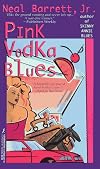
I found Barrett by way of reading his Hugo/Nebula novelette nominee, 'Ginny Sweethips' Flying Circus.' Something about the tone, humor and nicely paced story intrigued me, and I found more of the same in Pink Vodka Blues. A solid mystery of the 'find the missing item' show more school, Russell Murray ('not Murray Russell') wakes from a bender in a motel room with a very attractive young woman. While he's heaving up last night in the bathroom, two large men break into the motel room, shoot the girl and then spy him hiding in the bathroom. Within a flash, he's on the run.
"I decided last week was the ideal time to leave town. That I really liked fishing a lot. That I could surely learn to like the local beer. As ever, good planning is the key."
He's pretty sure a drink or three will help him cope, but Chicago isn't selling at this exact moment, so he makes his way to the Wisconsin border where they have early opening on Sundays.
"The sign at the Wisconsin border reads: 'Warning! Wisconsin Arrests Drunken drivers!' To help bring this about, an impressive number of taverns line the roads. Other states have Mom and Pop groceries… Wisconsin has Mom and Pop taverns – more taverns per capita, locals boast, than any other state."
He buys a bottle and calls his friend and employer Tony Palmer, who seems excessively interested in where Russell is and what happened to a briefcase. Russell has no clue what Tony is referring so but starts to get worried, so he hangs up and takes to the road with his booze. You can tell its the late 80s, because the cop that picks him up leaves him at a rehab facility instead of jail. (Of course, Wisconsin still remains one of the best states to drive in while drunk, if by 'best,' one means no minimum sentence and it'll take four OWI before you reach felony level offense). After a bit of hallucination and a missed urinal, he comes around to Sherry Lou Winn, fellow resident, staring him in the face. She's well endowed in the financial sense and looks like a red-headed Cheryl Ladd, but even better, is a bit of a loose cannon.
"Sherry took a bite of dry toast. 'Les doesn't care for me a lot. He figures I'll bring you down.'
'You just might,' I said. 'I have no will of my own. I am easily led astray.'
'I sure do admire that in a man,' Sherry said."
The two end up on the road, trying to figure out what is going on and clear Murray's reputation. The danger eventually becomes quite real, as if Murray didn't already know. There's a lot of drinking, some intermittent research, and narrow escapes that all tie up in a solid, if somewhat confusing, ending.
I found it highly enjoyable, a kind of perfect read for a not-too-serious mood. The banter was amusing and I particularly appreciated the dry wit punctuating Murray's thoughts. Murray wrote for "The Literary Times,' and more than one of his jokes draws on the literary ("my mouth was dry as a page of Henry James"). There's a number of running jokes which amuse--particularly the ones relating to vocabulary--as well as a few absurdist images.
I half expected the staccato narrative style to grate, but strangely, I enjoyed it. I think Barrett kept the pace moving, and switched to a more descriptive style at appropriate moments. It might have also helped that I didn't read this all at once, but more as a diversion. Characterization may seem a bit simple at first--Murray is a bit of a sweetly sincere and straight-forward drunk--but I thought there was a nice subtlety to how Sherry and Murray related, and how their relationship evolved through the strain of their search for the briefcase. It takes skill to weave the balance between humor and daring adventure, and this nicely navigated humor and suspense.
Note: although this is described sometimes as part of the 'Wiley Moss series,' it is no such thing. Apparently Barrett wrote four detective novels in a quick time frame, with similar style. This book is a stand-alone mystery.
The review is on my Wordpress blog, and contains a number of links/ references for those who don't believe me about Wisconsin. https://clsiewert.wordpress.com/2016/09/26/pink-vodka-blues-by-neal-barrett-jr-n... show less
I found Barrett by way of reading his Hugo/Nebula novelette nominee, 'Ginny Sweethips' Flying Circus.' Something about the tone, humor and nicely paced story intrigued me, and I found more of the same in Pink Vodka Blues. A solid mystery of the 'find the missing item' show more school, Russell Murray ('not Murray Russell') wakes from a bender in a motel room with a very attractive young woman. While he's heaving up last night in the bathroom, two large men break into the motel room, shoot the girl and then spy him hiding in the bathroom. Within a flash, he's on the run.
"I decided last week was the ideal time to leave town. That I really liked fishing a lot. That I could surely learn to like the local beer. As ever, good planning is the key."
He's pretty sure a drink or three will help him cope, but Chicago isn't selling at this exact moment, so he makes his way to the Wisconsin border where they have early opening on Sundays.
"The sign at the Wisconsin border reads: 'Warning! Wisconsin Arrests Drunken drivers!' To help bring this about, an impressive number of taverns line the roads. Other states have Mom and Pop groceries… Wisconsin has Mom and Pop taverns – more taverns per capita, locals boast, than any other state."
He buys a bottle and calls his friend and employer Tony Palmer, who seems excessively interested in where Russell is and what happened to a briefcase. Russell has no clue what Tony is referring so but starts to get worried, so he hangs up and takes to the road with his booze. You can tell its the late 80s, because the cop that picks him up leaves him at a rehab facility instead of jail. (Of course, Wisconsin still remains one of the best states to drive in while drunk, if by 'best,' one means no minimum sentence and it'll take four OWI before you reach felony level offense). After a bit of hallucination and a missed urinal, he comes around to Sherry Lou Winn, fellow resident, staring him in the face. She's well endowed in the financial sense and looks like a red-headed Cheryl Ladd, but even better, is a bit of a loose cannon.
"Sherry took a bite of dry toast. 'Les doesn't care for me a lot. He figures I'll bring you down.'
'You just might,' I said. 'I have no will of my own. I am easily led astray.'
'I sure do admire that in a man,' Sherry said."
The two end up on the road, trying to figure out what is going on and clear Murray's reputation. The danger eventually becomes quite real, as if Murray didn't already know. There's a lot of drinking, some intermittent research, and narrow escapes that all tie up in a solid, if somewhat confusing, ending.
I found it highly enjoyable, a kind of perfect read for a not-too-serious mood. The banter was amusing and I particularly appreciated the dry wit punctuating Murray's thoughts. Murray wrote for "The Literary Times,' and more than one of his jokes draws on the literary ("my mouth was dry as a page of Henry James"). There's a number of running jokes which amuse--particularly the ones relating to vocabulary--as well as a few absurdist images.
I half expected the staccato narrative style to grate, but strangely, I enjoyed it. I think Barrett kept the pace moving, and switched to a more descriptive style at appropriate moments. It might have also helped that I didn't read this all at once, but more as a diversion. Characterization may seem a bit simple at first--Murray is a bit of a sweetly sincere and straight-forward drunk--but I thought there was a nice subtlety to how Sherry and Murray related, and how their relationship evolved through the strain of their search for the briefcase. It takes skill to weave the balance between humor and daring adventure, and this nicely navigated humor and suspense.
Note: although this is described sometimes as part of the 'Wiley Moss series,' it is no such thing. Apparently Barrett wrote four detective novels in a quick time frame, with similar style. This book is a stand-alone mystery.
The review is on my Wordpress blog, and contains a number of links/ references for those who don't believe me about Wisconsin. https://clsiewert.wordpress.com/2016/09/26/pink-vodka-blues-by-neal-barrett-jr-n... show less
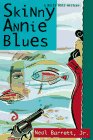
Amusing but occasionally tiresome, much like a visiting three-year-old. Also like a three year old, it insists on interacting with those who would rather remain untouched. It reminds me somewhat of the famous male writers I read in the late 80s: Tom Robbins, Updike--kind of clever but more than a little fixated on females and the possibility of sex.
A cop calls Wiley Moss to let him know his father has died:
"If you hadn't told me he was dead, I never would have known he was alive."
The cop show more went silent a moment. I heard ice tinkle in a glass. Part of a country song. The man was in a bar somewhere. Neon signs, something with horns on the wall. He had told me his name was R.J. You can't trust a man with initials for a name."
The phone call send Moss hurrying down to Galveston, Texas ("in the Southwest somewhere"). He leaves his girlfriend, Giselle, behind with few regrets; before long he's oogling a beautiful copper-haired woman on a plane as he tries to ignore his seatmate, Chicken Man, who has some quality advice about fluids: "He held up his empty plastic glass. 'Whiskey is made from pure natural grain. Straight from Mother Earth. Toss out that juicer and get yourself on the road to health." Moss is soon careening from one disaster to another, meeting acquaintances of his father and trying to understand the life he was living as he works out who would want to kill him.
The plotting is straight from the school bumbling interloper who stumbles into a situation much larger than himself and basically only works out what is going on through dumb luck. Unfortunately, there's a bit at the end that doesn't quite satisfy--if you every read this, look me up and we'll talk. Suffice it to say that it won't work for fans of the definitive. I don't think. Unless I read it wrong.
Characters are all rather fascinating, if a bit extreme. Sadly, Moss is not a particularly likeable lead. He's clueless, both needy and hostile, and spends far too much time thinking about how attractive the female characters are. I found myself most drawn to a deaf child, Git, who was easily the most cheerful, clever and gentle person in the book.
What I most enjoyed about it was Barrett's writing, an interesting mixture of description and fragments that often segued off into imagination without any clear markers. It is deceptively simple and able to evoke emotion without specifics. By far the most enjoyable aspect of the story is the extreme characters and their banter. Written in 1996, I experienced a surreal moment when I read: "Chicken Man tried to grin. He had a little mouth like Donald Trump. Donald Trump can't hardly grin at all." I'm also a sucker for a caper, and this has a feeling of mad-cap adventure about it. However, like a visiting three-year-old, I was worn out after a relatively short time. I read this one over a number of days and thus was able to enjoy it instead of sliding into exasperation.
Two-and-a-half stars, rounding up for making me laugh. show less
A cop calls Wiley Moss to let him know his father has died:
"If you hadn't told me he was dead, I never would have known he was alive."
The cop show more went silent a moment. I heard ice tinkle in a glass. Part of a country song. The man was in a bar somewhere. Neon signs, something with horns on the wall. He had told me his name was R.J. You can't trust a man with initials for a name."
The phone call send Moss hurrying down to Galveston, Texas ("in the Southwest somewhere"). He leaves his girlfriend, Giselle, behind with few regrets; before long he's oogling a beautiful copper-haired woman on a plane as he tries to ignore his seatmate, Chicken Man, who has some quality advice about fluids: "He held up his empty plastic glass. 'Whiskey is made from pure natural grain. Straight from Mother Earth. Toss out that juicer and get yourself on the road to health." Moss is soon careening from one disaster to another, meeting acquaintances of his father and trying to understand the life he was living as he works out who would want to kill him.
The plotting is straight from the school bumbling interloper who stumbles into a situation much larger than himself and basically only works out what is going on through dumb luck. Unfortunately, there's a bit at the end that doesn't quite satisfy--if you every read this, look me up and we'll talk. Suffice it to say that it won't work for fans of the definitive. I don't think. Unless I read it wrong.
Characters are all rather fascinating, if a bit extreme. Sadly, Moss is not a particularly likeable lead. He's clueless, both needy and hostile, and spends far too much time thinking about how attractive the female characters are. I found myself most drawn to a deaf child, Git, who was easily the most cheerful, clever and gentle person in the book.
What I most enjoyed about it was Barrett's writing, an interesting mixture of description and fragments that often segued off into imagination without any clear markers. It is deceptively simple and able to evoke emotion without specifics. By far the most enjoyable aspect of the story is the extreme characters and their banter. Written in 1996, I experienced a surreal moment when I read: "Chicken Man tried to grin. He had a little mouth like Donald Trump. Donald Trump can't hardly grin at all." I'm also a sucker for a caper, and this has a feeling of mad-cap adventure about it. However, like a visiting three-year-old, I was worn out after a relatively short time. I read this one over a number of days and thus was able to enjoy it instead of sliding into exasperation.
Two-and-a-half stars, rounding up for making me laugh. show less
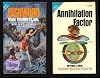
I purchased the Ace Double this appears in at a used book store for the Barrington novel, but was also happy to give this Barrett (an author previously unknown to me) novel a try. I would say that I enjoyed the first three-quarters of this book more than I expected, in that, despite a gratuitous early cross-species lesbian narrowly averted rape scene, the setting and its aliens were intriguing and even at times inspired, and that it offered an underlying mystery that left me curious. show more Unfortunately the ending was truly awful. I would recommend this only to those who are looking for an affirmation that, when the going gets tough, even the toughest of women collapse into a quivering pile of neediness desperate for a manly man to take care of their problems. show less
Lists
Awards


You May Also Like


Associated Authors
Statistics
- Works
- 102
- Also by
- 44
- Members
- 2,109
- Popularity
- #12,203
- Rating
- 3.5
- Reviews
- 37
- ISBNs
- 95
- Languages
- 7
- Favorited
- 1