
Richard Hoffman (1)
Author of Half the House
For other authors named Richard Hoffman, see the disambiguation page.
Works by Richard Hoffman
Associated Works
Family Trouble: Memoirists on the Hazards and Rewards of Revealing Family (2013) — Contributor — 21 copies
Tagged
Common Knowledge
- Gender
- male
Members
Reviews
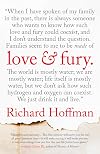
LOVE & FURY, by Richard Hoffman.
There are certainly parts of LOVE & FURY that moved me greatly, in a way that only a heartfelt and well-written memoir can do. And those parts are the passages that speak directly to the life-long difficult relationship Hoffman had with his father. I have not read his earlier memoir, HALF THE HOUSE, which apparently dealt in great depth with the childhood trauma of sexual abuse the author suffered at the hands of a coach. He alludes to that part of his life show more numerous times here, but his primary focus is on the last months of his father's life and his death. And those passages are extremely effective, as in when he says -
"We're talking here about love, after all, not sociology. Grief has always seemed to me to be love made briefly visible ..."
Indeed, and Hoffman goes on to describe how, at his father's open casket, he stared at his father's hands "that fed and struck me, teaching me gratitude and terror." He goes on to tell of a time when his father threw him against a wall, knocking him unconscious.
This is powerful and emotional stuff, make no mistake. It's when the author does veer off into that "sociology" that the narrative sometimes falters, when he stops to define "white trash" or dwells perhaps too often on his own struggles with alcoholism, or takes the penal system to task, that my attention began to lag. It's as if he can't quite decide whether he's writing a memoir or a sociological study of racism and injustice.
Hoffman is at his best when he describes his own emotions and the contradictory feelings he has about his father -
"The judgments, the recriminations, the guilt, the anger all get in my way. And the questions. I am still trying to know him, still asking who he was ..."
These parts are unquestionably the most powerful, as well as the emotions he feels when he holds his illegitimate grandson, who is half-black, and tries, often unsuccessfully, to figure out how he can shake off all the prejudices and hidden hatreds that he learned growing up from his father and uncles.
This is an ambitious book, and it succeeds if only in part. I admire Hoffman tremendously for the way he has lived his life, and would recommend it highly. show less
There are certainly parts of LOVE & FURY that moved me greatly, in a way that only a heartfelt and well-written memoir can do. And those parts are the passages that speak directly to the life-long difficult relationship Hoffman had with his father. I have not read his earlier memoir, HALF THE HOUSE, which apparently dealt in great depth with the childhood trauma of sexual abuse the author suffered at the hands of a coach. He alludes to that part of his life show more numerous times here, but his primary focus is on the last months of his father's life and his death. And those passages are extremely effective, as in when he says -
"We're talking here about love, after all, not sociology. Grief has always seemed to me to be love made briefly visible ..."
Indeed, and Hoffman goes on to describe how, at his father's open casket, he stared at his father's hands "that fed and struck me, teaching me gratitude and terror." He goes on to tell of a time when his father threw him against a wall, knocking him unconscious.
This is powerful and emotional stuff, make no mistake. It's when the author does veer off into that "sociology" that the narrative sometimes falters, when he stops to define "white trash" or dwells perhaps too often on his own struggles with alcoholism, or takes the penal system to task, that my attention began to lag. It's as if he can't quite decide whether he's writing a memoir or a sociological study of racism and injustice.
Hoffman is at his best when he describes his own emotions and the contradictory feelings he has about his father -
"The judgments, the recriminations, the guilt, the anger all get in my way. And the questions. I am still trying to know him, still asking who he was ..."
These parts are unquestionably the most powerful, as well as the emotions he feels when he holds his illegitimate grandson, who is half-black, and tries, often unsuccessfully, to figure out how he can shake off all the prejudices and hidden hatreds that he learned growing up from his father and uncles.
This is an ambitious book, and it succeeds if only in part. I admire Hoffman tremendously for the way he has lived his life, and would recommend it highly. show less
 This review was written for LibraryThing Early Reviewers.
I received Love and Fury from the Library Thing giveaway in exchange for an honest review. Prior to reading Richard Hoffman's memoir I was not aware of his work but the description of the book was interesting so I requested a copy. I was not disappointed and enjoyed reading about Hoffman"s reflection of his relationship with his father in the wake of his father's dying. He writes about this relationship as he saw it as a child, a father and now a new grandfather and intermingles his own show more relationships with his daughter, son, wife, and the imprisoned father of his grandson. Throughout the book he examines race, gender, class, religion and war and how these issues have shaped who he is and who is father was and how they have effected his familial relationships. I think one of the things I liked about this memoir was that it was not a shocking tell all aimed at gathering sympathy but rather an honest account of how he tries to understand and come to terms with his love and anger of his father. show less
This review was written for LibraryThing Early Reviewers.
Italian critic, writer, filmmaker poet and philosopher Pier Paolo Pasolini said an author cannot ventriloquize outside his own social class. What Richard Hoffman does iso well, over and over is to shine the light on his particular class: white, Catholic, American academic from an East Coast mill-town working class family who was sexually abused as a child by an athletic coach, whose long-suffering mother smoked too many cigarettes, whose father, after retirement, ended up sitting in soft show more chair watching TV all day “because he earned the right to do it. “
Rhetorically and stylistically Hoffman’s exceptional memoir paints the picture of the landscapes in which the people who he loves enter and exit. The people are his immediate family--wife daughter and son, living in North Cambridge, Massachusetts; his family of origin-- father mother, brothers, in Allentown, Pennsylvania; and the struggles of his daughter, her child and black boyfriend who are trying to carve a place for themselves and meanwhile crowd into the small North Cambridge house with Hoffman and his wife, who is also a working-class academic, and who, at one point in the memoir, has to deal with cancer.
Hoffman elegantly writes that no matter who we are, we are all here for a brief season of seasons that we have no name for. “Life” is too commonplace a word.” Lifespan has a span, a bridge in it that the author cannot muster feelings for. So he settles for “our portion: a single share of the plentitude of time, with little or nothing to do with anything but love.”
LOVE AND FURY is a notable memoir for its honesty, curiosity, insight and true voice. Additionally, Hoffman weaves an interesting and noteworthy thread through the generations: the author’s father expects that life might not fair, but the rules ought to be the same for everyone; while the author’s daughter and her mate know that life is not fair and the rules are not the same for everyone. show less
Rhetorically and stylistically Hoffman’s exceptional memoir paints the picture of the landscapes in which the people who he loves enter and exit. The people are his immediate family--wife daughter and son, living in North Cambridge, Massachusetts; his family of origin-- father mother, brothers, in Allentown, Pennsylvania; and the struggles of his daughter, her child and black boyfriend who are trying to carve a place for themselves and meanwhile crowd into the small North Cambridge house with Hoffman and his wife, who is also a working-class academic, and who, at one point in the memoir, has to deal with cancer.
Hoffman elegantly writes that no matter who we are, we are all here for a brief season of seasons that we have no name for. “Life” is too commonplace a word.” Lifespan has a span, a bridge in it that the author cannot muster feelings for. So he settles for “our portion: a single share of the plentitude of time, with little or nothing to do with anything but love.”
LOVE AND FURY is a notable memoir for its honesty, curiosity, insight and true voice. Additionally, Hoffman weaves an interesting and noteworthy thread through the generations: the author’s father expects that life might not fair, but the rules ought to be the same for everyone; while the author’s daughter and her mate know that life is not fair and the rules are not the same for everyone. show less
This review was written for LibraryThing Early Reviewers.Vacillating between present and past times, Hoffman's memoir trails through themes of religion, addiction, guilt, love, abuse and forgiveness, prompted by his relationships with his father, as well as the others in his immediate family. As a father and grandfather himself, Hoffman ponders, explores and examines his relationship with his father, sometimes tender and empathetic and sometimes disgusted.
There are moments of striking truth in Hoffman's graceful prose. "I am gravely disappointed show more by my inability to stay young, and I am becoming more fully aware every day of the unlikelihood that I will outwit death and live forever." This is a long way of writing a typically succinct point, yet, Hoffman is not being glib or fanciful. He is pointing out that adults harbor childhood impressions, hanging onto them long into adulthood. show less
There are moments of striking truth in Hoffman's graceful prose. "I am gravely disappointed show more by my inability to stay young, and I am becoming more fully aware every day of the unlikelihood that I will outwit death and live forever." This is a long way of writing a typically succinct point, yet, Hoffman is not being glib or fanciful. He is pointing out that adults harbor childhood impressions, hanging onto them long into adulthood. show less
This review was written for LibraryThing Early Reviewers.Lists
You May Also Like
Associated Authors
Statistics
- Works
- 6
- Also by
- 2
- Members
- 110
- Popularity
- #176,728
- Rating
- 4.1
- Reviews
- 15
- ISBNs
- 32
- Languages
- 1
- Favorited
- 1
