
Charles Gibson (1) (1920–1985)
Author of Spain in America
For other authors named Charles Gibson, see the disambiguation page.
About the Author
Image credit: AHA
Works by Charles Gibson
The Aztecs Under Spanish Rule: A History of the Indians of the Valley of Mexico, 1519-1810 (1964) 79 copies, 2 reviews
Tagged
Common Knowledge
- Legal name
- Gibson, Charles Edmund
- Birthdate
- 1920-08-12
- Date of death
- 1985-08-22
- Gender
- male
- Education
- Yale University (BA|1941, PhD|1950)
University of Texas (MA|1947) - Organizations
- U.S. Army
American Historical Association - Nationality
- USA
- Birthplace
- Buffalo, New York, USA
- Places of residence
- Ann Arbor, Michigan, USA
- Place of death
- Plattsburg, New York, USA
- Associated Place (for map)
- USA
Members
Reviews
The Aztecs Under Spanish Rule: A History of the Indians of the Valley of Mexico, 1519-1810 by Charles Gibson
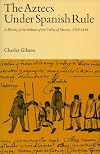
To the extent that Americans (including me) think of Mexican history at all, there’s a 300-year blank space between the fall of the Aztecs and the Mexican War of Independence. Something happened in that gap, but I only had the vaguest of ideas that it had something to do with mule trains and gold.
Professor Charles Gibson, late of the universities of Iowa and Michigan, lays a powerful foundation for filling that gap. He spent a decade digging through archives in Mexico, Spain, and France to show more build a documentary collage of what life was like for Indians in the Valley of Mexico under Spanish dominion.
His approach was groundbreaking in that it elevated an indigenous approach to Mexican history. He eschewed a traditional historiography of the ruling class in favor of the silent generations whose necks bore the Castilian yoke, a method which would prove fruitful for generations of historians after him.
The amount of detail here is staggering, from pre-conquest tribal polity to steady Spanish encroachments into religion, finance, labor, land, agriculture, and markets. This is not a narrative history, but a well-constructed analysis and synthesis of three centuries’s worth of colonial records.
This pushes Gibson’s work beyond the interest of many as the drama of Indian life emerges fitfully through layers of data, but this is why his achievement is noteworthy. The voice of the vanquished rarely emerges from the past, and the fact that through Gibson we hear the descendants of the Mexica, the Acolhua, the Otomi, or the Xochimilca is astonishing.
The story they tell is a hard one. Not all was darkness, of course; nothing in real life ever is. By the mid-1500s, there was reason to hope for an uneven but real equilibrium. The Crown of Castile had set up the repartimiento, a system of forced labor organized on a limited and rotating basis. Though still harsh, this was an improvement over encomienda, a patchwork of private fiefdoms of unchecked exploitation and abuse forged by the conquistadors. (Encomienda reminds me of nothing so much as the Five Families dividing up New York City, but with the force of law.)
Indians were learning Spanish tradecrafts, incorporating Spanish crops into their diets and economies, and even taking Spaniards to court — sometimes successfully. What destroyed any hope of a dignified native life was less a conspiracy of enslavement, and more the twin punches of epidemic disease and Spanish assumption of all political control higher than a town council.
As plagues decimated tribes, colonists swiftly moved into depopulated lands. Ranchers sucked up water resources for wheat farms and voracious European livestock. Collapsed Indian populations found themselves pressed ever harder by tribute demands they lacked the numbers to meet or the political tools to fight. The burgeoning racial caste system of peninsulares, criollos, mestizos, Negroes, and mulattos compressed native peoples ever downward into a faceless subclass at the bottom of society.
Many Indian towns caved in as individuals retreated into alcohol and drifted from place to place. Eventually, the rise of the haciendas offered a pale but stable form of community. Here Indians could retain a shred of dignity hiring out to private landowners for market wages, though those very haciendas would become cauldrons of despotism in the rhetoric of later and more revolutionary times.
The story is grim, and makes me thankful to live under a system of government that grants a voice to the governed. When the American founders reacted against suspected schemes of British tyranny, they surely had one eye on the south where the colonizer did what he could and the colonized suffered what he must. It’s a bitterly ironic shame that so many of New Spain’s upstream abuses and downstream effects would find echoes in the north, as American lovers of liberty rolled westward over the bodies of other native peoples doomed to fall beneath the wheels of progress. show less
Professor Charles Gibson, late of the universities of Iowa and Michigan, lays a powerful foundation for filling that gap. He spent a decade digging through archives in Mexico, Spain, and France to show more build a documentary collage of what life was like for Indians in the Valley of Mexico under Spanish dominion.
His approach was groundbreaking in that it elevated an indigenous approach to Mexican history. He eschewed a traditional historiography of the ruling class in favor of the silent generations whose necks bore the Castilian yoke, a method which would prove fruitful for generations of historians after him.
The amount of detail here is staggering, from pre-conquest tribal polity to steady Spanish encroachments into religion, finance, labor, land, agriculture, and markets. This is not a narrative history, but a well-constructed analysis and synthesis of three centuries’s worth of colonial records.
This pushes Gibson’s work beyond the interest of many as the drama of Indian life emerges fitfully through layers of data, but this is why his achievement is noteworthy. The voice of the vanquished rarely emerges from the past, and the fact that through Gibson we hear the descendants of the Mexica, the Acolhua, the Otomi, or the Xochimilca is astonishing.
The story they tell is a hard one. Not all was darkness, of course; nothing in real life ever is. By the mid-1500s, there was reason to hope for an uneven but real equilibrium. The Crown of Castile had set up the repartimiento, a system of forced labor organized on a limited and rotating basis. Though still harsh, this was an improvement over encomienda, a patchwork of private fiefdoms of unchecked exploitation and abuse forged by the conquistadors. (Encomienda reminds me of nothing so much as the Five Families dividing up New York City, but with the force of law.)
Indians were learning Spanish tradecrafts, incorporating Spanish crops into their diets and economies, and even taking Spaniards to court — sometimes successfully. What destroyed any hope of a dignified native life was less a conspiracy of enslavement, and more the twin punches of epidemic disease and Spanish assumption of all political control higher than a town council.
As plagues decimated tribes, colonists swiftly moved into depopulated lands. Ranchers sucked up water resources for wheat farms and voracious European livestock. Collapsed Indian populations found themselves pressed ever harder by tribute demands they lacked the numbers to meet or the political tools to fight. The burgeoning racial caste system of peninsulares, criollos, mestizos, Negroes, and mulattos compressed native peoples ever downward into a faceless subclass at the bottom of society.
Many Indian towns caved in as individuals retreated into alcohol and drifted from place to place. Eventually, the rise of the haciendas offered a pale but stable form of community. Here Indians could retain a shred of dignity hiring out to private landowners for market wages, though those very haciendas would become cauldrons of despotism in the rhetoric of later and more revolutionary times.
The story is grim, and makes me thankful to live under a system of government that grants a voice to the governed. When the American founders reacted against suspected schemes of British tyranny, they surely had one eye on the south where the colonizer did what he could and the colonized suffered what he must. It’s a bitterly ironic shame that so many of New Spain’s upstream abuses and downstream effects would find echoes in the north, as American lovers of liberty rolled westward over the bodies of other native peoples doomed to fall beneath the wheels of progress. show less
The Aztecs Under Spanish Rule: A History of the Indians of the Valley of Mexico, 1519-1810 by Charles Gibson
The author worked on this book from the 1950's to the 1960's and it seems safe to say that it is a product of it's time. He discusses how the Spanish organized economic production, religion, land usage, tribute, and a host of other things in the Aztec lands after the conquest and up to Mexican independence. The emphasis is on weighing the relative importance of different Spanish institutions and practices against each other through the colonial era, utilizing statistics when they are show more available and roundabout estimates when they are not. The research is so meticulous that even the endnotes and the bibliography are almost 200 pages long. I would imagine that this book can serve as a great bibliographical resource for later generations of researchers.
However, the author does not feel the need to provide any kind of evaluative commentary on his narrative. To a modern reader this seems absurd, particularly in light of the fact that the Aztec population declined precipitously after the conquest and was clearly exploited by its conquerors. In the 400 pages which constitute the main part of this book, the author spends perhaps two or three pages on discussing the reasons for Aztec decline and refrains from any moral condemnation. It was probably an ideal of historical scholarship in the 1960's not to pass judgment on bygone ages, but this attitude is not really satisfactory in the 21st century, especially in a book which claims to provide a discussion of the Aztec people. I would for this reason not recommend this book to modern readers even though the scholarship itself is of high quality. show less
However, the author does not feel the need to provide any kind of evaluative commentary on his narrative. To a modern reader this seems absurd, particularly in light of the fact that the Aztec population declined precipitously after the conquest and was clearly exploited by its conquerors. In the 400 pages which constitute the main part of this book, the author spends perhaps two or three pages on discussing the reasons for Aztec decline and refrains from any moral condemnation. It was probably an ideal of historical scholarship in the 1960's not to pass judgment on bygone ages, but this attitude is not really satisfactory in the 21st century, especially in a book which claims to provide a discussion of the Aztec people. I would for this reason not recommend this book to modern readers even though the scholarship itself is of high quality. show less
Old but still good, part of a very famous series.

Lists
Awards

You May Also Like


Statistics
- Works
- 10
- Members
- 326
- Popularity
- #72,686
- Rating
- 3.8
- Reviews
- 4
- ISBNs
- 32
- Languages
- 2