
Robert M. MacIver (1882–1970)
Author of The Web of Government
About the Author
Robert M. MacIver (1882-1970) was Lieber Professor of Political Philosophy and Sociology at Columbia University
Works by Robert M. MacIver
Community: A sociological study being an attempt to set out the nature and fundamental laws of social life (1970) 6 copies
Teoria del gobierno. 2 copies
Sociologia. 2 copies
Society: a Textbook of Sociology 2 copies
Sociología 2 copies
Power Transformed 1 copy
Governo e societa 1 copy
Governo e società 1 copy
Macht und Autorität 1 copy
Causación Social 1 copy
Associated Works
The Moral Life: An Introductory Reader in Ethics and Literature (1999) — Contributor — 202 copies, 2 reviews
Tagged
Common Knowledge
- Birthdate
- 1882-04-17
- Date of death
- 1970-06-15
- Gender
- male
Members
Reviews

A nice and compact analysis of dictatorship and democracy. It's interesting to compare these works from the 1930s and 40s to modern political theory, where democracy is just taken for granted. The author's useful insights on democracy stem mainly from his keen understanding of dictatorships. This reminded me of Hannah Arendt's work Between Past and Future.
The structure of the book is not very practical. The first part contains one chapter each on democracy and dictatorship, the second part show more a collection of assorted comments on the first part. On several occasions the argumentation seems to stop a bit short of it's full potential. But even so I think I will return to this book in the future, perhaps when I study 20th century dictatorships. show less
The structure of the book is not very practical. The first part contains one chapter each on democracy and dictatorship, the second part show more a collection of assorted comments on the first part. On several occasions the argumentation seems to stop a bit short of it's full potential. But even so I think I will return to this book in the future, perhaps when I study 20th century dictatorships. show less

I would divide this book in three parts. The first part is a general philosophical analysis of causation, without any reference to social science. The author takes a stand against positivist views which were still dominant when the first edition of this book was written. Since then the tide has turned his way, but even though much of what he says is right, this first part of the book seems somewhat outdated.
The second part, which moves into the philosophy of social science, is much better. show more The author carefully sets out the criteria of meaningful causal investigation in the social sciences, emphasizing time and again the need to find specific differences between comparable situations. One of his main arguments is that a cause must be a relatively simple "precipitant" in an event - not an abstract social attitude or structure which lies beyond all observation. He accepts sceptical arguments, but points out that partial knowledge of social causation is still better than no knowledge at all. The discussion is rich in detail and shows a nice balance of theories and examples.
After concluding that statistical analysis only goes partway to causal explanation, the author uses the third part of the book to describe the idiosyncratic "dynamic assessment" by which the social investigator must finish the job. I don't think this part of the book was as interesting as the second part and at times I struggled to see its relevance. So this book contains some superfluous material, but it's still an original work that philosophically inclined social scientists should consider reading. show less
The second part, which moves into the philosophy of social science, is much better. show more The author carefully sets out the criteria of meaningful causal investigation in the social sciences, emphasizing time and again the need to find specific differences between comparable situations. One of his main arguments is that a cause must be a relatively simple "precipitant" in an event - not an abstract social attitude or structure which lies beyond all observation. He accepts sceptical arguments, but points out that partial knowledge of social causation is still better than no knowledge at all. The discussion is rich in detail and shows a nice balance of theories and examples.
After concluding that statistical analysis only goes partway to causal explanation, the author uses the third part of the book to describe the idiosyncratic "dynamic assessment" by which the social investigator must finish the job. I don't think this part of the book was as interesting as the second part and at times I struggled to see its relevance. So this book contains some superfluous material, but it's still an original work that philosophically inclined social scientists should consider reading. show less

This is an impressive book which deals with the processes and institutions of government from a broad perspective. The original work was written in 1947 and the revised edition which I read was from 1965. The author's keen analysis of democracy and dictatorship as two key forms of government is obviously a product of its time, but surprisingly insightful even today. The part I liked most was the section on the different functions of government, transformations in government and the role of show more government in international relations. Throughout the book the author exhibits a level of historical and philosophical acuity which is far too rarely seen in modern political research. All in all an intelligent book which I highly recommend to anyone interested in politics and government. I will be looking to read other books by this author soon. show less
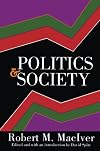
A collection of essays by Robert MacIver covering a span of almost 60 years. Some of them have not been published before and even as an admirer of MacIver I have to say that the early ones could just as well have remained unpublished. But there are some good pieces here too. I especially liked the essays written during and after World War II which contain interesting reflections on international order, global community and political decision-making in times of crisis. I would recommend show more MacIver's theoretical works before this one, but it serves well as an encapsulation of a scholar's reaction to times of trouble. show less
Awards

You May Also Like


Associated Authors
Statistics
- Works
- 46
- Also by
- 2
- Members
- 167
- Popularity
- #127,263
- Rating
- 4.1
- Reviews
- 6
- ISBNs
- 24
- Favorited
- 1