
David M. Glantz
Author of Clash of Titans
About the Author
David M. Glantz is founder and former director of the U.S. Army's Foreign Military Studies Office.
Series
Works by David M. Glantz
Before Stalingrad: Barbarossa, Hitler's Invasion of Russia 1941 (Battles & Campaigns) (2001) 211 copies, 4 reviews
The Stalingrad Trilogy, Volume 1: To the Gates of Stalingrad: Soviet-German Combat Operations, April-August 1942 (2009) 179 copies, 3 reviews
Zhukov's Greatest Defeat: The Red Army's Epic Disaster in Operation Mars, 1942 (1999) 164 copies, 1 review
The Stalingrad Trilogy, Volume 2: Armageddon in Stalingrad: September-November 1942 (2009) 147 copies, 1 review
Barbarossa Derailed : The Battle for Smolensk, 10 July - 10 September 1941, Volume 1: The German Advance to Smolensk, the Encirclement Battle, and the First and Second Soviet… (2010) 99 copies, 2 reviews
Barbarossa Derailed: The Battle for Smolensk 10 July-10 September 1941 Volume 2: The German Offensives on the Flanks and the Third Soviet Counteroffensive, 25 August-10 September… (2012) 67 copies, 2 reviews
Soviet Operational and Tactical Combat in Manchuria, 1945: 'August Storm' (Soviet (Russian) Study of War) (2003) 60 copies, 2 reviews
Red Storm over the Balkans: The Failed Soviet Invasion of Romania, Spring 1944 (2006) 59 copies, 1 review
From the Don to the Dnepr: Soviet Offensive Operations, December 1942 - August 1943 (Soviet (Russian) Military Experience) (1991) 59 copies
The Soviet Strategic Offensive in Manchuria, 1945: 'August Storm' (Soviet (Russian) Study of War) (2003) 44 copies
The Battle for Belorussia: The Red Army's Forgotten Campaign of October 1943 - April 1944 (2016) 36 copies, 1 review
Soviet Military Operational Art: In Pursuit of Deep Battle (Soviet (Russian) Military Theory and Practice) (1991) 32 copies
Operation Don's Main Attack: The Soviet Southern Front's Advance on Rostov, January-February 1943 (Modern War Studies) (2018) 29 copies, 1 review
Barbarossa Derailed. Volume 3: The Documentary Companion. Tables, Orders and Reports prepared by participating Red Army forces (2014) 29 copies, 1 review
Battle for the Ukraine: The Korsun'-Shevchenkovskii Operation (Soviet (Russian) Study of War) (2003) 28 copies
Soviet Military Deception in the Second World War (Soviet (Russian) Military Theory and Practice) (1989) 27 copies, 1 review
Operation Don's Left Wing: The Trans-Caucasus Front's Pursuit of the First Panzer Army, November 1942-February 1943 (Modern War Studies) (2019) 24 copies, 1 review
A History of Soviet Airborne Forces (Soviet (Russian) Military Theory and Practice) (1994) 18 copies
Soviet Military Intelligence in War (Soviet (Russian) Military Theory and Practice) (1990) 12 copies
The Soviet Conduct of Tactical Maneuver: Spearhead of the Offensive (Soviet (Russian) Military Theory and Practice) (1991) 11 copies
The Battle for L'vov: July 1944: The Soviet General Staff Study (Soviet (Russian) Study of War, 13) (2002) 11 copies
The Military Strategy of the Soviet Union: A History (Cass Series on Soviet Military Theory & Practice) (1992) 11 copies
The strategic and operational impact of terrain on military operations in Central and Eastern Europe (1991) 4 copies, 1 review
Red Army Ground Forces in June 1941 3 copies
Atlas of Operation Blau 2 copies
ATLAS OF THE BATTLE OF KURSK 2 copies
ATLAS OF THE BATTLE OF STALINGRAD : Red Army Offensive Operations, 19 Nov. 1942 to 2 Feb. 1943 1 copy
Red Army Combat Operations: Volume VI, The Winter Campaign (24 December 1943-April 1944) Part 3 1 copy, 1 review
Red Army Combat Operations: Volume IV, The Winter Campaign (19 November 1942-21 March 1943) 1 copy, 1 review
Red Army Combat Operations: Volume VI, The Winter Campaign (24 December 1943-April 1944) Part 1 1 copy, 1 review
Red Army Combat Operations: Volume VI, The Winter Campaign (24 December 1943-April 1944) Part 2 1 copy, 1 review
Leningrád ostroma 1941-1944 1 copy
Associated Works
If the Allies Had Fallen : Sixty Alternate Scenarios of World War II (2010) — Contributor — 425 copies, 4 reviews
The Bear Went Over the Mountain: Soviet Combat Tactics in Afghanistan (1996) — Introduction, some editions — 211 copies, 2 reviews
MHQ: The Quarterly Journal of Military History — Spring 1995 (1995) — Author "The Soviet Invasion of Japan" — 23 copies
MHQ: The Quarterly Journal of Military History — Summer 1997 (1997) — Author "The Battle That Never Happened" — 14 copies
Desperta Ferro. Ediciones Especiales. Panzer Volumen 2 (1941) De África a Barbarroja (2018) — Contributor — 3 copies, 1 review
Desperta Ferro Contemporánea. 1965, escalada americana en Vietnam — Contributor — 2 copies
Desperta Ferro Contemporánea. Stalingrado( II ) ¿Ni un paso atrás en el Volga! — Contributor — 2 copies
Tagged
Common Knowledge
- Canonical name
- Glantz, David M.
- Birthdate
- 1942-01-11
- Gender
- male
- Education
- Virginia Military Institute
University of North Carolina at Chapel Hill
United States Army Command and General Staff College
Defense Language Institute
Institute for Russian and Eastern European Studies
United States Army War College - Occupations
- soldier
army officer
military historian - Organizations
- United States Army (1963-1993)
Combat Studies Institute
United States Army Command and General Staff College
United States Military Academy
United States Army War College
Russian Academy of Natural Sciences - Awards and honors
- Samuel Eliot Morison Prize (2000)
Pritzker Literature Award (2020) - Relationships
- Glantz, Mary E. (daughter)
- Nationality
- USA
- Birthplace
- Port Chester, New York, USA
- Places of residence
- Carlisle, Pennsylvania, USA
- Map Location
- Etats-Unis
- Associated Place (for map)
- USA
Members
Reviews
The Battle for Belorussia: The Red Army's Forgotten Campaign of October 1943 - April 1944 (Modern War Studies) by David M. Glantz

When considering this examination of Soviet military operations in late 1943/early 1944 the word to be applied is perhaps not "forgotten," but "suppressed," as the Soviet military high command convinced itself that with just a little more pressure the German Army Group Center would collapse; an event that didn't happen until Operation Bagration in 1944. Glantz's conclusion is that this suppression is more than just trying to brush the deaths of thousands of soldiers in successive show more unimaginative operations accomplishing nothing into darkness; reputations are at stake. The particular reputation being that of Vasily Sokolovsky, protege of Georgii Zhukov and a senior commander of the Cold War Soviet military. Apart from that Glantz also makes the useful point of how the argument that Moscow had left its addiction to broad-front operations in the past by 1943 was not the case, as illustrated by the failures in Belorussia. All that said this is even more of a reference work than a narrative even as compared to some of Glantz's other studies. show less
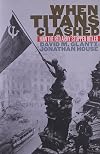
Although there are some points when the authors fall into, what I see as, tropes and unevidenced conclusions (not about military matters, I could never judge that aspect, as I have no expertise on the matter), this book is a valuable insight into the titanic struggle that the Soviet Union undertook, and the enormous costs it paid to protect it's peoples, defend the revolution and extinguish the nazi scourge once and for all.
Although I went into the book with my eyes open to the fact that show more this is a military history, sometimes I found myself glazing over the details of a operations due to the level of detail; I suppose I expected, similar to Adam Tooze's book, some insight on the economic resources mobilized to effectuate this victory, instead of just the operational and strategical manoeuvres/ doctrine. The fault of expectation eh? show less
Although I went into the book with my eyes open to the fact that show more this is a military history, sometimes I found myself glazing over the details of a operations due to the level of detail; I suppose I expected, similar to Adam Tooze's book, some insight on the economic resources mobilized to effectuate this victory, instead of just the operational and strategical manoeuvres/ doctrine. The fault of expectation eh? show less
Soviet Operational and Tactical Combat in Manchuria, 1945: 'August Storm' (Soviet (Russian) Study of War) by David M. Glantz
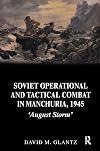
Glantz is something of an expert on Soviet combat operations during the Second World War, about which he has written a number of thick books. This particular one deals with the Soviet conquest of Manchuria in August 1945, and is organized as a set of case studies of the crucial operations. It's rather a specialized military book, but I thought I'd give a quick review.
The good: Incredibly detailed orders of battle. Some real insights into how the Soviets carried out the campaign. Good show more description of unit movements and actions. A good structured format, with detailed description of the local geography, the Japanese defense plans, the Soviet operational plans, and the outcome.
The bad: The maps are absolutely atrocious; maybe two out of the whole book were actually useful. They appear to be mostly very poor reproductions of military topographical maps. Most are all but unreadable.
Surprises: Glantz concludes that the Soviets were quite willing to throw an awful lot of firepower against the Japanese to ensure a quick and crushing victory. They were not willing to expend a lot of soldier's lives to do it; their operations were carried out to minimize casualties. I doubt this was any avuncular concern for his men on Stalin's part; more likely he didn't want to waste trained and experienced troops that he might soon need elsewhere.
The operations in Manchuria overcame heavy fortifications and daunting terrain through fairly impressive planning and conduct of operations. The Japanese kept discovering that their assumptions about where heavy military forces could operate were wrong, and they hardly knew what had hit them as a result. Think eight separate Battles of the Bulge.
THe operations Sakhalin and the Kuriles were not nearly as successful as those in Manchuria. There was less room to maneuver and the Soviets were severely lacking in amphibious capability. None of these operations would have been possible if the Japanese still had any kind of functioning navy or had committed any sizable air force.
Not for the casual reader, but interesting to the serious student of military history. Except for the blasted maps. show less
The good: Incredibly detailed orders of battle. Some real insights into how the Soviets carried out the campaign. Good show more description of unit movements and actions. A good structured format, with detailed description of the local geography, the Japanese defense plans, the Soviet operational plans, and the outcome.
The bad: The maps are absolutely atrocious; maybe two out of the whole book were actually useful. They appear to be mostly very poor reproductions of military topographical maps. Most are all but unreadable.
Surprises: Glantz concludes that the Soviets were quite willing to throw an awful lot of firepower against the Japanese to ensure a quick and crushing victory. They were not willing to expend a lot of soldier's lives to do it; their operations were carried out to minimize casualties. I doubt this was any avuncular concern for his men on Stalin's part; more likely he didn't want to waste trained and experienced troops that he might soon need elsewhere.
The operations in Manchuria overcame heavy fortifications and daunting terrain through fairly impressive planning and conduct of operations. The Japanese kept discovering that their assumptions about where heavy military forces could operate were wrong, and they hardly knew what had hit them as a result. Think eight separate Battles of the Bulge.
THe operations Sakhalin and the Kuriles were not nearly as successful as those in Manchuria. There was less room to maneuver and the Soviets were severely lacking in amphibious capability. None of these operations would have been possible if the Japanese still had any kind of functioning navy or had committed any sizable air force.
Not for the casual reader, but interesting to the serious student of military history. Except for the blasted maps. show less
Barbarossa Derailed: The Battle For Smolensk 10 July - 10 September 1941 Volume 2: The German Offensives on the Flanks and the Third Soviet Counteroffensive, 25 August–10 September 1941 by David M. Glantz
Continuing on from Volume I of the series, Col. Glantz uncovers a smattering of additional operational level counter offensives launched by the Soviets against AGC during the late summer of 1941. I won't go into each one, but it is incredibly nice to finally see a historian cover this timeframe in much more detail. The book is written in his typical style with large amounts of analysis interspersed with very large amounts of translated Soviet reports. The reports are fascinating, as always. show more It was interesting to see that the Soviets set these goals that they really never had any chance of reaching at this stage of the war. But, they continued to literally write the same orders each and every day, even though their divisions were being bled white. It really reinforces the perception that most people have of the Soviets during this time. That all being said, the authors contention that these large-scale operational offensives somehow derailed Barbarossa is a house without a foundation. The Germans (i.e. Hitler) had always intended to redirect large portions of AGC to AGN and AGS to take care of the flanks (rightly or wrongly), and no where in the archives is there any evidence to that because of the stiff resistance (and counter offensives) of the Soviets, that this forced the Germans to the North and the South. The Germans simply did that (at Hitler's insistence) to clear the flanks. Now this brings me to the final analysis of these books written by Col. Glantz, and that is the when the Germans launched a Korps level offensive or higher, during this time frame, the Soviets were 100% unable to stop them. Small counter attacks by individual German divisions (i.e. 7. Panzer Division along the Vop) were able to be stopped by the Soviets, but not once was a Korps level attack during this time stopped by the Soviets. Col. Glantz's coverage of Gruppe Stumme's attack along the norther flank of AGC and the multiple large offensives by 2. Army and 2. Panzergruppe to the south more than reinforce this hypothesis. This was all taken place during a time when many main stream historians claim that the Germans were (or should have been) unable to launch full scale offensives because of the paucity of supply in AGC. Clearly, this was not the case. This book is an absolute must for anyone interested in the Eastern Front during WWII. show less
Lists
You May Also Like


Associated Authors
Statistics
- Works
- 95
- Also by
- 12
- Members
- 3,586
- Popularity
- #7,069
- Rating
- 4.0
- Reviews
- 42
- ISBNs
- 156
- Languages
- 6
- Favorited
- 10
