
George Genovese
Author of A Scout's Report: My 70 Years in Baseball
Works by George Genovese
Tagged
Common Knowledge
There is no Common Knowledge data for this author yet. You can help.
Members
Reviews
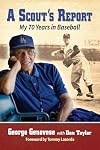
There isn't a baseball fan who won't enjoy Goerge Genovese's (1922-2015) baseball memoir, "A Scout's Report: My 70 Years in Baseball." Player, manager (he would be the first US citizen to manage a Mexican League team), field coordinator, and scout, Mr Genovese was born and raised in Depression-era New York City, specifically Staten Island. He was stung by the baseball bug early, as his older brothers played youth baseball in the city. Perhaps the itch turned to love when he was named the show more team's bat boy. Even more exciting for the eight-year old George and his team advanced to the city championship, which was played in Yankee Stadium. A career in the minors as a middle infielder (with a very brief cup-of-coffee with the American League's Washington Senators) led to Mr Genovese being hired as a minor-league manager by Branch Rickey. Managing and scouting both in the US and internationally, he utilized the lessons he learned as he eventually turned to scouting full-time.
Geneovese's fascinating baseball journey spanned crucial decades of the sport: the 1940s "golden age," the breaking of the segregation barriers in the 1940s and 1950s, the franchise re-locations and expansions of the 1950s and 1960s (Genovese would scout for the San Francisco Giants): Mr. Rickey confiding that he was deliberately "gutting" his Pittsburgh Pirates team so they could draft Roberto Clemente from the Brooklyn Dodgers; the discrimination he encountered while playing for and managing in cities and towns both north and south; his older brother, a minor-league coach, excited almost beyond words in describing this 17-year old kid he just saw play (Willie Mays); his own (disregarded) advice to his LA Dodger superiors to please, please!, check out this kid (Giancarlo Stanton).
Mr. Genovese's co-author, Dan Taylor, deserves a big shout-out. His writing surely made me feel as if I was having a comfortable sit as I listened to a baseball lifer tell his stories. Mr Taylor's expertise took me back in time, near to half a century ago now, to an afternoon and evening I had with my great-uncle, who was a baseball-lifer as well. (The club he was GM of lost the playoffs -- to Havana, Cuba. Like I said, a long time ago.) show less
Geneovese's fascinating baseball journey spanned crucial decades of the sport: the 1940s "golden age," the breaking of the segregation barriers in the 1940s and 1950s, the franchise re-locations and expansions of the 1950s and 1960s (Genovese would scout for the San Francisco Giants): Mr. Rickey confiding that he was deliberately "gutting" his Pittsburgh Pirates team so they could draft Roberto Clemente from the Brooklyn Dodgers; the discrimination he encountered while playing for and managing in cities and towns both north and south; his older brother, a minor-league coach, excited almost beyond words in describing this 17-year old kid he just saw play (Willie Mays); his own (disregarded) advice to his LA Dodger superiors to please, please!, check out this kid (Giancarlo Stanton).
Mr. Genovese's co-author, Dan Taylor, deserves a big shout-out. His writing surely made me feel as if I was having a comfortable sit as I listened to a baseball lifer tell his stories. Mr Taylor's expertise took me back in time, near to half a century ago now, to an afternoon and evening I had with my great-uncle, who was a baseball-lifer as well. (The club he was GM of lost the playoffs -- to Havana, Cuba. Like I said, a long time ago.) show less
 This review was written for LibraryThing Early Reviewers.
I had never heard of George Genovese when I requested this book from the Early Reviewers list, but after reading this story, I understand why. Genovese's book both states explicitly and shows anecdotally the ways in which scouts have often been overlooked by the media and other members of the baseball industry (such as Cooperstown), although a reliable scout (like Genovese) can dramatically affect the long-term success of a baseball franchise.
This book is framed chronologically, so it show more begins with the story of Genovese's early baseball endeavors and attempts to make a career in baseball. He played in the minor leagues for several years (with a break for military service), had one brief stint in the major leagues, and worked as a coach and assistant manager before being invited to be a scout. Genovese initially saw scouting as a demotion, but soon seemed to enjoy the challenges of identifying god players, maintaining relative secrecy, and mentoring his discovered players as they began careers in baseball.
Before reading this book, I had never really thought about player selections as an aspect of a team's long-term strategy, but the impact scouting could have on a professional team is best exemplified by Genovese's story about the Giants' starting lineup on September 13, 1973. He was surprised to be congratulated on the lineup (177) but soon discovered that he himself had scouted and signed 7 of the 9 players who began the game. His observations and acquisitions of many of these players are described earlier in the book, and--in many instances--show his specific attentiveness to minor details and support for players who otherwise might have been overlooked. Throughout the book, there are numerous stories of players whose mangers wanted to release them, only to be proven wrong after Genovese convinced the managers to give these players more chances or better support.
Anyone who enjoys the strategy aspect of baseball, or stories of baseball in the past, should acquire and read this book, which provides dozens of wonderful stories and a glimpse into an often-overlooked area of baseball strategy. It is one of the most enjoyable books I have ever read about baseball. show less
This book is framed chronologically, so it show more begins with the story of Genovese's early baseball endeavors and attempts to make a career in baseball. He played in the minor leagues for several years (with a break for military service), had one brief stint in the major leagues, and worked as a coach and assistant manager before being invited to be a scout. Genovese initially saw scouting as a demotion, but soon seemed to enjoy the challenges of identifying god players, maintaining relative secrecy, and mentoring his discovered players as they began careers in baseball.
Before reading this book, I had never really thought about player selections as an aspect of a team's long-term strategy, but the impact scouting could have on a professional team is best exemplified by Genovese's story about the Giants' starting lineup on September 13, 1973. He was surprised to be congratulated on the lineup (177) but soon discovered that he himself had scouted and signed 7 of the 9 players who began the game. His observations and acquisitions of many of these players are described earlier in the book, and--in many instances--show his specific attentiveness to minor details and support for players who otherwise might have been overlooked. Throughout the book, there are numerous stories of players whose mangers wanted to release them, only to be proven wrong after Genovese convinced the managers to give these players more chances or better support.
Anyone who enjoys the strategy aspect of baseball, or stories of baseball in the past, should acquire and read this book, which provides dozens of wonderful stories and a glimpse into an often-overlooked area of baseball strategy. It is one of the most enjoyable books I have ever read about baseball. show less
This review was written for LibraryThing Early Reviewers.After 70 years in baseball, George Genovese has seen it all as a player (though only briefly in the majors), a coach, a manager, and, over most of his baseball career, as one of the greatest scouts ever.
I enjoyed hearing about his days trying to break into baseball and also about his stories from World War 2. I especially enjoyed hearing about famous and not so famous players and the interactions he had with them as a fellow player, coach, and manager.
The bulk of the book, naturally, focuses show more on his career as a scout, including 30 years with the Giants. He set up a semi-pro team so that he could see potential players play. He explained how "bird dogs" work and talked extensively about many of the 250 players he signed. Sadly, he also talked about how the Moneyball revolutionary affected scouting.
For the baseball fan, this is an outstanding book. One I would highly recommend to those who follow the game and like to read about familiar parts of the game. show less
I enjoyed hearing about his days trying to break into baseball and also about his stories from World War 2. I especially enjoyed hearing about famous and not so famous players and the interactions he had with them as a fellow player, coach, and manager.
The bulk of the book, naturally, focuses show more on his career as a scout, including 30 years with the Giants. He set up a semi-pro team so that he could see potential players play. He explained how "bird dogs" work and talked extensively about many of the 250 players he signed. Sadly, he also talked about how the Moneyball revolutionary affected scouting.
For the baseball fan, this is an outstanding book. One I would highly recommend to those who follow the game and like to read about familiar parts of the game. show less
This review was written for LibraryThing Early Reviewers.I received a copy of this book through the LibraryThing Early Reviewers program.
I'd recommend this book to readers who enjoy both baseball history and memoirs. It's fun to see the author in the locker room, zinging Ty Cobb, or warming up on a minor-league field with Stan Musial, or scouting Bobby Bonds for Branch Rickey. One suspects that in the new Moneyball era, when everything is measurable, high-school games are videotaped and motion-captured, and no one flies under the radar, the role show more of scouts and the value placed on their subjective judgment will continue to diminish. Certainly, Genovese seems somewhat bitter about the way his own authority had faded by the end of his career.
I guess this is why people read memoirs: a bit of conflict; some inside dirt. In this case, it's fun to see inside the draft process, and we share Genovese's frustration as, in the 1984 draft, his Giants let his top prospects -- Mark McGwire and Greg Maddux -- get away. One gets the feeling that if management had just paid attention, the Giants would have won every game. After a while, this started to wear on me a bit. It really is somewhat startling to read that Genovese advised Kurt Russell to forget pro baseball and stick with acting, and suggested that Derryl Cousins might want to think about working as an umpire, but this book would really be improved by a few stories about "the ones that got away" -- famous players that didn't impress Genovese as high-schoolers, or recommendations that never panned out.
It comes through clearly that Genovese saw himself as an advocate and a mentor to the players he scouted -- whether first-round picks or undrafted free agents -- and as an expert whose ability was dedicated to the success of his organization. This attitude of service, together with seventy years' worth of baseball stories, make me glad I got to hear what he had to say. show less
I'd recommend this book to readers who enjoy both baseball history and memoirs. It's fun to see the author in the locker room, zinging Ty Cobb, or warming up on a minor-league field with Stan Musial, or scouting Bobby Bonds for Branch Rickey. One suspects that in the new Moneyball era, when everything is measurable, high-school games are videotaped and motion-captured, and no one flies under the radar, the role show more of scouts and the value placed on their subjective judgment will continue to diminish. Certainly, Genovese seems somewhat bitter about the way his own authority had faded by the end of his career.
I guess this is why people read memoirs: a bit of conflict; some inside dirt. In this case, it's fun to see inside the draft process, and we share Genovese's frustration as, in the 1984 draft, his Giants let his top prospects -- Mark McGwire and Greg Maddux -- get away. One gets the feeling that if management had just paid attention, the Giants would have won every game. After a while, this started to wear on me a bit. It really is somewhat startling to read that Genovese advised Kurt Russell to forget pro baseball and stick with acting, and suggested that Derryl Cousins might want to think about working as an umpire, but this book would really be improved by a few stories about "the ones that got away" -- famous players that didn't impress Genovese as high-schoolers, or recommendations that never panned out.
It comes through clearly that Genovese saw himself as an advocate and a mentor to the players he scouted -- whether first-round picks or undrafted free agents -- and as an expert whose ability was dedicated to the success of his organization. This attitude of service, together with seventy years' worth of baseball stories, make me glad I got to hear what he had to say. show less
This review was written for LibraryThing Early Reviewers.Lists
Statistics
- Works
- 3
- Members
- 35
- Popularity
- #405,583
- Rating
- 4.4
- Reviews
- 17
- ISBNs
- 9
