
Sextus Empiricus (160–210)
Author of Sextus Empiricus I: Outlines of Pyrrhonism
About the Author
Image credit: From Wikipedia
Works by Sextus Empiricus
Sextus Empiricus: Outlines of Scepticism (Cambridge Texts in the History of Philosophy) (1994) 162 copies
Sextus Empiricus: Against the Logicians (Cambridge Texts in the History of Philosophy) (1935) 138 copies
Sextus Empiricus: Selections from the Major Writings on Scepticism, Man, and God (Hackett Classics) (1985) 126 copies
Sextus Empiricus: Against the Ethicists: (Adversus Mathematicos XI) (Clarendon Later Ancient Philosophers) (1995) 17 copies
Sextus Empiricus: Against the Grammarians (Adversus Mathematicos I) (Clarendon Later Ancient Philosophers) (1998) 15 copies
Contra los dogmáticos / Against the dogmatic (Biblioteca clásica / Classical Library) (Spanish Edition) (1984) 8 copies
Сочинения в двух томах. Том 1 7 copies
Сочинения : в двух томах. Том 2 5 copies
Sextus Empiricus 5 copies
El arte de cultivar una mente abierta: Un manual de sabiduría clásica para vivir con la serenidad de un escéptico (Spanish Edition) (2022) 5 copies
Contro i matematici. Libri I-VI 3 copies
Opere filozofice vol. 1 1 copy
Opera, vols. 1-4 1 copy
Associated Works
Tagged
Common Knowledge
- Canonical name
- Sextus Empiricus
- Legal name
- Σέξτος Ἐμπειρικός
- Other names
- Sexto Empírico
- Birthdate
- 160
- Date of death
- 210
- Gender
- male
- Nationality
- Ancient Greece
- Places of residence
- Athens, Greece
- Place of death
- Alexandria, Egypt
- Map Location
- Greece
Members
Reviews
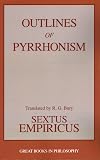
Getting through this book was a bit of a trial. I can say, though, that now having finished it, this philosophy impressed me even less than Epicureanism did, which doesn't say much for either, but says even less for Pyrrhonism.
Pyrrhonism can rightly be called the earliest school of philosophy devoted to skepticism. Now, before atheists wet themselves with glee, Pyrrhonism would have even denied the certitude of the empirical method that today's atheists adore. It really starts with the show more position that almost nothing is certain; so absolute non-committal is the desired outcome to all inquiry--if inquiry is to be considered beneficial at all, that is.
I couldn't help but think of the later philosophy of Descartes and the inane method of Cartesian doubt. It isn't surprising that one of Pascal's labels for Cartesians was Pyrrhonists. Descartes and the Pyrrhonists started with the denial of self-evident truth and believed that that denial was a pretext for a genuine philosophy of first principles. Of course, skepticism has had adherents in others, sometimes it is used constructively and sometimes not; but, as I said in my review of Descartes, a system of skepticism, or doubt, is a contradiction in terms. It is often pointless to even entertain it for any length of time. Basically, though, Pyrrhonism is guilty of the same errors as Cartesianism.
Sextus Empiricus was probably the most notable of the Pyrrhonists. With this book he laid out the methods and principles they appeal to when refuting the so-called dogmatists, which include Platonists, Stoics, Peripatetics, Cynics, Epicureans, etc. Pyrrhonism is really a one-trick pony. If you know a few of their methods, you pretty much know how a Pyrrhonist will handle any other philosophy. It is, if nothing else, predictable. I am personally glad it didn't hold much sway in the history of philosophy. Almost no effort would have been made towards understanding the world if it had. One can be glad that many others saw it as intellectually bankrupt.
One method of refutation that Sextus Empiricus appeals to regularly is the perpetual aggregate of evidence; namely, that all evidence used to support a claim must also require evidence, and that requires further evidence, and that further evidence… ad infinitum. Since accumulating infinite evidence is absurd (to Empiricus) all evidence used by dogmatists must be rejected. Another of his go-to methods is the lack of agreement between dogmatists. He regularly uses that to show that no dogmatic philosophy is compelling because different schools may claim different and contradictory things. He also denies the state of transition between states, e.g. stasis/motion, learning/teaching, cause/effect, etc, are seen as doubtful because there is no clear state of transition between them.
He isn't afraid to use the dogmatists methods as well. With no amount of irony, Sextus Empiricus will even use syllogism to prove syllogism is erroneous. While one might think that Empiricus should either adhere to intelligible or empirical evidence to refute all competing philosophies, he must consistently show both to be doubtful, while at the same time appealing to both! You have to compliment him on his ability to use the methods he claims are dubious. It's almost a kind of philosophical chicanery. The only thing that Empiricus apparently thinks is incontrovertible is the certitude of non-contradiction and the absurdity of perpetual aggregation of evidence. He doesn't explain why in these instances alone we can be certain. If he were consistent, he would not only have to reject those, but also all appeals to syllogistic argument as well. Of course, if he did that, there would be no book and his philosophy would be exposed as the pedantic foolery it is.
I will admit to not caring for skeptical philosophy, so I am probably too biased to review this book fairly. I give the book between 2 and 2 and-a-half stars. Some arguments are mildly interesting, but I would say they are few and far between. show less
Pyrrhonism can rightly be called the earliest school of philosophy devoted to skepticism. Now, before atheists wet themselves with glee, Pyrrhonism would have even denied the certitude of the empirical method that today's atheists adore. It really starts with the show more position that almost nothing is certain; so absolute non-committal is the desired outcome to all inquiry--if inquiry is to be considered beneficial at all, that is.
I couldn't help but think of the later philosophy of Descartes and the inane method of Cartesian doubt. It isn't surprising that one of Pascal's labels for Cartesians was Pyrrhonists. Descartes and the Pyrrhonists started with the denial of self-evident truth and believed that that denial was a pretext for a genuine philosophy of first principles. Of course, skepticism has had adherents in others, sometimes it is used constructively and sometimes not; but, as I said in my review of Descartes, a system of skepticism, or doubt, is a contradiction in terms. It is often pointless to even entertain it for any length of time. Basically, though, Pyrrhonism is guilty of the same errors as Cartesianism.
Sextus Empiricus was probably the most notable of the Pyrrhonists. With this book he laid out the methods and principles they appeal to when refuting the so-called dogmatists, which include Platonists, Stoics, Peripatetics, Cynics, Epicureans, etc. Pyrrhonism is really a one-trick pony. If you know a few of their methods, you pretty much know how a Pyrrhonist will handle any other philosophy. It is, if nothing else, predictable. I am personally glad it didn't hold much sway in the history of philosophy. Almost no effort would have been made towards understanding the world if it had. One can be glad that many others saw it as intellectually bankrupt.
One method of refutation that Sextus Empiricus appeals to regularly is the perpetual aggregate of evidence; namely, that all evidence used to support a claim must also require evidence, and that requires further evidence, and that further evidence… ad infinitum. Since accumulating infinite evidence is absurd (to Empiricus) all evidence used by dogmatists must be rejected. Another of his go-to methods is the lack of agreement between dogmatists. He regularly uses that to show that no dogmatic philosophy is compelling because different schools may claim different and contradictory things. He also denies the state of transition between states, e.g. stasis/motion, learning/teaching, cause/effect, etc, are seen as doubtful because there is no clear state of transition between them.
He isn't afraid to use the dogmatists methods as well. With no amount of irony, Sextus Empiricus will even use syllogism to prove syllogism is erroneous. While one might think that Empiricus should either adhere to intelligible or empirical evidence to refute all competing philosophies, he must consistently show both to be doubtful, while at the same time appealing to both! You have to compliment him on his ability to use the methods he claims are dubious. It's almost a kind of philosophical chicanery. The only thing that Empiricus apparently thinks is incontrovertible is the certitude of non-contradiction and the absurdity of perpetual aggregation of evidence. He doesn't explain why in these instances alone we can be certain. If he were consistent, he would not only have to reject those, but also all appeals to syllogistic argument as well. Of course, if he did that, there would be no book and his philosophy would be exposed as the pedantic foolery it is.
I will admit to not caring for skeptical philosophy, so I am probably too biased to review this book fairly. I give the book between 2 and 2 and-a-half stars. Some arguments are mildly interesting, but I would say they are few and far between. show less
I guess my problem with Western philosophy is that it is always so long-winded and thus if something can be said in 100 words rather than 10, the philosophy sounds wiser and much more grave than it really is.
I can't believe how long this book is. Had to give up mid way because it just sounded like the rants of petulant children.
I can't believe how long this book is. Had to give up mid way because it just sounded like the rants of petulant children.

ESBOZOS PIRRÓNICOS
sta obra en tres libros es la principal fuente que poseemos sobre la escuela escéptica de filosofía y, en general, sobre la filosofía helenística. Sexto Empírico da gran cantidad de argumentos a favor del escepticismo y ataca a la filosofía dogmática (que pretendía poder alcanzar el conocimiento absoluto en cuestiones de moral y científicas). Es el suyo un enfoque relativista y fenomenista, antimetafísico y empirista. Sin llegar a los extremos del escepticismo show more acerca de la inexistencia del mundo, limita el conocimiento que sobre él podemos obtener al modo en que nos afectan los objetos de la realidad, sin que podamos afirmar nada seguro acerca de las cosas en sí. En ética la única guía fiable es la del sentido común y la experiencia empírica. En su oposición a las explicaciones causales que vinculan los fenómenos observables y la realidad en sí, hace una crítica del silogismo, al que considera un círculo vicioso, y pone en entredicho la noción de signo. Ataca la idea de divinidad (sobre todo la de la escuela estoica) con diversas argumentaciones, y subraya la necesidad de mantener la suspensión del juicio. En fin, Sexto registra con todo detalle la metodología de Pirrón y sus seguidores, en un análisis que se abstiene de todo artificio literario y se ciñe al vocabulario técnico y la estructura lógica de su obra. show less
sta obra en tres libros es la principal fuente que poseemos sobre la escuela escéptica de filosofía y, en general, sobre la filosofía helenística. Sexto Empírico da gran cantidad de argumentos a favor del escepticismo y ataca a la filosofía dogmática (que pretendía poder alcanzar el conocimiento absoluto en cuestiones de moral y científicas). Es el suyo un enfoque relativista y fenomenista, antimetafísico y empirista. Sin llegar a los extremos del escepticismo show more acerca de la inexistencia del mundo, limita el conocimiento que sobre él podemos obtener al modo en que nos afectan los objetos de la realidad, sin que podamos afirmar nada seguro acerca de las cosas en sí. En ética la única guía fiable es la del sentido común y la experiencia empírica. En su oposición a las explicaciones causales que vinculan los fenómenos observables y la realidad en sí, hace una crítica del silogismo, al que considera un círculo vicioso, y pone en entredicho la noción de signo. Ataca la idea de divinidad (sobre todo la de la escuela estoica) con diversas argumentaciones, y subraya la necesidad de mantener la suspensión del juicio. En fin, Sexto registra con todo detalle la metodología de Pirrón y sus seguidores, en un análisis que se abstiene de todo artificio literario y se ciñe al vocabulario técnico y la estructura lógica de su obra. show less
Lists
Awards

You May Also Like


Associated Authors
Statistics
- Works
- 45
- Also by
- 1
- Members
- 1,107
- Popularity
- #23,219
- Rating
- 3.9
- Reviews
- 3
- ISBNs
- 71
- Languages
- 10