
Mike Phillips (5) (1971–)
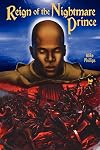
Author of Reign of the Nightmare Prince
For other authors named Mike Phillips, see the disambiguation page.
Works by Mike Phillips
Tagged
Common Knowledge
- Legal name
- Phillips, Michael Patrick
- Birthdate
- 1971
- Gender
- male
- Places of residence
- Rockford, Michigan, USA
- Associated Place (for map)
- Rockford, Michigan
Members
Reviews
After finishing this book my first thought was, "What the crap did I just read?" It's hard to compose a plot summary because most of this novel is frankly inexplicable. The common phrase, "Show don't tell" is a great piece of advice and one this author could benefit from following. Crazily enough, it would also help if the author told a little more too.
I often found myself wondering who the various characters are and why I should care. Does this novel take place on earth or some other show more planet? Who are the strange invaders? Aliens? Refugees from a far more advanced culture? There are Jinn's witches, ghosts, the list goes on and on. None of it makes any sense.
Here's what I got out of it: There is a remote jungle civilization, basically stone age, maybe bronze age but with the addition of shamanistic magic. The civilization finds themselves under attack by an invading force of highly advanced outsiders. One man must set out on a quest to save his people.
This novel is extremely disorienting. Characters wander in an out with no apparent purpose. The most jarring is the main character's love interest. She is introduced as someone he knew as a child but hasn't seen in years. Literally two days later they are married. The worst part is they don't even seem to like each other. She is abrasive and emasculating. He is insensitive and juvenile. After some extremely uncomfortable honeymoon sequences, she disappears from the book for the rest of the novel, just as abruptly as she arrived. Gross. Just awful from beginning to end. show less
I often found myself wondering who the various characters are and why I should care. Does this novel take place on earth or some other show more planet? Who are the strange invaders? Aliens? Refugees from a far more advanced culture? There are Jinn's witches, ghosts, the list goes on and on. None of it makes any sense.
Here's what I got out of it: There is a remote jungle civilization, basically stone age, maybe bronze age but with the addition of shamanistic magic. The civilization finds themselves under attack by an invading force of highly advanced outsiders. One man must set out on a quest to save his people.
This novel is extremely disorienting. Characters wander in an out with no apparent purpose. The most jarring is the main character's love interest. She is introduced as someone he knew as a child but hasn't seen in years. Literally two days later they are married. The worst part is they don't even seem to like each other. She is abrasive and emasculating. He is insensitive and juvenile. After some extremely uncomfortable honeymoon sequences, she disappears from the book for the rest of the novel, just as abruptly as she arrived. Gross. Just awful from beginning to end. show less
 This review was written for LibraryThing Early Reviewers.
There’s a long tradition among Western writers of lionising ancient ways of life, as if there’s something better about giving up all the trappings of modernity and wallowing about in the pain and dirt. The myth of the noble savage is responsible for such idiotic beliefs as the power of alternative medicine and the idea that anything that refutes the scientific process is necessarily true. Worst of all, it gave us Avatar – a movie that makes Smurfs 3D look like Citizen Kane.
Reign of the show more Nightmare Prince is just like Avatar – noble savages in tune with nature are attacked by evil technologists who want to take their resources – but differs in one respect; you care what happens. The story’s told from the point of view of one of the alien natives who’s returning from their version of Walkabout to find out monsters are killing off the rest of his people, and follows his attempts to muster a defence in the face of impossible odds.
Although it’s an entertaining and fun read, it’s not explained why the aboriginal population of an alien planet feels so human and a lot of the non-native attackers are almost as one-dimensional as Jake “I see you” Sully. Also, the end was so abrupt it felt like a sixth grader who’s suddenly reached the word limit on an English essay but don’t let that put you off.
If you’ve got some downtime while you’re committing genocide on an alien planet you could do worse than Mike Phillips’ début.
http://bit.ly/oWvXqJ show less
Reign of the show more Nightmare Prince is just like Avatar – noble savages in tune with nature are attacked by evil technologists who want to take their resources – but differs in one respect; you care what happens. The story’s told from the point of view of one of the alien natives who’s returning from their version of Walkabout to find out monsters are killing off the rest of his people, and follows his attempts to muster a defence in the face of impossible odds.
Although it’s an entertaining and fun read, it’s not explained why the aboriginal population of an alien planet feels so human and a lot of the non-native attackers are almost as one-dimensional as Jake “I see you” Sully. Also, the end was so abrupt it felt like a sixth grader who’s suddenly reached the word limit on an English essay but don’t let that put you off.
If you’ve got some downtime while you’re committing genocide on an alien planet you could do worse than Mike Phillips’ début.
http://bit.ly/oWvXqJ show less
This review was written for LibraryThing Early Reviewers.Reign of the Nightmare Prince is an Avatar-type story, without the avatars. The decaying Earth is desperate to find new worlds and does not care about indigenous people, who are designated 'hostiles.' An unusual, and effective twist is that parts of the story is told from the invaders' point of view; we see their tensions within the group, and dangers on an unfamiliar planet, and their complete disregard for life on other worlds, coupled with a complete lack of empathy for other people. show more Earth is now a terrible place to live, and finding other more pleasant worlds is all that matters.
The beginning is a little slow, but well worth persisting, as the story becomes more involving and exciting so that you are left breathless, and rooting for the hero, Rakam.
I believe that young people would enjoy this book very much; it might even encourage boys to read.
I have to admit that I still haven't worked out where the title came from. show less
The beginning is a little slow, but well worth persisting, as the story becomes more involving and exciting so that you are left breathless, and rooting for the hero, Rakam.
I believe that young people would enjoy this book very much; it might even encourage boys to read.
I have to admit that I still haven't worked out where the title came from. show less
This review was written for LibraryThing Early Reviewers.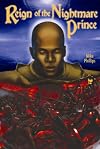
I truly enjoyed Reign of the Nightmare Prince, a thought provoking, clever, new, science fiction novel. There is a mystery for the reader to solve, just as the novel's native inhabitants must determine who these new "Mashaitani" (if I am not mistaken, I believe the author has used a middle-eastern word "Shaitan", which means Satan or the Devil and added an "i" to indicate that these invaders are "from the Devil", and then inferring from the use of "Ma" as a prefix before the proper names for show more other various groups of people in the novella, I believe the "Ma" means that they are "people of, or from, Satan, or the Devil" - I hope I have deciphered this terminology correctly) are, so they can defeat them, or they will be wiped from their own planet. The pacing is great; I never lost interest and was compelled to keep reading.
It is organized without a primary narrator. Each chapter is told from the perspective of one of several main characters (and once from someone minor, with the purpose of giving the reader a better understanding of what is happening in this world as a whole). Apparently, several other readers found it too jarring or difficult to understand when the author changed the viewpoint -- primarily back and forth between someone from the native population and then sometimes the following chapter would be devoted to the viewpoint of one of the invaders. Personally, I was completely able to follow the various story lines and was intrigued as to the mystery of the invaders. I was pleased to have been able to figure out their true purpose on the planet very early. This was possible because the story is well written. Phillips discloses the situation in a slow but steady manner, keeping the mystery going, in an effort I think, to force people to wonder if this is a situation that is happening here in our world called Earth (there is so much about this story that makes a reader think about the way Africa was colonized by the Europeans, and is still being raped by the West today) rather than the far off planet with two moons (although the invaders very well might be from Earth). Ultimately, all the mysteries are resolved by the end. However, he has left two very small threads only partially resolved; perhaps Phillips did this with the intention that they be used to develop conflicts and drama in a new book or two as sequels.
---------------------WARNING---------------------
Reading further will divulge too much about this book, and is for those who enjoy literary analysis.
-- EXCEPT for the FINAL PARAGRAPH --
That section would still be a very useful review and will not give anything away.
-------------------------------------------------
One thread involves the remaining Mashaitani (whose numbers are decimated after the final assault), and their backup plan if everything went wrong in the battle. Prior to the final assault, the leader Crenshaw had told Smitty to bring any of the remaining trustworthy survivors -- killing the ones he cannot trust -- and lead them to a prearranged location disclosed by Crenshaw to Smitty. The survivors were to gather together and follow the instructions to travel to the plains over the mountains, where they were to wait for the imminent arrival of the colonists' ships and to try and hook up with the coming colonists and their space ships. They would pretend to be marooned scientists from an earlier expedition, with the ultimate hope that Crenshaw, Smitty and the few others would be able to take the next transport home within 5 years. They would have to keep the true nature of their mission from the colonists. It had been Crenshaw's secret mission to wipe the Natives from the planet by not only killing them and then cremating their remains, but also by eliminating any signs that they had ever existed. This is why they had destroyed the holy places, including any written marks on various stones and trees, as well as their huts and villages. They were being paid a big bonus by "the company" to produce an empty planet, all ready for the coming colonists to inhabit, without a humanoid native population with whom to fight or compete. Had all gone as planned, it had been Crenshaw's secret desire to take, with his men, the capitol city and the neighboring mines and rule all as its governor.
The other thread would be Rakam returning to help free Timbo, who is under the evil influence of a Jinn, and his army, lost in the haunted forest with the souls of the Choklotan, who are all at the mercy of the Muklak. In this book he has promised to return to help free the souls of the Choklotan from the Muklak, as well as Timbo and his people, but only after he defeats the invaders. The book ends with him having accomplished this goal and we assume that once he has recovered from his injuries from that final showdown with the invaders, he will honor his promise and return to the haunted forest to help them all.
The Characters are well developed and likeable. All have recognizable voices, differing sufficiently from one another so that at the beginning of each chapter, the reader quickly knows which person is currently the focus and narrator. They are not stiff or stereotypes. Even the antagonists have some redeeming qualities readers can identify and appreciate; perhaps some readers can even like them. All of this is to Phillips' credit. It even reminds me of the descriptive style of Frank Herbert (my favorite Sci-Fi writer); he also had each chapter devoted to one perspective from a variety of numerous characters in his books (sometimes one of the main characters, sometimes one of the planet's ordinary subjects - a lowly soldier or even a humble servant). Another aspect that reminds me of Frank Herbert is the interconnection of all the living things of this planet with the two moons...Phillips even has the rocks and rivers having influential life force energy as well as plants and animals - this was especially notable in Mabetu's spirit journey to save Rakam. Frank Herbert was almost obsessed with the importance of ecology and the energy of a living planet, even giving sentient consciousness to ecosystems or insect hives. Herbert did all this I believe in an effort to use science fiction to explore the problems of exploiting our planet, with the hopes of enlightening readers to the current problems facing our planet.
The very best Sci-Fi uses an alien setting to expose and examine problems in our own real world. I thoroughly enjoyed Phillips' clever use of the tragedies of the colonization of the African continent by Europeans (which is an ongoing situation under the guise of the global economy) as well as Americans and other Westernized nationals, including the emerging Chinese. I have read about and seen news focusing on how villages occupying lands discovered to have oil have been surgically attacked by mercenaries - it is burned to the ground, the people with the village. The mercenaries are supposed to burn away any remnant of the village, so that no one can prove it had ever been there. Sadly, these things are done with the consent of the government because they have been paid a great deal of money to look the other way by the oil company. Sometimes, the mercenaries are members of that country's own military. Some people have managed to escape with their lives and are speaking out about this horror. Africa is still a continent rich with natural resources attracting foreigners attempting to take what they want by any means. One has only to look at how the middle class (necessary to any republic or democratic country for the continuing growth, economic health and welfare of all its country's citizenry) disappears and the people become impoverished, while a few leaders of that country become wealthy (and the countryside becomes polluted - where the rivers are no longer fit to drink and the fish have died off, so that there are no fish to feed the people, and the waters are poisonous to the plants in the fields, thus they are barren and the people stave, or they are poisoned by the few plants that do grow because they have sucked up the poisons through their root systems from the highly polluted water) whenever oil is discovered in a particular country or area. In Africa, it is actually not in the best interests of the people as a whole, for the West to discover some natural resource it desires. It always ends with the people, as well as the land, losing out.
I wish to mention two other aspects of the novel which pleased me. Rakam's life is saved by an otter, who he names Betu. She brings him fish when he was nearly dying. She not only saved his life, she represents the Almighty gifting him with divine help (a reference is made later in the book that otters are messengers from the Almighty). Perhaps the Almighty (in Rakam's universe) has sent him Betu because Rakam is going to be the instrument to save his people and planet, but also as a reward for having survived the temptation from the Jinn. Mike Phillips may not be aware of this but in the early Christian mythos in Ireland, otters were believed to bring fish to aesthetic monks isolated on rocky islands. The fish not only represented physical sustenance, but also symbolized spiritual nourishment since the fish was a symbol for Christ (this also is a symbol for the eating of the Eucharist). I personally believe that this tradition of otters saving man's body and spirit with gifts of fish predates Christianity. I am sure it was unintentional on Phillip's part, but the coincidence might be serendipitous. In any case, the relationship between Rakam and Betu is a sweet and gentle one and brings joy and happiness to situations within the story that might otherwise be too sad.
The other aspect that pleased me was the romance that develops between Rakam and the princess. The writing allows the reader to feel the relationship blossom without any coarse sexual descriptions. Even the killings lack gory descriptions, yet the crime of genocide is still comprehended. It is refreshing to find an author who can convey both horror and romance without explicitness. This novel is enjoyable for adults and also can be read safely by youngsters.
.....................................................
.........................END.........................
-----DISCLOSURE------
I received this book through a LibraryThing's early review give away in exchange for an honest review after finishing the book. I do not know Mike Phillips, his agent or anyone from his publisher. There is nothing that could have biased my review. show less
It is organized without a primary narrator. Each chapter is told from the perspective of one of several main characters (and once from someone minor, with the purpose of giving the reader a better understanding of what is happening in this world as a whole). Apparently, several other readers found it too jarring or difficult to understand when the author changed the viewpoint -- primarily back and forth between someone from the native population and then sometimes the following chapter would be devoted to the viewpoint of one of the invaders. Personally, I was completely able to follow the various story lines and was intrigued as to the mystery of the invaders. I was pleased to have been able to figure out their true purpose on the planet very early. This was possible because the story is well written. Phillips discloses the situation in a slow but steady manner, keeping the mystery going, in an effort I think, to force people to wonder if this is a situation that is happening here in our world called Earth (there is so much about this story that makes a reader think about the way Africa was colonized by the Europeans, and is still being raped by the West today) rather than the far off planet with two moons (although the invaders very well might be from Earth). Ultimately, all the mysteries are resolved by the end. However, he has left two very small threads only partially resolved; perhaps Phillips did this with the intention that they be used to develop conflicts and drama in a new book or two as sequels.
---------------------WARNING---------------------
Reading further will divulge too much about this book, and is for those who enjoy literary analysis.
-- EXCEPT for the FINAL PARAGRAPH --
That section would still be a very useful review and will not give anything away.
-------------------------------------------------
One thread involves the remaining Mashaitani (whose numbers are decimated after the final assault), and their backup plan if everything went wrong in the battle. Prior to the final assault, the leader Crenshaw had told Smitty to bring any of the remaining trustworthy survivors -- killing the ones he cannot trust -- and lead them to a prearranged location disclosed by Crenshaw to Smitty. The survivors were to gather together and follow the instructions to travel to the plains over the mountains, where they were to wait for the imminent arrival of the colonists' ships and to try and hook up with the coming colonists and their space ships. They would pretend to be marooned scientists from an earlier expedition, with the ultimate hope that Crenshaw, Smitty and the few others would be able to take the next transport home within 5 years. They would have to keep the true nature of their mission from the colonists. It had been Crenshaw's secret mission to wipe the Natives from the planet by not only killing them and then cremating their remains, but also by eliminating any signs that they had ever existed. This is why they had destroyed the holy places, including any written marks on various stones and trees, as well as their huts and villages. They were being paid a big bonus by "the company" to produce an empty planet, all ready for the coming colonists to inhabit, without a humanoid native population with whom to fight or compete. Had all gone as planned, it had been Crenshaw's secret desire to take, with his men, the capitol city and the neighboring mines and rule all as its governor.
The other thread would be Rakam returning to help free Timbo, who is under the evil influence of a Jinn, and his army, lost in the haunted forest with the souls of the Choklotan, who are all at the mercy of the Muklak. In this book he has promised to return to help free the souls of the Choklotan from the Muklak, as well as Timbo and his people, but only after he defeats the invaders. The book ends with him having accomplished this goal and we assume that once he has recovered from his injuries from that final showdown with the invaders, he will honor his promise and return to the haunted forest to help them all.
The Characters are well developed and likeable. All have recognizable voices, differing sufficiently from one another so that at the beginning of each chapter, the reader quickly knows which person is currently the focus and narrator. They are not stiff or stereotypes. Even the antagonists have some redeeming qualities readers can identify and appreciate; perhaps some readers can even like them. All of this is to Phillips' credit. It even reminds me of the descriptive style of Frank Herbert (my favorite Sci-Fi writer); he also had each chapter devoted to one perspective from a variety of numerous characters in his books (sometimes one of the main characters, sometimes one of the planet's ordinary subjects - a lowly soldier or even a humble servant). Another aspect that reminds me of Frank Herbert is the interconnection of all the living things of this planet with the two moons...Phillips even has the rocks and rivers having influential life force energy as well as plants and animals - this was especially notable in Mabetu's spirit journey to save Rakam. Frank Herbert was almost obsessed with the importance of ecology and the energy of a living planet, even giving sentient consciousness to ecosystems or insect hives. Herbert did all this I believe in an effort to use science fiction to explore the problems of exploiting our planet, with the hopes of enlightening readers to the current problems facing our planet.
The very best Sci-Fi uses an alien setting to expose and examine problems in our own real world. I thoroughly enjoyed Phillips' clever use of the tragedies of the colonization of the African continent by Europeans (which is an ongoing situation under the guise of the global economy) as well as Americans and other Westernized nationals, including the emerging Chinese. I have read about and seen news focusing on how villages occupying lands discovered to have oil have been surgically attacked by mercenaries - it is burned to the ground, the people with the village. The mercenaries are supposed to burn away any remnant of the village, so that no one can prove it had ever been there. Sadly, these things are done with the consent of the government because they have been paid a great deal of money to look the other way by the oil company. Sometimes, the mercenaries are members of that country's own military. Some people have managed to escape with their lives and are speaking out about this horror. Africa is still a continent rich with natural resources attracting foreigners attempting to take what they want by any means. One has only to look at how the middle class (necessary to any republic or democratic country for the continuing growth, economic health and welfare of all its country's citizenry) disappears and the people become impoverished, while a few leaders of that country become wealthy (and the countryside becomes polluted - where the rivers are no longer fit to drink and the fish have died off, so that there are no fish to feed the people, and the waters are poisonous to the plants in the fields, thus they are barren and the people stave, or they are poisoned by the few plants that do grow because they have sucked up the poisons through their root systems from the highly polluted water) whenever oil is discovered in a particular country or area. In Africa, it is actually not in the best interests of the people as a whole, for the West to discover some natural resource it desires. It always ends with the people, as well as the land, losing out.
I wish to mention two other aspects of the novel which pleased me. Rakam's life is saved by an otter, who he names Betu. She brings him fish when he was nearly dying. She not only saved his life, she represents the Almighty gifting him with divine help (a reference is made later in the book that otters are messengers from the Almighty). Perhaps the Almighty (in Rakam's universe) has sent him Betu because Rakam is going to be the instrument to save his people and planet, but also as a reward for having survived the temptation from the Jinn. Mike Phillips may not be aware of this but in the early Christian mythos in Ireland, otters were believed to bring fish to aesthetic monks isolated on rocky islands. The fish not only represented physical sustenance, but also symbolized spiritual nourishment since the fish was a symbol for Christ (this also is a symbol for the eating of the Eucharist). I personally believe that this tradition of otters saving man's body and spirit with gifts of fish predates Christianity. I am sure it was unintentional on Phillip's part, but the coincidence might be serendipitous. In any case, the relationship between Rakam and Betu is a sweet and gentle one and brings joy and happiness to situations within the story that might otherwise be too sad.
The other aspect that pleased me was the romance that develops between Rakam and the princess. The writing allows the reader to feel the relationship blossom without any coarse sexual descriptions. Even the killings lack gory descriptions, yet the crime of genocide is still comprehended. It is refreshing to find an author who can convey both horror and romance without explicitness. This novel is enjoyable for adults and also can be read safely by youngsters.
.....................................................
.........................END.........................
-----DISCLOSURE------
I received this book through a LibraryThing's early review give away in exchange for an honest review after finishing the book. I do not know Mike Phillips, his agent or anyone from his publisher. There is nothing that could have biased my review. show less
This review was written for LibraryThing Early Reviewers.Statistics
- Works
- 5
- Members
- 79
- Popularity
- #226,896
- Rating
- 3.3
- Reviews
- 41
- ISBNs
- 72
- Languages
- 5
