
About the Author
Nessa Carey is a visiting professor at Imperial College in London and currently works in the biotechnology and pharmaceutical industries, where she has specialized in epigenetics for nearly a decade.
Works by Nessa Carey
The Epigenetics Revolution: How Modern Biology Is Rewriting Our Understanding of Genetics, Disease, and Inheritance (2012) 536 copies, 10 reviews
Hacking the Code of Life: How gene editing will rewrite our futures (Hot Science) (2019) 39 copies, 2 reviews
Tagged
Common Knowledge
- Birthdate
- 20th century
- Gender
- female
- Organizations
- Imperial College London
- Nationality
- UK
- Places of residence
- Norfolk, England, UK
- Associated Place (for map)
- England, UK
Members
Reviews
The Epigenetics Revolution: How Modern Biology is Rewriting Our Understanding of Genetics, Disease and Inheritance by Nessa Carey
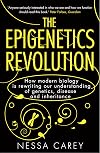
DNA --> mRNA --> proteins --> you understand life! Well, it was never that simple but now it's not even an accurate description of all the functions of DNA. Genes exist in binary "off or on" states. Wrong! Many genes effectively have dimmer switches that allow a continuous spectrum of activation from fully off to some maximum rate of expression. 98% of our DNA is "junk." Wrong! Only 2% codes for proteins but various parts of the rest are now understood to serve several functions, from acting show more as the above mentioned dimmer switches, to coding for types of RNA that serve functions other than being an intermediary in protein production, including suppressing cancerous changes in cells. Things that happened to your parents or even grandparents can affect your phenotype, e.g. how prone you are to obesity.
In other words, however complicated you thought molecular biology was twenty years ago, when people were hubristically saying, "we almost understand 'the cell' completely," it turns out it's way more complicated than that. The revolution described here bares a resemblance to that that occurred in physics at the turn of the 20th Century, where comments regarding physics being essentially complete turned out to be spectacularly wrong. What is this revolution? It's the understanding that the structure of DNA cannot be functionally reduced to a list of base-pairs. The Watson-Crick double-helix model of DNA isn't the whole story. If it was, all your autosomes (non-sex chromosomes) would be metres long and never fit inside a microscopic cell. The fact that chromosomes fold up into tight, tiny balls that sit roughly in the middle of each cell was known before the fact that they are made of DNA was. It turns out that this folding up has profound consequences beyond just allowing the molecules to fit in a confined space. So does where methyl groups are present on base pairs and how many are present. The same goes for histones. Ditto acetyl groups. Read this book if you want to know what these consequences are in such diverse contexts as aging, mental health, cancer, obesity and anorexia.
If you don't know what any of the above mentioned molecules are, don't worry; this book gives good, comprehensible explanations that I could easily follow from hazy memories of school chemistry and there is a glossary, in case you forget something. It's an incredibly useful few pages and yet it's often neglected in pop sci books.
There are other things I can strongly recommend about this book. It is well referenced, so if you're inclined to look up the technical details and verify what Nessa is saying, you can. Nessa is mostly presenting work that is not controvercial today, even though it is radical by standards of the end of last century. When she does talk about matters that are still murky - when there is still no consensus today - she tells you. She also isn't on a giant self-promotion exercise for her own theories, as many pop sci writers are. All of this makes her trust-worthy in my eyes, in stark contrast to many pop sci authors.
If you are at all interested in molecular biology, this book is worth your time. It's contents fascinated me. show less
In other words, however complicated you thought molecular biology was twenty years ago, when people were hubristically saying, "we almost understand 'the cell' completely," it turns out it's way more complicated than that. The revolution described here bares a resemblance to that that occurred in physics at the turn of the 20th Century, where comments regarding physics being essentially complete turned out to be spectacularly wrong. What is this revolution? It's the understanding that the structure of DNA cannot be functionally reduced to a list of base-pairs. The Watson-Crick double-helix model of DNA isn't the whole story. If it was, all your autosomes (non-sex chromosomes) would be metres long and never fit inside a microscopic cell. The fact that chromosomes fold up into tight, tiny balls that sit roughly in the middle of each cell was known before the fact that they are made of DNA was. It turns out that this folding up has profound consequences beyond just allowing the molecules to fit in a confined space. So does where methyl groups are present on base pairs and how many are present. The same goes for histones. Ditto acetyl groups. Read this book if you want to know what these consequences are in such diverse contexts as aging, mental health, cancer, obesity and anorexia.
If you don't know what any of the above mentioned molecules are, don't worry; this book gives good, comprehensible explanations that I could easily follow from hazy memories of school chemistry and there is a glossary, in case you forget something. It's an incredibly useful few pages and yet it's often neglected in pop sci books.
There are other things I can strongly recommend about this book. It is well referenced, so if you're inclined to look up the technical details and verify what Nessa is saying, you can. Nessa is mostly presenting work that is not controvercial today, even though it is radical by standards of the end of last century. When she does talk about matters that are still murky - when there is still no consensus today - she tells you. She also isn't on a giant self-promotion exercise for her own theories, as many pop sci writers are. All of this makes her trust-worthy in my eyes, in stark contrast to many pop sci authors.
If you are at all interested in molecular biology, this book is worth your time. It's contents fascinated me. show less
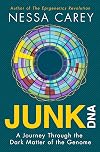
98% of our DNA has until recently been considered "junk." That's the percentage that's not devoted to recipeing proteins, which for decades was supposed to be what DNA was all about. But the view of so-called junk DNA has been slowly changing. Better tools and procedures have allowed researchers to locate mutations implicated in rare genetic diseases, and many of these mutations turn out to be located in the "junk" areas. As clues mount, scientists can start connecting dots and developing show more theories regarding multitudes of previously unconsidered ways in which genetic errors can cause problems.
Ms. Carey's book does not make many generalizations about junk DNA's overall purposes might be. Instead she relates disparate tales of research results as relating to known genetic disorders. Her stories exemplify the strange, non-intuitive ways that genetic information can interact. It doesn't seem likely that science will soon have an orderly story to tell about how it all works.
Many of the interactions are actually epigenetic rather than genetic, meaning that they concern markers added to the the genetic code rather than the code itself. Epigenetic markings can be prompted by changes in the cell environment. Their purpose is to enable, amplify, damp down, or turn off individual genes. Their role and presence vastly complicates the whole genetic picture. Richard Dawkins's view of genes as simple, coherent actors seems increasingly naive.
This book is well and entertainingly written, but may be too technical for some readers. Something of a refresher course in cell biology might be advisable before giving this a go. show less
Ms. Carey's book does not make many generalizations about junk DNA's overall purposes might be. Instead she relates disparate tales of research results as relating to known genetic disorders. Her stories exemplify the strange, non-intuitive ways that genetic information can interact. It doesn't seem likely that science will soon have an orderly story to tell about how it all works.
Many of the interactions are actually epigenetic rather than genetic, meaning that they concern markers added to the the genetic code rather than the code itself. Epigenetic markings can be prompted by changes in the cell environment. Their purpose is to enable, amplify, damp down, or turn off individual genes. Their role and presence vastly complicates the whole genetic picture. Richard Dawkins's view of genes as simple, coherent actors seems increasingly naive.
This book is well and entertainingly written, but may be too technical for some readers. Something of a refresher course in cell biology might be advisable before giving this a go. show less
Carey follows up her book on epigenetics (essentially the effects of parts of DNA that aren't the base-pairs that make up genes) with another that looks at the 98% of your DNA that doesn't code for proteins, generally referred to as "junk" because it was believed it had no biological function.
This model, that all you need to understand cellular life is a list of the protein-coding segments of DNA, has completely colapsed. Numerous DNA sequences that have nothing directly to do with protein show more manufacture have been found to be essential to the proper functioning of cells in complex life. You can learn about many of them here, in a very clear, fair and balanced way.
I have become interested in the actual chemistry of the various processes Carey describes in her first two books at the level of metaphor. I'm not sure where to find out about that, short of an academic text. Similarly, although the references to the academic literature are all present and correct, Carey glosses over the details of the experiments used to reach the conclusions expressed. A book about that would go down well, too.
Carey has a book about gene editing and CRISPR - I'm looking forward to reading that, too. show less
This model, that all you need to understand cellular life is a list of the protein-coding segments of DNA, has completely colapsed. Numerous DNA sequences that have nothing directly to do with protein show more manufacture have been found to be essential to the proper functioning of cells in complex life. You can learn about many of them here, in a very clear, fair and balanced way.
I have become interested in the actual chemistry of the various processes Carey describes in her first two books at the level of metaphor. I'm not sure where to find out about that, short of an academic text. Similarly, although the references to the academic literature are all present and correct, Carey glosses over the details of the experiments used to reach the conclusions expressed. A book about that would go down well, too.
Carey has a book about gene editing and CRISPR - I'm looking forward to reading that, too. show less
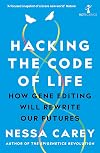
Definitely an informative book. Brings everyone up to date (as much as is possible in a fast moving field such as this can be done in a published book). The author shoots straight on a variety of topics within the field of genetic editing. Includes many examples in an assortment of areas such as plant life, insects, reptiles, mammals and of course humans - where DNA editing has already been successfully used. Sometimes with good and sometimes with not so good results. A must read for those show more of us who are interested in this field but can't or don't want to wade through all the technical jargon in Cell. The future of DNA editing is exciting and somewhat alarming but I'm sure Carey will keep us all posted on a regular basis. show less
Lists
Awards

You May Also Like


Associated Authors
Statistics
- Works
- 6
- Members
- 769
- Popularity
- #33,094
- Rating
- 3.8
- Reviews
- 16
- ISBNs
- 29
- Languages
- 2