
Carl Zimmer
Author of Parasite Rex: Inside the Bizarre World of Nature's Most Dangerous Creatures
About the Author
Carl Zimmer is a columnist for the New York Times. His most recent books are Life's Edge and She Has Her Mother's Laugh, the latter named the best science book of 2018 by the Guardian. He is professor adjunct of bio-physics and biochemistry and a lecturer in English at Yale University.
Image credit: Ben Stechshulte
Works by Carl Zimmer
Parasite Rex: Inside the Bizarre World of Nature's Most Dangerous Creatures (2000) 1,147 copies, 37 reviews
She Has Her Mother's Laugh: The Powers, Perversions, and Potential of Heredity (2018) — Author — 954 copies, 23 reviews
At the Water's Edge : Fish with Fingers, Whales with Legs, and How Life Came Ashore but Then Went Back to Sea (1998) 489 copies, 9 reviews
Soul Made Flesh: The Discovery of the Brain—and How It Changed the World (2005) 455 copies, 11 reviews
Hypersea Invasion 1 copy
The Processing Plant 1 copy
Coming onto the Land 1 copy
How To Make a Desert 1 copy
First Cells 1 copy
The Dolphin Strategy 1 copy
1996 Animals: Shell Game 1 copy
1996 Earth: In Time of Ur 1 copy
First, Kill the Babies 1 copy
Circus Science 1 copy
Computer Watch: Metamusic 1 copy
The Body Electric 1 copy
Wet, Wild, and Weird 1 copy
Perfect Gibberish 1 copy
Geo Watch: Lost World 1 copy
Ruffled Feathers 1 copy
Star Watch: Making Aurores 1 copy
Portrait in Blubber 1 copy
Physics Watch: Watery Eyes 1 copy
Contact 1 copy
Stardust 1 copy
Making Senses 1 copy
Space Watch: Into the Fire 1 copy
See How They Run 1 copy
Masters of An Ancient Sky 1 copy
Geo Watch: Inconstant Field 1 copy
The Flat Face of Technology 1 copy
Associated Works
Virus: An Illustrated Guide to 101 Incredible Microbes (2016) — Foreword, some editions — 73 copies, 2 reviews
Tagged
Common Knowledge
- Canonical name
- Zimmer, Carl
- Birthdate
- 1966-07-13
- Gender
- male
- Education
- Yale University (BA|English|1987)
- Occupations
- science writer
blogger
lecturer
editor
carpenter
librarian - Organizations
- Morse College, Yale University
Yale University
Discover Magazine
New York Times
Council for the Advancement of Science Writing
National Geographic (show all 10)
Time
Popular Science
Scientific American
Science - Awards and honors
- National Academies Communication Award (2007)
Guggenheim Fellowship (2002)
American Association for the Advancement of Sciences Writing Award (2004)
American Association for the Advancement of Sciences Kavli Science Journalism Award ( [2009, 2012])
National Center for Science Education Friend of Darwin Award (2005)
USA Science & Engineering Festival's Nifty Fifty (show all 11)
United States National Academy of Sciences Communication Award (2007)
The Pan American Health Organization's Award for Excellence in International Health Reporting
American Institute Biological Sciences Media Award
Everett Clark Award for Science Writing
Acanthobothrium zimmeri (species of tapeworm) named in his honor - Agent
- Eric Simonoff (Janklow Nesbit)
- Nationality
- USA
- Birthplace
- New Haven, Connecticut, USA
- Places of residence
- Guilford, Connecticut, USA
New York, New York, USA - Associated Place (for map)
- Connecticut, USA
Members
Reviews
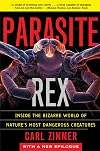
I picked up this book, not expecting much. The book was written in 2000, and these types of books tend to be hit or miss, mostly miss. Instead what I found was a very well written book, that will creep a reader out, as well as keep a reader fascinated. The history of parasite research (Darwin thought they were the lowest of the low) was something I never considered before.
What I found amazing is just how modern this book is. It was written 20 years ago, and parasitology has advanced, but it show more covered many things that are only now been completely understood (such as immune response to parasites might cure certain types of diseases).
The author clearly did his research. The interviews with various scientists, from parasite catalogers to geneticists, cover the spectrum of researchers studying parasites. And some of the parasite techniques, such as changing fish behavior to be more noticeable to birds, is downright scary. This is NOT a book for the squeamish, but give this 20 year old book a chance, it has stood the test of time. show less
What I found amazing is just how modern this book is. It was written 20 years ago, and parasitology has advanced, but it show more covered many things that are only now been completely understood (such as immune response to parasites might cure certain types of diseases).
The author clearly did his research. The interviews with various scientists, from parasite catalogers to geneticists, cover the spectrum of researchers studying parasites. And some of the parasite techniques, such as changing fish behavior to be more noticeable to birds, is downright scary. This is NOT a book for the squeamish, but give this 20 year old book a chance, it has stood the test of time. show less
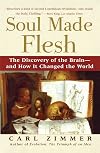
Ostensibly about Thomas Willis, a 17th century physician and anatomist, and his discovery of the the brain as the seat of intelligence and the 'command center' of the rest of the body, the book actually documents what is essentially the transition from 'natural philosophy' to 'science'. It centers on Oxford in the mid 17th century and the extraordinary men who working there, men who were willing to discard centuries of accepted wisdom about the natural world, including medicine, in favor of show more doing actual experiments to discover how things, including the human body, actually worked. Unlike Willis, many of these men did not limit themselves to medicine, and the list of them reads like a who's who of 17th C science, philosophy, and of all things, architecture! The cast, besides Willis, includes: Descartes, Hobbes, Boyle, Vesalius, Paracelsus, Harvey, Hooke, Locke, Wallis, Ward, Wilkins, Wren, Sydenham, and many others.
The ferment of ideas in this period is extraordinary and Zimmer does an excellent job in summarizing them and tying them together, showing how discoveries in one 'area', like chemistry, affected other in other 'areas', like medicine (though these men certainly had not conceived of our modern 'areas' of science like chemistry and physics), and how these discoveries both were influenced by, and influenced in turn, the way we view the world around us.
Zimmer's centerpiece is Willis' investigations into the brain and nerves, and he argues that his discoveries essentially presaged much of modern neurology, limited mostly by Willis' lack of knowledge of electricity. He further argues that these discoveries had a profound effect on how we viewed sickness and health, and how we understand 'the soul'.
I want to spend a second taking issue with some comments by another reviewer: First, because Willis is not generally as well known as some of the other scientists described here does not mean his importance has been overstated. Zimmer's arguments that his discoveries changed how we look at the body and world are compelling, even if most of the world has forgotten where the discoveries originated. Second, I don't think that people feel relief just because they find out that mental illness is treatable; whether treatable or not, patients are often relieved to find out that their illness has a rational basis, that we can put a label on it, and describe why it is happening. It relieves them to know that they are not just 'crazy'. Third, to paraphrase Mozart in 'Amadeus', the book is precisely as long as it needs to be to get Zimmer's points across. It does not ramble, it is not repetitious, and is just plain interesting from beginning to end.
For all students of science and history, this is a wonderful book and is well worth your time. show less
The ferment of ideas in this period is extraordinary and Zimmer does an excellent job in summarizing them and tying them together, showing how discoveries in one 'area', like chemistry, affected other in other 'areas', like medicine (though these men certainly had not conceived of our modern 'areas' of science like chemistry and physics), and how these discoveries both were influenced by, and influenced in turn, the way we view the world around us.
Zimmer's centerpiece is Willis' investigations into the brain and nerves, and he argues that his discoveries essentially presaged much of modern neurology, limited mostly by Willis' lack of knowledge of electricity. He further argues that these discoveries had a profound effect on how we viewed sickness and health, and how we understand 'the soul'.
I want to spend a second taking issue with some comments by another reviewer: First, because Willis is not generally as well known as some of the other scientists described here does not mean his importance has been overstated. Zimmer's arguments that his discoveries changed how we look at the body and world are compelling, even if most of the world has forgotten where the discoveries originated. Second, I don't think that people feel relief just because they find out that mental illness is treatable; whether treatable or not, patients are often relieved to find out that their illness has a rational basis, that we can put a label on it, and describe why it is happening. It relieves them to know that they are not just 'crazy'. Third, to paraphrase Mozart in 'Amadeus', the book is precisely as long as it needs to be to get Zimmer's points across. It does not ramble, it is not repetitious, and is just plain interesting from beginning to end.
For all students of science and history, this is a wonderful book and is well worth your time. show less
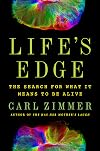
Summary: An exploration of how scientists attempt (and have failed) to define what life is and the quest to understand how life arose.
Philosophers talk about the meaning of life. Carl Zimmer offers us a glimpse into the world of scientists who are trying to define what is life. What is the definition of life and when can something be defined as alive? What about particles like viruses and prions that appear dead until they interact with other living matter? And how did life originate here, show more and has it in other places in our solar system and beyond?
Zimmer takes us on an exploratory tour of this question that begins in the Cavendish Laboratory in 1904 with John Butler Burke who believed he had created the missing link between inorganic and organic life when he released grains of radium into a sterile broth and discovered under a microscope that shapes were there and were dividing. He called them radiobes and he believed that the radium provided the “vital flux” to turn the constituent elements into blobs of protoplasm. Eventually, he was disproven by other scientists after enjoying fleeting fame.
Zimmer takes us through the history of research on life from van Leeuwenhoek’s discoveries of microscopic life, to the growth of neural networks in laboratories. We go with him to pools near the mouths of volcanoes where some think organic life developed to discussions with researchers studying vents in the ocean. We enter caves to learn of the homeostatic relationship between hibernating bats and parasites who live off them and can kill them if they draw too much energy from the bat. We read of research demonstrating the lifelessness of soil samples on Mars and a meteorite from Mars that may evidence signs of life. I learned that red blood cells have no chromosomes and cannot divide and multiply like other cells.
Zimmer recounts the efforts of scientists to re-create the conditions under which they think life arose, whether it is in forming a strand of RNA or figuring out how to form a lipid membrane of the sort that surround every cell. Some scientists believe that the constituents of life have to come together fast, within 10,000 hours, because of the entropic forces that would destroy the constituents. That leads some to believe that they will achieve this in the next ten years.
In the end, he comes back to the question of the definition of life, cataloging the many scientists have proposed. He introduces us to Carol Cleland, a philosopher of scientist who thinks the whole enterprise is flawed and that what is needed is not a definition of life but a theory of life that helps us understand what life is.
As one reads Zimmer’s account, one realizes what is so fascinating in this quest to understand life and how it is possible. Zimmer introduces us to so many forms of life and the wonder of a planet teaming with life from microbes to every other form of life including ourselves. Some religious believers dismiss this whole quest to understand life and its origins with a wave of the hand saying, “God did it.” I’m not so quick to dismiss these quests. I realize some see nothing beyond the physical reality. Others, and I include myself here, would recognize in every scientific discovery the wonders and wisdom of God. If someone replicates the physical processes by which life arose, I will be delighted rather than distraught. My faith doesn’t rest on the gaps in our knowledge remaining gaps.
Zimmer gives us a glimpse at the reality of science. He shows us both the amazing things we are learning about the world, and the questions that remain, some on which multiple generations of scientists will work. He shows us the mistakes, and the ways that continued research and the rigorous peer review processes of science correct those mistakes. He shows us the big questions and what we still don’t know. This is great science writing!
________________________________
Disclosure of Material Connection: I received a complimentary review copy of this book from the publisher via Edelweiss. The opinions I have expressed are my own. show less
Philosophers talk about the meaning of life. Carl Zimmer offers us a glimpse into the world of scientists who are trying to define what is life. What is the definition of life and when can something be defined as alive? What about particles like viruses and prions that appear dead until they interact with other living matter? And how did life originate here, show more and has it in other places in our solar system and beyond?
Zimmer takes us on an exploratory tour of this question that begins in the Cavendish Laboratory in 1904 with John Butler Burke who believed he had created the missing link between inorganic and organic life when he released grains of radium into a sterile broth and discovered under a microscope that shapes were there and were dividing. He called them radiobes and he believed that the radium provided the “vital flux” to turn the constituent elements into blobs of protoplasm. Eventually, he was disproven by other scientists after enjoying fleeting fame.
Zimmer takes us through the history of research on life from van Leeuwenhoek’s discoveries of microscopic life, to the growth of neural networks in laboratories. We go with him to pools near the mouths of volcanoes where some think organic life developed to discussions with researchers studying vents in the ocean. We enter caves to learn of the homeostatic relationship between hibernating bats and parasites who live off them and can kill them if they draw too much energy from the bat. We read of research demonstrating the lifelessness of soil samples on Mars and a meteorite from Mars that may evidence signs of life. I learned that red blood cells have no chromosomes and cannot divide and multiply like other cells.
Zimmer recounts the efforts of scientists to re-create the conditions under which they think life arose, whether it is in forming a strand of RNA or figuring out how to form a lipid membrane of the sort that surround every cell. Some scientists believe that the constituents of life have to come together fast, within 10,000 hours, because of the entropic forces that would destroy the constituents. That leads some to believe that they will achieve this in the next ten years.
In the end, he comes back to the question of the definition of life, cataloging the many scientists have proposed. He introduces us to Carol Cleland, a philosopher of scientist who thinks the whole enterprise is flawed and that what is needed is not a definition of life but a theory of life that helps us understand what life is.
As one reads Zimmer’s account, one realizes what is so fascinating in this quest to understand life and how it is possible. Zimmer introduces us to so many forms of life and the wonder of a planet teaming with life from microbes to every other form of life including ourselves. Some religious believers dismiss this whole quest to understand life and its origins with a wave of the hand saying, “God did it.” I’m not so quick to dismiss these quests. I realize some see nothing beyond the physical reality. Others, and I include myself here, would recognize in every scientific discovery the wonders and wisdom of God. If someone replicates the physical processes by which life arose, I will be delighted rather than distraught. My faith doesn’t rest on the gaps in our knowledge remaining gaps.
Zimmer gives us a glimpse at the reality of science. He shows us both the amazing things we are learning about the world, and the questions that remain, some on which multiple generations of scientists will work. He shows us the mistakes, and the ways that continued research and the rigorous peer review processes of science correct those mistakes. He shows us the big questions and what we still don’t know. This is great science writing!
________________________________
Disclosure of Material Connection: I received a complimentary review copy of this book from the publisher via Edelweiss. The opinions I have expressed are my own. show less
I hadn't even thought this was a topic worth reading about, but a friend recommended this book and I had a peek. I was drawn in immediately and amazed at the history I didn't know and was never taught! What's interesting is that it takes about 120 pages to finally get to the gist of the actual subject of the book, but those 120 pages are filled with wonderful detail of English history, war, medicine, religion, superstition and science. The story of the protagonist is then told over another show more 120 or so pages, before giving way to a beautiful educational history-filled coda. What an enlightening book. What an experience! show less
Lists
Library TBR (1)
Read These Too (1)
Awards


You May Also Like


Associated Authors
Statistics
- Works
- 118
- Also by
- 7
- Members
- 6,146
- Popularity
- #4,002
- Rating
- 4.1
- Reviews
- 156
- ISBNs
- 142
- Languages
- 17
- Favorited
- 28

