
Works by Ricky Maye
An Emerging Spirituality: Your Spiritual Revolution Without the Smoke and Mirrors (2011) 14 copies, 2 reviews
Barefoot Christianity: The Rough Road Ahead in the Life of a Jesus Follower (2012) 8 copies, 2 reviews
An Emerging Spirituality 1 copy
Tagged
Common Knowledge
There is no Common Knowledge data for this author yet. You can help.
Members
Reviews
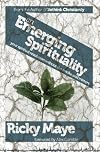
- I received a copy of this book from GoodReads' First Reads program in exchange for an honest review-
I found this book to be quite refreshing. I know, I often say that of books that offer ways of thinking that aren't wrapped up in the same dogma many of us are tired of, but I really do mean it. To have an author open one's mind to possibilities, instead of using faith to limit them, is always something I find to be like a breath of fresh air in an otherwise stale place of faith. And this show more book really was no exception.
The chapters in this book are quite short, so it makes for an easy read. And I understand, or think I understand, that the point of the short sections was intended to allow room for the reader to think, instead of the author to impose his own views upon us. I just would have loved to have been able to get a deeper look at his thoughts, at what he has to say, because for me, when I read, it's like a dialogue, and it's easier for me to think and respond when there is more to respond to. Not that what is there wasn't sufficient, because it did offer a lot to look at (it just means that I'm an avid and intense reader, and that I'll have to keep my eye open for his other works). For example, I really did love his take on sin, salvation, revival, the way he emphasized personal need and personal relationship, his thoughts on the phrase "in vain," and many, many other thoughts he shared.
The phrase, found on page 28, that "your spiritual life is not a destination, it is a journey," is something that I have always felt and thought myself, seeing it not as a moment of conversion, but instead as a continued process of cultivation, of growing and serving and loving. I also loved his saying that "discussion is a journey" on page 30. He goes on to say that "Conversation isn't about proving a point; true conversation is about going on a journey with the people you are speaking with." I loved that. It was like he was writing things I have felt and believed, in his explanations of how he sees the idea of a journey, in comparison to a quest. I love various quotes throughout the book that tie into this idea, of spirituality as a journey, like on page 42, where he says "It's not a location, it's a direction. It's not a place to end up, it's a life of enduring," and "We don't want to focus on a moment, but the momentum." I love how, on the same page, he stresses that even though we may be on different paths "we are all on that journey back to God; the journey back to what we have heard of, what we feel inside of all of us." Of course, I might take that in a hyper-universalistic sense he doesn't intend, as I believe even other faiths are valid paths back to God, but even if not intended as I naturally take it, based on my beliefs, it is refreshing to hear what he's saying on any level, even if just on the most basic kind of different versions of Christianity.
I enjoyed his section discussing the difference between religion and spirituality, and in that section is perhaps one of my absolute favorite quotes of the whole book. It's found on page 46, and he says "I find it weird that the hope and wish of God's salvation to everyone is a revolutionary thought in Christian circles. It will get you in trouble if you think the Love of God is open for everyone in some churches. We still have a long way to go." He goes on to talk, in the next few pages, about how Jesus "didn't see legalism or laws. Jesus saw people and pain and real situations."
In probably one of my favorite sections, the author talks about salvation, and about how it is "more about the quality of life and our ability to function on this earth" than getting into heaven (page 117), and goes on to show how Jesus offered salvation to various people based on their individual needs, through this different understanding of salvation, this idea of wholeness and healing. I must admit, that's the way I think of salvation. I do believe in heaven, but for me salvation is so much deeper than that, in a way that I wasn't even sure if I still liked the word, because of all that is usually attached. But salvation the way Ricky Maye talks about it is one way I can find the word redeemable. And I love that he takes that idea and uses it as a way to call us to think of how we can bring salvation to those we see in our lives, based on their needs - how he calls us, as I believe Jesus did, to a life of service and restoration for those who are our neighbors.
Another of my favorite quotes can be found on page 129, where the author says "Sometimes, I think when we look through the scriptures we haven't learned anything from the mistakes of the Pharisees and scribes. We still seem to categorize the scriptures between sin and not sin, rather than looking at is as a chronicle of unique divine relationships." It kind of goes along with the way I think about atonement - not as acceptance of some sacrifice, but as at-one-ment between individuals and God, focusing on the relationship between the two, as well as being at-one-with our fellow man. He goes on to talk about the idea of condemnation and judgment, about how much of a priority needs to be made of not throwing stones at others. He uses the example of Jesus and the woman caught in adultery to make his point, and he brings that chapter to a close by saying, on page 134, that "Throwing stones hurts. If you don't get the metaphor; judgment by you and me, never wins. It's not our job, it's not our responsibility and it's not our place. If Jesus didn't judge that woman, then we sure as hell can't."
I love the way the author looks at the way Christianity represents itself, expressing "how we wish Christianity would be known for love, generosity, and acceptance," (page 138) then going on (on the next page) to discuss how "Christianity is not known for good fruit," and how "the media, the world, isn't ragging on us because we love too hard," but instead because of the negative and unloving examples of Christians.
As long as this review already is, and I do apologize for that, there is so much more that this book contains, so many other ideas that I could mention and express complete agreement with, but I guess I need to be wrapping this up. All I can really say that this is a book that really did resonate with me, and has left me wanting to read whatever else the author has written or writes in the future. I think it's important that these kinds of voices are heard and represented within not just the Christian community, but the world in general, and I would recommend this book to any Christian with a mind open enough to consider what is to be found within the pages, and even any non-Christian yearning to see evidence that not all Christians are the way Christianity seems to represent itself. I really did enjoy the book, the engaging style in which it was written, and the fresh perspective it has to give. It is one that I am glad to have added to my growing collection. show less
I found this book to be quite refreshing. I know, I often say that of books that offer ways of thinking that aren't wrapped up in the same dogma many of us are tired of, but I really do mean it. To have an author open one's mind to possibilities, instead of using faith to limit them, is always something I find to be like a breath of fresh air in an otherwise stale place of faith. And this show more book really was no exception.
The chapters in this book are quite short, so it makes for an easy read. And I understand, or think I understand, that the point of the short sections was intended to allow room for the reader to think, instead of the author to impose his own views upon us. I just would have loved to have been able to get a deeper look at his thoughts, at what he has to say, because for me, when I read, it's like a dialogue, and it's easier for me to think and respond when there is more to respond to. Not that what is there wasn't sufficient, because it did offer a lot to look at (it just means that I'm an avid and intense reader, and that I'll have to keep my eye open for his other works). For example, I really did love his take on sin, salvation, revival, the way he emphasized personal need and personal relationship, his thoughts on the phrase "in vain," and many, many other thoughts he shared.
The phrase, found on page 28, that "your spiritual life is not a destination, it is a journey," is something that I have always felt and thought myself, seeing it not as a moment of conversion, but instead as a continued process of cultivation, of growing and serving and loving. I also loved his saying that "discussion is a journey" on page 30. He goes on to say that "Conversation isn't about proving a point; true conversation is about going on a journey with the people you are speaking with." I loved that. It was like he was writing things I have felt and believed, in his explanations of how he sees the idea of a journey, in comparison to a quest. I love various quotes throughout the book that tie into this idea, of spirituality as a journey, like on page 42, where he says "It's not a location, it's a direction. It's not a place to end up, it's a life of enduring," and "We don't want to focus on a moment, but the momentum." I love how, on the same page, he stresses that even though we may be on different paths "we are all on that journey back to God; the journey back to what we have heard of, what we feel inside of all of us." Of course, I might take that in a hyper-universalistic sense he doesn't intend, as I believe even other faiths are valid paths back to God, but even if not intended as I naturally take it, based on my beliefs, it is refreshing to hear what he's saying on any level, even if just on the most basic kind of different versions of Christianity.
I enjoyed his section discussing the difference between religion and spirituality, and in that section is perhaps one of my absolute favorite quotes of the whole book. It's found on page 46, and he says "I find it weird that the hope and wish of God's salvation to everyone is a revolutionary thought in Christian circles. It will get you in trouble if you think the Love of God is open for everyone in some churches. We still have a long way to go." He goes on to talk, in the next few pages, about how Jesus "didn't see legalism or laws. Jesus saw people and pain and real situations."
In probably one of my favorite sections, the author talks about salvation, and about how it is "more about the quality of life and our ability to function on this earth" than getting into heaven (page 117), and goes on to show how Jesus offered salvation to various people based on their individual needs, through this different understanding of salvation, this idea of wholeness and healing. I must admit, that's the way I think of salvation. I do believe in heaven, but for me salvation is so much deeper than that, in a way that I wasn't even sure if I still liked the word, because of all that is usually attached. But salvation the way Ricky Maye talks about it is one way I can find the word redeemable. And I love that he takes that idea and uses it as a way to call us to think of how we can bring salvation to those we see in our lives, based on their needs - how he calls us, as I believe Jesus did, to a life of service and restoration for those who are our neighbors.
Another of my favorite quotes can be found on page 129, where the author says "Sometimes, I think when we look through the scriptures we haven't learned anything from the mistakes of the Pharisees and scribes. We still seem to categorize the scriptures between sin and not sin, rather than looking at is as a chronicle of unique divine relationships." It kind of goes along with the way I think about atonement - not as acceptance of some sacrifice, but as at-one-ment between individuals and God, focusing on the relationship between the two, as well as being at-one-with our fellow man. He goes on to talk about the idea of condemnation and judgment, about how much of a priority needs to be made of not throwing stones at others. He uses the example of Jesus and the woman caught in adultery to make his point, and he brings that chapter to a close by saying, on page 134, that "Throwing stones hurts. If you don't get the metaphor; judgment by you and me, never wins. It's not our job, it's not our responsibility and it's not our place. If Jesus didn't judge that woman, then we sure as hell can't."
I love the way the author looks at the way Christianity represents itself, expressing "how we wish Christianity would be known for love, generosity, and acceptance," (page 138) then going on (on the next page) to discuss how "Christianity is not known for good fruit," and how "the media, the world, isn't ragging on us because we love too hard," but instead because of the negative and unloving examples of Christians.
As long as this review already is, and I do apologize for that, there is so much more that this book contains, so many other ideas that I could mention and express complete agreement with, but I guess I need to be wrapping this up. All I can really say that this is a book that really did resonate with me, and has left me wanting to read whatever else the author has written or writes in the future. I think it's important that these kinds of voices are heard and represented within not just the Christian community, but the world in general, and I would recommend this book to any Christian with a mind open enough to consider what is to be found within the pages, and even any non-Christian yearning to see evidence that not all Christians are the way Christianity seems to represent itself. I really did enjoy the book, the engaging style in which it was written, and the fresh perspective it has to give. It is one that I am glad to have added to my growing collection. show less
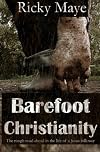
- I received a copy of this book in exchange for an honest review -
After reading Ricky Maye's last book, Emerging Spirituality, I was hooked. So I was super excited when given the chance to read his latest work, Barefoot Christianity. And just like his last book, this was one that did not disappoint, though I am finding a little difficulty in writing a review when I get to the end of my reading and realize I've found something noteworthy on almost every page, lol. So bear with me, I am going show more to do my best in narrowing it all down.
On the very first page of the introduction, we are told that Barefoot Christianity is a "movement," a "simpler movement," one that "can start with a single step." (page 13) From there, the author goes on to talk about what it looks like to live out our faith, to follow Jesus, to carry what he carried, to care about what he cared about. I loved the way he explained the significance of "losing our shoes," starting on page 52, and how it is "more about connecting us with God than God connecting with us," how it's about "exposing your humanity before the divine." He goes on to explain the historical significance of the idea, how "taking off ones shoes would have been an act of humility." (page 54) Applying this idea to the title of this book, to the concept of what Barefoot Christianity would be, really helps to make a difference in how one reads this book. Come as you are, without any sort of covering or cover up, expose yourself in humility and openness to God, without pretensions, while being open to "experiencing God in this very moment" (page 67). It serves as a strong comparison to the parts of the book where he mentions how the Bible, and faith, etc, can be misused and their purpose abused in arrogant, prideful ways that God did not intend.
I loved how the author spoke of stars and how we find them to be so beautiful and inspiring, and then made the connection of how "stars are the wounds of the world," and how we, ourselves, can be seen in the same beautiful, inspiring way, even with all of our own personal wounds. He then goes even further, speaking of how stars are the light of the world, taking his connection and driving home the point that even in our hurt we can, and should, emit light and beauty into the world around us, that "being the light of the world is about being a broken, exploding, scarred star and shining a light of hope and inspiration to everyone around you." (page 26)
I also really enjoyed how the author spoke on how following someone really means more than just to walk after someone, it refers to carrying what that person carried - which paints "take up your cross and follow me" in a whole different light - at least in my opinion, when people often associate this quote with the persecution that Jesus faced. Thinking of carrying the "cross" in the context of what Jesus "carried" - "the poor, the widows, the children, the broken, the homeless and hungry" (page 37) - seems to change to focus of that quote so completely, from a "me" self centered approach that encourages self righteousness and pride to an other focused way of faith encouraging compassion and humility, which also ties into the author's section on what it meant when Jesus called his followers to "go" out into the world - to put others first, to give of ourselves...
In an attempt not to ramble on and on - other parts of this book that I enjoyed include his sections on the individuality of the journey that is faith, the difference between practicing faith in and practicing faith with a community, his take on the words holy and glory, responsibility and action instead of just mere/only belief or faith ("action brings faith to life" - page 79), and Holy Ground; how "the world is a holy ground waiting to be experienced" (page 66 - I really loved that section).
This book was truly an enjoyable read, and it was a quick read, as well. I always find the author's writing style engaging, and it was very interesting to be given a chance to hear his thoughts more deeply, after reading his last book. I would recommend it to any Christian, and hope others come to enjoy and appreciate the author's works as much as I have.
Rating : four stars :) show less
After reading Ricky Maye's last book, Emerging Spirituality, I was hooked. So I was super excited when given the chance to read his latest work, Barefoot Christianity. And just like his last book, this was one that did not disappoint, though I am finding a little difficulty in writing a review when I get to the end of my reading and realize I've found something noteworthy on almost every page, lol. So bear with me, I am going show more to do my best in narrowing it all down.
On the very first page of the introduction, we are told that Barefoot Christianity is a "movement," a "simpler movement," one that "can start with a single step." (page 13) From there, the author goes on to talk about what it looks like to live out our faith, to follow Jesus, to carry what he carried, to care about what he cared about. I loved the way he explained the significance of "losing our shoes," starting on page 52, and how it is "more about connecting us with God than God connecting with us," how it's about "exposing your humanity before the divine." He goes on to explain the historical significance of the idea, how "taking off ones shoes would have been an act of humility." (page 54) Applying this idea to the title of this book, to the concept of what Barefoot Christianity would be, really helps to make a difference in how one reads this book. Come as you are, without any sort of covering or cover up, expose yourself in humility and openness to God, without pretensions, while being open to "experiencing God in this very moment" (page 67). It serves as a strong comparison to the parts of the book where he mentions how the Bible, and faith, etc, can be misused and their purpose abused in arrogant, prideful ways that God did not intend.
I loved how the author spoke of stars and how we find them to be so beautiful and inspiring, and then made the connection of how "stars are the wounds of the world," and how we, ourselves, can be seen in the same beautiful, inspiring way, even with all of our own personal wounds. He then goes even further, speaking of how stars are the light of the world, taking his connection and driving home the point that even in our hurt we can, and should, emit light and beauty into the world around us, that "being the light of the world is about being a broken, exploding, scarred star and shining a light of hope and inspiration to everyone around you." (page 26)
I also really enjoyed how the author spoke on how following someone really means more than just to walk after someone, it refers to carrying what that person carried - which paints "take up your cross and follow me" in a whole different light - at least in my opinion, when people often associate this quote with the persecution that Jesus faced. Thinking of carrying the "cross" in the context of what Jesus "carried" - "the poor, the widows, the children, the broken, the homeless and hungry" (page 37) - seems to change to focus of that quote so completely, from a "me" self centered approach that encourages self righteousness and pride to an other focused way of faith encouraging compassion and humility, which also ties into the author's section on what it meant when Jesus called his followers to "go" out into the world - to put others first, to give of ourselves...
In an attempt not to ramble on and on - other parts of this book that I enjoyed include his sections on the individuality of the journey that is faith, the difference between practicing faith in and practicing faith with a community, his take on the words holy and glory, responsibility and action instead of just mere/only belief or faith ("action brings faith to life" - page 79), and Holy Ground; how "the world is a holy ground waiting to be experienced" (page 66 - I really loved that section).
This book was truly an enjoyable read, and it was a quick read, as well. I always find the author's writing style engaging, and it was very interesting to be given a chance to hear his thoughts more deeply, after reading his last book. I would recommend it to any Christian, and hope others come to enjoy and appreciate the author's works as much as I have.
Rating : four stars :) show less
The good thing about this book is that I downloaded the Kindle version free. I am glad I didn't pay for it.
I found myself - perhaps irrationally - annoyed by one of the first sentences in the introduction: ‘We all want to change the world, start revolutions and make an impact.’
Huh? I certainly don’t. Most people I know have not the slightest desire to start any revolutions.
A sentence or two afterwards, I read this: ‘To continue a journey we can’t make that often piet and show more commonly accepted choice to ignore the past or count it as less importance.’ [sic]
I have no idea what ‘piet’ might mean - I even looked it up, but no joy. Perhaps it was a typo for something else, but I can’t guess what, and the last few words are so ungrammatical as to make me wince.
Alas, this wasn’t just a problem with the introduction. There were grammatical and punctuation errors that were on almost every page of the book. I wondered if I had somehow managed to download a ‘proof’ edition - but I checked the ‘Look Inside’ version on Amazon, and could see at once that I did indeed have the correct version, and that it is still full of errors. In some sections a paragraph just tails away without ending… and the Kindle formatting is poorly done, with some completely blank pages in the middle, a lot of oddly lined pages at the end, and some strange double spacing throughout. This book urgently needs an editor.
I could easily have ignored a few typos, and might even have overlooked the other errors if the content had been inspiring and encouraging - but I searched in vain for something of value. The author talks about stars being ‘scars in the universe’, which is very dubious science. The book leaps about from topic to topic, misquoting Scripture at times, and never - as far as I could determine - actually saying anything clearly. It reads not like a book, but as if it is rough notes for sermons - a speaker using these would pause, and expound on different sections. I kept feeling that there was a lot that the author wanted to say - but almost everything in the book was either trite and obvious, or mysteriously incomprehensible.
Two stars rather than one because I did at least finish reading it - and also because I feel that the author really did have some good points, even though I am none the wiser as to what they were.
Really not recommended. show less
I found myself - perhaps irrationally - annoyed by one of the first sentences in the introduction: ‘We all want to change the world, start revolutions and make an impact.’
Huh? I certainly don’t. Most people I know have not the slightest desire to start any revolutions.
A sentence or two afterwards, I read this: ‘To continue a journey we can’t make that often piet and show more commonly accepted choice to ignore the past or count it as less importance.’ [sic]
I have no idea what ‘piet’ might mean - I even looked it up, but no joy. Perhaps it was a typo for something else, but I can’t guess what, and the last few words are so ungrammatical as to make me wince.
Alas, this wasn’t just a problem with the introduction. There were grammatical and punctuation errors that were on almost every page of the book. I wondered if I had somehow managed to download a ‘proof’ edition - but I checked the ‘Look Inside’ version on Amazon, and could see at once that I did indeed have the correct version, and that it is still full of errors. In some sections a paragraph just tails away without ending… and the Kindle formatting is poorly done, with some completely blank pages in the middle, a lot of oddly lined pages at the end, and some strange double spacing throughout. This book urgently needs an editor.
I could easily have ignored a few typos, and might even have overlooked the other errors if the content had been inspiring and encouraging - but I searched in vain for something of value. The author talks about stars being ‘scars in the universe’, which is very dubious science. The book leaps about from topic to topic, misquoting Scripture at times, and never - as far as I could determine - actually saying anything clearly. It reads not like a book, but as if it is rough notes for sermons - a speaker using these would pause, and expound on different sections. I kept feeling that there was a lot that the author wanted to say - but almost everything in the book was either trite and obvious, or mysteriously incomprehensible.
Two stars rather than one because I did at least finish reading it - and also because I feel that the author really did have some good points, even though I am none the wiser as to what they were.
Really not recommended. show less
I received this book through the GoodReads first reads program.
[a:Ricky Maye|4616475|Ricky Maye|http://d202m5krfqbpi5.cloudfront.net/authors/1331239217p2/4616475.jpg]'s book is a concise examination of Christianity and the problems that he has with the current incarnation of the faith. He explains how Christian's should strive to be more... well, Christian. What emerges is an understanding of the faith that incorporates the understanding, empathy, and altogether open-mindedness of the faith show more that existed when the religion first came into existence. I've no problem whatsoever with this message, and indeed, think it is altogether quite a good one.
The book didn't receive more stars from me because altogether this message is one that I've read/heard many times before. I didn't feel that this book brought anything to the table that other authors have not previously thought about and/or wrote about or spoke about in other mediums. Indeed, I thought some other books (such as [b:Jesus for President|1109255|Jesus for President Politics for Ordinary Radicals|Shane Claiborne|http://d202m5krfqbpi5.cloudfront.net/books/1348840695s/1109255.jpg|1096213]) did it a bit better. This book, however, may reach a larger audience as it is readily available through more mediums and might catch someone else's eye.
It's a pretty good quick read, in other words. :) show less
[a:Ricky Maye|4616475|Ricky Maye|http://d202m5krfqbpi5.cloudfront.net/authors/1331239217p2/4616475.jpg]'s book is a concise examination of Christianity and the problems that he has with the current incarnation of the faith. He explains how Christian's should strive to be more... well, Christian. What emerges is an understanding of the faith that incorporates the understanding, empathy, and altogether open-mindedness of the faith show more that existed when the religion first came into existence. I've no problem whatsoever with this message, and indeed, think it is altogether quite a good one.
The book didn't receive more stars from me because altogether this message is one that I've read/heard many times before. I didn't feel that this book brought anything to the table that other authors have not previously thought about and/or wrote about or spoke about in other mediums. Indeed, I thought some other books (such as [b:Jesus for President|1109255|Jesus for President Politics for Ordinary Radicals|Shane Claiborne|http://d202m5krfqbpi5.cloudfront.net/books/1348840695s/1109255.jpg|1096213]) did it a bit better. This book, however, may reach a larger audience as it is readily available through more mediums and might catch someone else's eye.
It's a pretty good quick read, in other words. :) show less
Statistics
- Works
- 4
- Members
- 27
- Popularity
- #483,026
- Rating
- 2.7
- Reviews
- 4
- ISBNs
- 2