
John Lancaster (5) (1958–)
Author of The Great Air Race: Glory, Tragedy, and the Dawn of American Aviation
For other authors named John Lancaster, see the disambiguation page.
Works by John Lancaster
Associated Works
Tagged
Common Knowledge
- Birthdate
- 1958
- Gender
- male
- Education
- Stanford University
- Occupations
- journalist
- Organizations
- The Washington Post
Members
Reviews
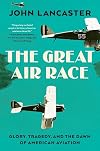
On October 8, 1919 more than 60 pilots took to the air in what was officially called “The First Transcontinental Reliability and Endurance Test”, but everyone involved in it knew it was a race - an air race - across the United States. By the time it was done, the pilots and their planes would suffer 54 accidents and crashes, and nine men would be dead (two died even before the race began).
For a time the race captured the country’s attention, and newspapers of the day were packed with show more updates on the flyers and their progress, some laid out in grids reminiscent of the box scores that went along with the articles on the World Series, happening at the same time. But over time memories of the event have faded away, and today not many people know about this transcontinental race.
In The Great Air Race John Lancaster has done amazing research to create a fascinating account of the race itself, how it came to be, and what it meant for the future of commercial aviation in the US.
The race was Billy Mitchell’s idea. Mitchell, a highly decorated aviator in the Great War, and considered by many to be the father of the US Air Force was, at the time, the chief of Army Air Service Training. He hoped that the publicity from the event would assist his efforts in lobbying Congress to establish an air force as a separate branch of the armed services.
The race was an “out and back”, with pilots taking off simultaneously from New York and San Francisco, flying to the opposite coast, and then returning to their starting point. The course included twenty “control stops” - landing strips - many of which did not even exist when the race was announced. It was open only to military personnel. Most were returned veterans of air combat in Europe. The planes themselves were a mixed lot, biplanes of mostly wood and cloth, with open air cockpits and finicky engines. Flying at night was forbidden, and Air Service officers at each control stop enforced weather stops when they judged conditions too bad to allow flyers to continue.
All of this set the stage for what would be a thrilling race, and Lancaster’s account of it is as dramatic and thrilling as it gets. It’s full of wonderful details and amazing moments and holds your interest to the very end. He’s done a great job bringing an event that had almost been forgotten back to life. The race created heroes, among them the first to finish the course, the “Flying Parson” Belvin Maynard. It also fueled a hunger for flying in the public that helped spur not only the formation of commercial airlines, but support for the funding of airports for the airlines to fly in and out of.
It’s amazing to think today of the skill of the pilots who took part, and that of their mechanics who accompanied them. They flew in open cockpit planes through the Rocky Mountains at the start of winter weather, encountered rain and sleet that coated the planes with ice, and had to handle all kinds of mishaps like engine fires, stalls, landings in muddy fields that could rip the landing gear from their planes (or worse). They did all of this without the aid of modern equipment - no radios, no radar, no GPS, no lighted runways, no air controllers, and with sometimes spotty ground support and limited supplies.
History buffs, aviation enthusiasts, and those who appreciate a good race will love this book.
RATING: Five Stars ⭐⭐⭐⭐⭐
NOTE: I received an advanced copy of this book from W.W. Norton & Co. and NetGalley, and am voluntarily providing this review. The book is available starting November 15, 2022. show less
For a time the race captured the country’s attention, and newspapers of the day were packed with show more updates on the flyers and their progress, some laid out in grids reminiscent of the box scores that went along with the articles on the World Series, happening at the same time. But over time memories of the event have faded away, and today not many people know about this transcontinental race.
In The Great Air Race John Lancaster has done amazing research to create a fascinating account of the race itself, how it came to be, and what it meant for the future of commercial aviation in the US.
The race was Billy Mitchell’s idea. Mitchell, a highly decorated aviator in the Great War, and considered by many to be the father of the US Air Force was, at the time, the chief of Army Air Service Training. He hoped that the publicity from the event would assist his efforts in lobbying Congress to establish an air force as a separate branch of the armed services.
The race was an “out and back”, with pilots taking off simultaneously from New York and San Francisco, flying to the opposite coast, and then returning to their starting point. The course included twenty “control stops” - landing strips - many of which did not even exist when the race was announced. It was open only to military personnel. Most were returned veterans of air combat in Europe. The planes themselves were a mixed lot, biplanes of mostly wood and cloth, with open air cockpits and finicky engines. Flying at night was forbidden, and Air Service officers at each control stop enforced weather stops when they judged conditions too bad to allow flyers to continue.
All of this set the stage for what would be a thrilling race, and Lancaster’s account of it is as dramatic and thrilling as it gets. It’s full of wonderful details and amazing moments and holds your interest to the very end. He’s done a great job bringing an event that had almost been forgotten back to life. The race created heroes, among them the first to finish the course, the “Flying Parson” Belvin Maynard. It also fueled a hunger for flying in the public that helped spur not only the formation of commercial airlines, but support for the funding of airports for the airlines to fly in and out of.
It’s amazing to think today of the skill of the pilots who took part, and that of their mechanics who accompanied them. They flew in open cockpit planes through the Rocky Mountains at the start of winter weather, encountered rain and sleet that coated the planes with ice, and had to handle all kinds of mishaps like engine fires, stalls, landings in muddy fields that could rip the landing gear from their planes (or worse). They did all of this without the aid of modern equipment - no radios, no radar, no GPS, no lighted runways, no air controllers, and with sometimes spotty ground support and limited supplies.
History buffs, aviation enthusiasts, and those who appreciate a good race will love this book.
RATING: Five Stars ⭐⭐⭐⭐⭐
NOTE: I received an advanced copy of this book from W.W. Norton & Co. and NetGalley, and am voluntarily providing this review. The book is available starting November 15, 2022. show less
While the author may speak of this event as being "all but forgotten," I was actually aware that this race had taken place for a long time, probably courtesy of the copy of Martin Caidin's "Air Force" that I had as a kid. So, when I noticed this work in a book store late last year it immediately went on the soon-to-read list.
Intertwined with this event, which turns out to have been quite the big deal at the time, is the legacy of General Billy Mitchell. When I first started reading about show more aviation, Mitchell still enjoyed the aura of a martyr, as an apostle of Air Power; cut down by his supposed truth-telling. However, recent scholarship (upon which this book is based), no longer overlooks the man's crass careerism. Still, there is no denying that Mitchell was also a man who got things done, and he had an ally in a senior U.S. Postal Service official, one Otto Praeger, who wanted to expand the nation's airmail system as fast as possible. If nothing else this race had the potential to expand the nation's aeronautical infrastructure rapidly.
That's the problem, in the process of trying to make political points before the Wilson Administration ended, it was decided that the race would take place in late October, with a route that traced the major cities like New York, Cleveland, Chicago, and points west, until reaching San Francisco. Anyone who has lived in that tier of the U.S. can tell you that betting on nice weather in late autumn is like living in a state of denial, and bad weather was a major safety issue; contributing to the deaths of nine contestants, and doing some damage to Mitchell's reputation, and that of his beloved Air Service.
Still, there is no denying that this event was epic, and probably did make a contribution towards accelerating the development of both civil and military aviation in the United States. That Lancaster is an aviation enthusiast himself is a virtue, and he is fair-minded in assessing the costs and achievements of the race. To be fair to Mitchell, he didn't expect this to be a suicide mission, but as soon as the event turned into a competitive exercise, all bets were off in terms of the chances that the pilots were prepared to take.
About the only thing that I'm marking this book down for is that Lancaster still ascribes a hostility to aviation in the United States Navy that was mostly in the minds of the U.S. Army's aviators. the USN was all for aviation, so long they were controlling their own air arm! show less
Intertwined with this event, which turns out to have been quite the big deal at the time, is the legacy of General Billy Mitchell. When I first started reading about show more aviation, Mitchell still enjoyed the aura of a martyr, as an apostle of Air Power; cut down by his supposed truth-telling. However, recent scholarship (upon which this book is based), no longer overlooks the man's crass careerism. Still, there is no denying that Mitchell was also a man who got things done, and he had an ally in a senior U.S. Postal Service official, one Otto Praeger, who wanted to expand the nation's airmail system as fast as possible. If nothing else this race had the potential to expand the nation's aeronautical infrastructure rapidly.
That's the problem, in the process of trying to make political points before the Wilson Administration ended, it was decided that the race would take place in late October, with a route that traced the major cities like New York, Cleveland, Chicago, and points west, until reaching San Francisco. Anyone who has lived in that tier of the U.S. can tell you that betting on nice weather in late autumn is like living in a state of denial, and bad weather was a major safety issue; contributing to the deaths of nine contestants, and doing some damage to Mitchell's reputation, and that of his beloved Air Service.
Still, there is no denying that this event was epic, and probably did make a contribution towards accelerating the development of both civil and military aviation in the United States. That Lancaster is an aviation enthusiast himself is a virtue, and he is fair-minded in assessing the costs and achievements of the race. To be fair to Mitchell, he didn't expect this to be a suicide mission, but as soon as the event turned into a competitive exercise, all bets were off in terms of the chances that the pilots were prepared to take.
About the only thing that I'm marking this book down for is that Lancaster still ascribes a hostility to aviation in the United States Navy that was mostly in the minds of the U.S. Army's aviators. the USN was all for aviation, so long they were controlling their own air arm! show less
details the perilous 1919 transcontinental air race, a pivotal event where daring pilots flew open-cockpit biplanes across the U.S. to prove aviation's potential for long-distance travel, highlighting the era's dangers, the lack of infrastructure, and the numerous crashes and fatalities that marked this milestone in American aviation history.
Lists
Flight (1)
You May Also Like
Associated Authors
Statistics
- Works
- 1
- Also by
- 3
- Members
- 105
- Popularity
- #183,190
- Rating
- 3.7
- Reviews
- 4
- ISBNs
- 57
- Languages
- 3