
About the Author
Image credit: via Eureka Kids Club
Works by Menaka Raman
Tagged
Common Knowledge
- Canonical name
- Raman, Menaka
Members
Reviews
review - https://booksteacupreviews.com/2023/08/29/how-to-reach-mars-and-other-impossible...
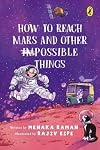
How to Reach Mars and Other (Im)possible Things is a beautiful and lovely Women in STEM book for little girls and young readers that is based on India’s Mars Orbiter Mission (MoM) and its success in 2014.
Rabia is most curious girl who loves to ask questions- “”Why don’t crabs have eyebrows”, “How does Manju Aunty’s cat know its way home?”, “Where does the light come from the bulb?” show more and so many such questions. When Rabia’s science teacher Mr. Madhu, gave students to draw a scientist and she was the only one who drew a female scientist. The class bully laughs at her picture and teases her women can’t be scientists.
When Rabia and her class U.R. Rao Satellite Centre in Banglore on National Science Day, she meets Dr. Mary, a physicist at ISRO, who answers Rabia’s many questions about scientists, Mars, India’s Mars Orbiter Mission, and how scientists are working on it.
Writing is lucid and fun for kids with beautiful, vivid illustrations. Rabia’s meeting with Dr. Mary is set in Feb 2012 and after that author takes us to real events in Nov 2013 when India launched the rocket for its first Mars mission and to Sept 2014 when it entered Martian orbit. This made history as no other countries entered the Martian Orbit on the first attempt and that too in low budget of INR 450 crore. The author’s comment on how it was less than making cost of the movie ‘The Martian’ made me smile.
I loved how the author included facts about Mars, the payload and what is it, where it is developed in India, who worked on MoM project, how they made it work on small budget, how they send spacecraft to the launch site… It was all explained through conversations, pictures, and comic art which makes it fun for kids.
I loved the highlight on the number of women scientists who worked at ISRO and those who worked on MoM mission and played crucial leadership roles in all areas- navigation, communication, control system, spacecraft design, and tracking. It was interesting to have a list of those women at the end of the story. There and an author’s note on why it is important to see women in STEM and about the “Draw-a-scientist Test” that I never heard of before reading this. It’s such an inspiring idea and I hope we have boys too in stats for drawing a female scientist pic.
I never read a STEM book for young readers before nor we were encouraged to choose a field that wasn’t medical as a kid. I’m sure this will inspire young girls to take up and explore the science field and also will make parents and boys to see girls can be scientists and they can do so many things and gender does not describe what a person can do or achieve.
Overall, How to Reach Mars and Other (Im)possible Things is an amazing, informative, and inspiring Women in STEM book for young readers. show less
How to Reach Mars and Other (Im)possible Things is a beautiful and lovely Women in STEM book for little girls and young readers that is based on India’s Mars Orbiter Mission (MoM) and its success in 2014.
Rabia is most curious girl who loves to ask questions- “”Why don’t crabs have eyebrows”, “How does Manju Aunty’s cat know its way home?”, “Where does the light come from the bulb?” show more and so many such questions. When Rabia’s science teacher Mr. Madhu, gave students to draw a scientist and she was the only one who drew a female scientist. The class bully laughs at her picture and teases her women can’t be scientists.
When Rabia and her class U.R. Rao Satellite Centre in Banglore on National Science Day, she meets Dr. Mary, a physicist at ISRO, who answers Rabia’s many questions about scientists, Mars, India’s Mars Orbiter Mission, and how scientists are working on it.
Writing is lucid and fun for kids with beautiful, vivid illustrations. Rabia’s meeting with Dr. Mary is set in Feb 2012 and after that author takes us to real events in Nov 2013 when India launched the rocket for its first Mars mission and to Sept 2014 when it entered Martian orbit. This made history as no other countries entered the Martian Orbit on the first attempt and that too in low budget of INR 450 crore. The author’s comment on how it was less than making cost of the movie ‘The Martian’ made me smile.
I loved how the author included facts about Mars, the payload and what is it, where it is developed in India, who worked on MoM project, how they made it work on small budget, how they send spacecraft to the launch site… It was all explained through conversations, pictures, and comic art which makes it fun for kids.
I loved the highlight on the number of women scientists who worked at ISRO and those who worked on MoM mission and played crucial leadership roles in all areas- navigation, communication, control system, spacecraft design, and tracking. It was interesting to have a list of those women at the end of the story. There and an author’s note on why it is important to see women in STEM and about the “Draw-a-scientist Test” that I never heard of before reading this. It’s such an inspiring idea and I hope we have boys too in stats for drawing a female scientist pic.
I never read a STEM book for young readers before nor we were encouraged to choose a field that wasn’t medical as a kid. I’m sure this will inspire young girls to take up and explore the science field and also will make parents and boys to see girls can be scientists and they can do so many things and gender does not describe what a person can do or achieve.
Overall, How to Reach Mars and Other (Im)possible Things is an amazing, informative, and inspiring Women in STEM book for young readers. show less
Awards


Statistics
- Works
- 7
- Members
- 36
- Popularity
- #397,830
- Rating
- 3.5
- Reviews
- 1
- ISBNs
- 12
- Languages
- 3
