
About the Author
John Corcoran has worked as an entertainment reporter, critic & feature reporter in TV stations in Washington, DC, Boston & Los Angeles, earning Emmys in each market. He has been a radio talk show host, after-dinner speaker, freelance writer, columnist & author. He wants you to know he is not show more Johnnie Cochran the lawyer, or John Cochran the network newscaster. (Bowker Author Biography) show less
Works by John Corcoran
The Teacher Who Couldn't Read: The True Story of a High School Instructor Who Triumphed over His Illiteracy (1994) 95 copies, 4 reviews
The Ultimate Martial Arts Q&A Book : 750 Expert Answers to Your Essential Questions (2001) 13 copies, 1 review
The Unauthorized Jackie Chan Encyclopedia : From "Project A" to "Shanghai Noon" and Beyond (2002) 8 copies
The Ultimate Martial Arts Q & A Book-750 Expert Answers to Your Essential Questions 2 copies, 1 review
Associated Works
Tagged
Common Knowledge
- Gender
- male
Members
Reviews

Outdated but delightful primer on martial arts.
Believed that I had never heard of Cynthia Rothrock until watching the documentary Iron Fists and Kung Fu Kicks but turns 0ut I had just forgotten entire swathes of this book.
The Bruce Lee anecdote is very entertaining - probably not true but very entertaining nonetheless.
Despite the cover, really doesn't get into ninjutsu much.
Very funny to hear the author promise that Jackie Chan will be a massive star in the USA. They also promise the show more same thing for Ernie Reyes Jr. show less
Believed that I had never heard of Cynthia Rothrock until watching the documentary Iron Fists and Kung Fu Kicks but turns 0ut I had just forgotten entire swathes of this book.
The Bruce Lee anecdote is very entertaining - probably not true but very entertaining nonetheless.
Despite the cover, really doesn't get into ninjutsu much.
Very funny to hear the author promise that Jackie Chan will be a massive star in the USA. They also promise the show more same thing for Ernie Reyes Jr. show less
The Teacher Who Couldn't Read: The True Story of a High School Instructor Who Triumphed over His Illiteracy by John Corcoran

It's hard to believe that someone could make his way through 12 years of school, graduate from college and teach high school for 17 years without letting on that he couldn't read, but that's just what John Corcoran did. Due to a learning disability, lack of stability in school, failings in our education system, social pressures, and his own fears, among other issues, John was unable to read until the age of 48. This book chronicles his life, his feelings of inadequacy through grade school, show more acting out in class during his teen years, skipping high school classes, cheating his way through college and ending up on the other side of the classroom as a teacher, all the while hiding his illiteracy from family, friends, his own students and colleagues. It is an interesting story as well as a call to action for parents and educators in the fight against illiteracy. show less
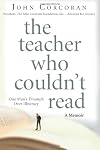
I thought the best part was where he talked about the coping skills and methods of getting through class (cheating) - clearly a person using intelligence to get through school, but not how you normally think of it. I believe many students get tested as they go into schools for phonemic awareness, etc., so if this book helped that process when it was written 20 years ago, wonderful. However, I think there are many more illiterate people in America than when it was written - so his foundation show more is needed more than ever. show less
The Teacher Who Couldn't Read: The True Story of a High School Instructor Who Triumphed over His Illiteracy by John Corcoran
teacher who couldn’t read sounds unbelievable, but it is true. John Corcoran was a high school teacher and coach, a college graduate, and he had a huge secret. He couldn’t read.
How did this come about? How was it even possible?
John attended 17 different schools before he got his first full time job.
He had teachers who tried to teach him, but the marks on the page never made sense to him. He had teachers who tried to help him, but as he moved from school to school their short term efforts show more did not help him become literate. John was assigned again and again to the row at the back with other students who were struggling.
John learned to hate being in the “dumb row.” He also eventually learned to cope with his disability by developing ways to learn through listening and observing. John learned which people were valuable assets in his “human library.” He also learned to cheat, lie and steal just to survive the system and attain his goals.
One day his 3-year-old daughter asked him to read her a bedtime story. John could not, and felt a deep sense of shame as his wife cried herself to sleep.
Still it was years before he reached a point where he walked into a library that had a literacy program and asked for help. John was reassured by the program’s director that he was not alone. She paired him up with a tutor who patiently spent 13 months teaching him the basic phonics skills he had never mastered as a youth. John learned the basics of reading at 48 years old.
John still struggled. The words never seemed to flow easily into his brain. Then he was contacted by an expert in reading disorders and agreed to go to the Lindamood-Bell clinic for testing. There he learned that his brain could not easily distinguish between differences in sound. He could not process the difference between certain sounds like d and t. Suddenly John understood why reading had always been such a struggle for him. With specific therapy a whole new world was opened up for John, and he made huge leaps in his ability to decode and recognize words, spell, follow oral directions, and comprehend what he reads.
Now John shares his story and has started a foundation to fight against illiteracy in the United States.
More of his story is found in his book The Teacher Who Couldn’t Read: One man’s triumph over illiteracy, which I highly recommend. show less
How did this come about? How was it even possible?
John attended 17 different schools before he got his first full time job.
He had teachers who tried to teach him, but the marks on the page never made sense to him. He had teachers who tried to help him, but as he moved from school to school their short term efforts show more did not help him become literate. John was assigned again and again to the row at the back with other students who were struggling.
John learned to hate being in the “dumb row.” He also eventually learned to cope with his disability by developing ways to learn through listening and observing. John learned which people were valuable assets in his “human library.” He also learned to cheat, lie and steal just to survive the system and attain his goals.
One day his 3-year-old daughter asked him to read her a bedtime story. John could not, and felt a deep sense of shame as his wife cried herself to sleep.
Still it was years before he reached a point where he walked into a library that had a literacy program and asked for help. John was reassured by the program’s director that he was not alone. She paired him up with a tutor who patiently spent 13 months teaching him the basic phonics skills he had never mastered as a youth. John learned the basics of reading at 48 years old.
John still struggled. The words never seemed to flow easily into his brain. Then he was contacted by an expert in reading disorders and agreed to go to the Lindamood-Bell clinic for testing. There he learned that his brain could not easily distinguish between differences in sound. He could not process the difference between certain sounds like d and t. Suddenly John understood why reading had always been such a struggle for him. With specific therapy a whole new world was opened up for John, and he made huge leaps in his ability to decode and recognize words, spell, follow oral directions, and comprehend what he reads.
Now John shares his story and has started a foundation to fight against illiteracy in the United States.
More of his story is found in his book The Teacher Who Couldn’t Read: One man’s triumph over illiteracy, which I highly recommend. show less
You May Also Like


Associated Authors
Statistics
- Works
- 17
- Also by
- 2
- Members
- 243
- Popularity
- #93,556
- Rating
- 3.9
- Reviews
- 13
- ISBNs
- 22