
Dmitry Likhachov (1906–1999)
Author of Reflections on the Russian Soul
About the Author
Dmitry S. Likhachev was one of Russia's most famous literary historians and cultural commentators. In the late 1980's Mikhail Gorbachev enlisted him as Chairman of the Soviet Cultural Fund. In 1998 he was the first person since 1917 to be presented with the order of St Andrew. He was made show more corresponding member of the Austrian, American, British and Italian academies of arts and sciences. He died 30 September 1999, aged 92. show less
Works by Dmitry Likhachov
Izbrannye raboty v trekh tomakh 2 copies
Izbrannye raboty : v 3 t. 3 Čelovek v literature Drevnej Rusi. O "Slove o polku Igoreve" [u.a.] 1 copy
La mia Russia 1 copy
Словарь книжников и книжности дреней Руси. Вып. 2 (вторая половина XIV-XVI в.) Часть 1 А-К (1987) 1 copy
Смех в Древней Руси 1 copy
Puti izucheniia drevnerusskoˆi literatury i pis'mennosti [Doklady soveshchaniia, 13-14 maia 1968 g 1 copy
Раздумья 1 copy
Письма о добром 1 copy
Smekh v Drevneˆi Rusi 1 copy
Associated Works
The Song of Igor's Campaign, An Epic of the Twelfth Century (1800) — Translator, some editions — 249 copies, 3 reviews
Tagged
Common Knowledge
- Canonical name
- Likhachov, Dmitry
- Legal name
- Likhachev, Dmitry Sergeevich
- Other names
- Лихачёв, Дмитрий Сергеевич
- Birthdate
- 1906-11-26
- Date of death
- 1999-09-30
- Gender
- male
- Education
- Leningrad University
- Occupations
- literary theorist
editor
scholar - Organizations
- Soviet Academy of Sciences
- Awards and honors
- Order of St. Andrew
- Relationships
- Tolz, Vera (granddaughter)
- Nationality
- Russia
- Birthplace
- St Petersburg, Russian Empire
- Places of residence
- St. Petersburg, Russia
- Place of death
- St Petersburg, Russia
- Associated Place (for map)
- Russia
Members
Reviews
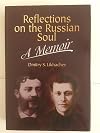
Memoir is the key word. This is a set of reminiscences of a Russian literary scholar from St. Petersburg (Leningrad), Dmitry Likhachov, who lived from 1906 to 1999.
Arrested for no good reason (the overwhelming norm), Likhachov experienced months in prison and several years in a Soviet labor camp on the White Sea where Stalin had decided in 1931 to build in a hurry, with forced manual camp labor, a canal from the White Sea to Lake Onega, so connecting the White Sea indirectly to the Baltic show more Sea. Around 15,000 of the workers died thus. Likhachov also survived the 872-day siege of Leningrad, which was isolated by the Germans during WW2, resulting in up to 100,000 deaths per month from starvation. He somehow maintained his good morals and strength of character. His survival was largely a matter of luck.
During these experiences Likhachov met many other intellectuals, 95% of whom even the well-read in Russian literature and history will never have heard of. It seems that much of the book was about those people and so was of minor interest. (Of the remaining 5%, little of note is reported.)
Likhachov's experiences in the labor camp and the Leningrad siege were of interest, but there are a number of books about those that are more absorbing and informative. Thus this book is apparently of substantial interest only to Russian readers familiar with the Russian intellectuals whom Likhachov reminisces about. They may read it in Russian.
Thus I don't understand why this was translated into English. As to the writing style, for a memoir it is satisfactory, but for a book of possible interest to the general reader, it is as if composed by a commonplace writer in serious need of an editor. There is very little about Old Russian literature, the writer's primary academic interest, or about the author's other considerable work, dedicated to preserving the best in Russian culture. show less
Arrested for no good reason (the overwhelming norm), Likhachov experienced months in prison and several years in a Soviet labor camp on the White Sea where Stalin had decided in 1931 to build in a hurry, with forced manual camp labor, a canal from the White Sea to Lake Onega, so connecting the White Sea indirectly to the Baltic show more Sea. Around 15,000 of the workers died thus. Likhachov also survived the 872-day siege of Leningrad, which was isolated by the Germans during WW2, resulting in up to 100,000 deaths per month from starvation. He somehow maintained his good morals and strength of character. His survival was largely a matter of luck.
During these experiences Likhachov met many other intellectuals, 95% of whom even the well-read in Russian literature and history will never have heard of. It seems that much of the book was about those people and so was of minor interest. (Of the remaining 5%, little of note is reported.)
Likhachov's experiences in the labor camp and the Leningrad siege were of interest, but there are a number of books about those that are more absorbing and informative. Thus this book is apparently of substantial interest only to Russian readers familiar with the Russian intellectuals whom Likhachov reminisces about. They may read it in Russian.
Thus I don't understand why this was translated into English. As to the writing style, for a memoir it is satisfactory, but for a book of possible interest to the general reader, it is as if composed by a commonplace writer in serious need of an editor. There is very little about Old Russian literature, the writer's primary academic interest, or about the author's other considerable work, dedicated to preserving the best in Russian culture. show less
Awards

You May Also Like
Associated Authors
Statistics
- Works
- 64
- Also by
- 2
- Members
- 105
- Popularity
- #183,190
- Rating
- 3.7
- Reviews
- 1
- ISBNs
- 39
- Languages
- 2
