

Stephen Donaldson (1) (1947–)
Author of Lord Foul's Bane
For other authors named Stephen Donaldson, see the disambiguation page.
Stephen Donaldson (1) has been aliased into Stephen R. Donaldson.
Series
Works by Stephen Donaldson
Works have been aliased into Stephen R. Donaldson.
World Tales 1 copy
Tagged
Common Knowledge
- Other names
- Stephens, Reed
- Birthdate
- 1947-05-13
- Gender
- male
- Education
- The College of Wooster (1968)
Kent State University (MA, English)
Kodaikanal International School - Awards and honors
- John W. Campbell Award for Best New Writer (1979)
The College of Wooster Distinguished Alumni Award (1988)
Popular Fiction Readers Choice Award for Favorite Fantasy Author (1991)
Atlanta Fantasy Fair Award for Outstanding Achievement (1992)
President's Award, International Association for the Fantastic in the Arts (1997)
University of St Andrews Honorary Doctor of Letters (2009) - Nationality
- USA
- Birthplace
- Cleveland, Ohio, USA
- Places of residence
- New Mexico, USA
- Map Location
- USA
Members
Reviews
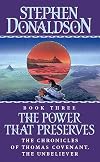
I gave the first book of this series grief for being a slow burn. I stand by that assessment, but this volume illustrates why you might spend an entire book building a world — so you can burn it to the ground in the most horrifying way possible.
“The Illearth War” picks up a few weeks after the events of the first book. Thomas Covenant has barely had time to readjust to life in our world as a despised leper when he's drawn back to the Land, thrust into his unwanted destiny to save or show more destroy it — assuming it’s not the product of a broken mind.
One strength of this book is that it doesn’t shy away from the consequences of Covenant’s first visit to the Land. As in Narnia, time works differently here; and in the interval since his first visit, the ripples of his crime have wrought both great evil and great good.
With that in mind, if the first book grapples with the question of whether or not redemption is possible for unredeemable people, this second book attacks the question of whether or not evil itself can have redemptive purpose. Donaldson’s answer seems, again, to be yes.
This is perhaps best illustrated by Warmark Hile Troy, who quickly became one of my favorite literary characters. His arc from disability to command is magnificent, especially his evolution as a leader of men in a frantic forced march against Lord Foul the Despiser’s terrifying horde.
After countless cycles of war with Lord Foul, Troy’s strategy is the first that breaks with the hidebound defense offered by the Lords of Revelstone, the first that offers a chance of real victory. But without Covenant’s original sin, Troy wouldn’t be positioned to bring his unique vision to the war.
This theme of evil birthing good surfaces in other ways, such as in the speculation of some in the Land that Kevin Landwaster’s ancient, despairing enactment of the Ritual of Desecration may have been a deliberate self-sacrifice; and that only through a terrible rending can good triumph over evil.
If you sense in this a shadow of Christ’s cross, I don’t think you’re imagining things. As in “Lord Foul’s Bane,” I believe Donaldson’s Presbyterian upbringing is one tributary of his thought. Certainly he grew up steeped in the core ideal of Christianity; namely, that death has been defeated through death.
Of course, Donaldson no longer accepts the faith of his fathers, and so blurs this hopeful theme in the person of Thomas Covenant, Unbeliever. Covenant remains the question mark at the center of the story: a man at once resistant to the promise of the Land and unable to resist its imperatives.
Even as Covenant struggles to escape the urgency of the Land, he is pulled deeper into a life offensive both to his reason and his paranoia. His unbelief motivates him to see further into Lord Foul’s plans, and the unpredictability of the Wild Magic he carries forces caution on the Despiser.
And so, even the sin of Covenant’s unbelief serves to affirm, strengthen, and preserve the very Land whose reality he doubts. Is this a happy accident, or the wise purpose of the Land’s Creator, a Creator whose existence is questioned even by residents of the Land?
Either way, Donaldson seems to say, the righteous indignations on which we mount are too small for the vistas of our moral universe. Good can, and perhaps sometimes must, come from evil; we’re simply too small to see the end from the beginning. Perhaps glory exists only at the end of dark paths. Perhaps Friday’s death is only the turn of a key that throws open the door to Sunday’s resurrection. show less
“The Illearth War” picks up a few weeks after the events of the first book. Thomas Covenant has barely had time to readjust to life in our world as a despised leper when he's drawn back to the Land, thrust into his unwanted destiny to save or show more destroy it — assuming it’s not the product of a broken mind.
One strength of this book is that it doesn’t shy away from the consequences of Covenant’s first visit to the Land. As in Narnia, time works differently here; and in the interval since his first visit, the ripples of his crime have wrought both great evil and great good.
With that in mind, if the first book grapples with the question of whether or not redemption is possible for unredeemable people, this second book attacks the question of whether or not evil itself can have redemptive purpose. Donaldson’s answer seems, again, to be yes.
This is perhaps best illustrated by Warmark Hile Troy, who quickly became one of my favorite literary characters. His arc from disability to command is magnificent, especially his evolution as a leader of men in a frantic forced march against Lord Foul the Despiser’s terrifying horde.
After countless cycles of war with Lord Foul, Troy’s strategy is the first that breaks with the hidebound defense offered by the Lords of Revelstone, the first that offers a chance of real victory. But without Covenant’s original sin, Troy wouldn’t be positioned to bring his unique vision to the war.
This theme of evil birthing good surfaces in other ways, such as in the speculation of some in the Land that Kevin Landwaster’s ancient, despairing enactment of the Ritual of Desecration may have been a deliberate self-sacrifice; and that only through a terrible rending can good triumph over evil.
If you sense in this a shadow of Christ’s cross, I don’t think you’re imagining things. As in “Lord Foul’s Bane,” I believe Donaldson’s Presbyterian upbringing is one tributary of his thought. Certainly he grew up steeped in the core ideal of Christianity; namely, that death has been defeated through death.
Of course, Donaldson no longer accepts the faith of his fathers, and so blurs this hopeful theme in the person of Thomas Covenant, Unbeliever. Covenant remains the question mark at the center of the story: a man at once resistant to the promise of the Land and unable to resist its imperatives.
Even as Covenant struggles to escape the urgency of the Land, he is pulled deeper into a life offensive both to his reason and his paranoia. His unbelief motivates him to see further into Lord Foul’s plans, and the unpredictability of the Wild Magic he carries forces caution on the Despiser.
And so, even the sin of Covenant’s unbelief serves to affirm, strengthen, and preserve the very Land whose reality he doubts. Is this a happy accident, or the wise purpose of the Land’s Creator, a Creator whose existence is questioned even by residents of the Land?
Either way, Donaldson seems to say, the righteous indignations on which we mount are too small for the vistas of our moral universe. Good can, and perhaps sometimes must, come from evil; we’re simply too small to see the end from the beginning. Perhaps glory exists only at the end of dark paths. Perhaps Friday’s death is only the turn of a key that throws open the door to Sunday’s resurrection. show less
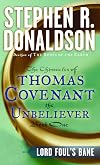
OMG that was a rather difficult book to get into. I mean, most of the time I had keep re-shifting the gears in my head to see what might be valuable and good about this book, and for a great 200 pages I was wondering if I had stumbled into another Eddings slogfest full of completely predictable situations and heroes, with only the main character being a bit out of the ordinary.
And then I had to remind myself that this came out in 1977 and the cult fantasy favourite (as opposed to the show more mainstream fantasy favourite) was LOTR. We've been inundated with Lewis and Beagle and who knows what else in the fantasy field. The time was ripe for a change, and all the big fantasy fans have all declared this fantasy cycle as a major turning point with a textual breakaway into new territory that has stuck with us all the way to modern fantasy, (which I have to say, I now adore).
But did I really get into this book? Is it even possible? The answer is yes, with a pretty huge caveat.
It's pretty obvious that the entire book is an exploration of a quote by John Milton in Paradise Lost: "The mind is its own place, and in itself can make a heaven of hell, a hell of heaven."
Putting that firmly in mind, now read our self-hating Thomas Covenant in his American home being treated as a Leper, because he is one, and see America as Mordor. He's in hell. And then he gets sent to heaven.
The magical land is just that. It's magical, people CAN live on beauty, alone, and there are honourable seafaring giants reminiscent of the Ents, horse riders with much more magic in the horses, just like Rohan, only more like Valdemar, and the Council, who are mages who have lost much lore over the centuries.
Covenant is skeptical of everything he sees, now, for although he used to be a best-selling author, he's now given up on all things imaginative in the wake of the hell of being diagnosed as a Leper and to learn he has no hope whatsoever. So when he is miraculously cured, and the wedding ring of his divorced wife has turned into the receptacle of the mystical Wild Magic that could either restore or destroy this wonderful fantasy world, he just Can Not Believe any of it. He's hallucinating. He's dreaming.
Too bad for him, it's all too real to his senses, and even his nerves have regenerated, which he knows is impossible. Oh Dear.
Honestly, the ideas come across as much more interesting than the execution. Like I said, it was a slogfest.
It's also too bad, because he's rather an asshole.
After reading so much modern fantasy, I ALMOST wish he'd done something other than rape the wide-eyed girl that was doing her damnedest to help him, like murder a cute puppy or an innocent child. Maybe he'd have had an easier time making me believe he really did regret the act later, or even right after the passion had been spent. Jesus. What a fucking prick.
Okay. Moving along. And that's another thing. It was just a very, very long travelogue. At least LOTR had it in service of excellent secondary or tertiary goals. The most we can say about Covenant is his gradual slide into belief and eventual realization that he's been a major asshole.
At least there was lots of dancing! And the initial metaphor and how it changed each time was not lost upon me. That was one of the nicer aspects of the novel, other than the realizations of Covenant, himself.
Okay, now here's my biggest nut and bolt complaint: Lord Foul is both a pretty damn interesting strategist and uber-powerful magical villain. I wish it hadn't taken so damn long for us as readers to GET THAT POINT. Practically anything else would have been a better introduction to Drool and Foul. They came across as an actual snivelling idiot and a minor house lord, and not the wielder of a staff fashioned by the Creator, himself, to right the corruption being spread throughout the fabric of reality, or the source of that corruption, itself: Lord Foul. It was all properly epic and I loved the ideas once I was finally INTRODUCED to them.
I saw the influence of Zelazny's Amber series right away, and I've always loved it when authors did that. You know. Uber Reality and the lesser realms, with Earth being one of many minor realms. It was a nice addition to the book.
And oddly enough, I got a lot more out of the novel's spoken-aloud tales, campfire style, than I did with the entire "let's go get that damn Staff" storyline.
It's not a bad novel. Don't get me wrong. I'm not jumping off the deep end and slamming this as I would with a modern fantasy that tried to pull this off. I'm trying to respect it as a product of it's time and place, and as such, I'd probably give it a 5 star rating, too, or perhaps a 4 because Zelazny's was better. Or at least I remember it more fondly, and since I haven't read the other Covenant novels, I really shouldn't judge just yet.
But the language in this novel wasn't up to Tolkien's high standards, and the worldbuilding didn't leave all that much impression on me, either. Maybe that's a personal failing, and the fact that I couldn't get into the groove and kept falling out of whatever groove I eventually got... well, it certainly didn't help.
I'll keep going, because once I invest in a thing, I like to maintain the investment, especially when others tell me it only gets a lot better, but as of right this moment, I'm a bit weary. Maybe a few novels before I sink into the next might be best.
*sigh* show less
And then I had to remind myself that this came out in 1977 and the cult fantasy favourite (as opposed to the show more mainstream fantasy favourite) was LOTR. We've been inundated with Lewis and Beagle and who knows what else in the fantasy field. The time was ripe for a change, and all the big fantasy fans have all declared this fantasy cycle as a major turning point with a textual breakaway into new territory that has stuck with us all the way to modern fantasy, (which I have to say, I now adore).
But did I really get into this book? Is it even possible? The answer is yes, with a pretty huge caveat.
It's pretty obvious that the entire book is an exploration of a quote by John Milton in Paradise Lost: "The mind is its own place, and in itself can make a heaven of hell, a hell of heaven."
Putting that firmly in mind, now read our self-hating Thomas Covenant in his American home being treated as a Leper, because he is one, and see America as Mordor. He's in hell. And then he gets sent to heaven.
The magical land is just that. It's magical, people CAN live on beauty, alone, and there are honourable seafaring giants reminiscent of the Ents, horse riders with much more magic in the horses, just like Rohan, only more like Valdemar, and the Council, who are mages who have lost much lore over the centuries.
Covenant is skeptical of everything he sees, now, for although he used to be a best-selling author, he's now given up on all things imaginative in the wake of the hell of being diagnosed as a Leper and to learn he has no hope whatsoever. So when he is miraculously cured, and the wedding ring of his divorced wife has turned into the receptacle of the mystical Wild Magic that could either restore or destroy this wonderful fantasy world, he just Can Not Believe any of it. He's hallucinating. He's dreaming.
Too bad for him, it's all too real to his senses, and even his nerves have regenerated, which he knows is impossible. Oh Dear.
Honestly, the ideas come across as much more interesting than the execution. Like I said, it was a slogfest.
It's also too bad, because he's rather an asshole.
After reading so much modern fantasy, I ALMOST wish he'd done something other than rape the wide-eyed girl that was doing her damnedest to help him, like murder a cute puppy or an innocent child. Maybe he'd have had an easier time making me believe he really did regret the act later, or even right after the passion had been spent. Jesus. What a fucking prick.
Okay. Moving along. And that's another thing. It was just a very, very long travelogue. At least LOTR had it in service of excellent secondary or tertiary goals. The most we can say about Covenant is his gradual slide into belief and eventual realization that he's been a major asshole.
At least there was lots of dancing! And the initial metaphor and how it changed each time was not lost upon me. That was one of the nicer aspects of the novel, other than the realizations of Covenant, himself.
Okay, now here's my biggest nut and bolt complaint: Lord Foul is both a pretty damn interesting strategist and uber-powerful magical villain. I wish it hadn't taken so damn long for us as readers to GET THAT POINT. Practically anything else would have been a better introduction to Drool and Foul. They came across as an actual snivelling idiot and a minor house lord, and not the wielder of a staff fashioned by the Creator, himself, to right the corruption being spread throughout the fabric of reality, or the source of that corruption, itself: Lord Foul. It was all properly epic and I loved the ideas once I was finally INTRODUCED to them.
I saw the influence of Zelazny's Amber series right away, and I've always loved it when authors did that. You know. Uber Reality and the lesser realms, with Earth being one of many minor realms. It was a nice addition to the book.
And oddly enough, I got a lot more out of the novel's spoken-aloud tales, campfire style, than I did with the entire "let's go get that damn Staff" storyline.
It's not a bad novel. Don't get me wrong. I'm not jumping off the deep end and slamming this as I would with a modern fantasy that tried to pull this off. I'm trying to respect it as a product of it's time and place, and as such, I'd probably give it a 5 star rating, too, or perhaps a 4 because Zelazny's was better. Or at least I remember it more fondly, and since I haven't read the other Covenant novels, I really shouldn't judge just yet.
But the language in this novel wasn't up to Tolkien's high standards, and the worldbuilding didn't leave all that much impression on me, either. Maybe that's a personal failing, and the fact that I couldn't get into the groove and kept falling out of whatever groove I eventually got... well, it certainly didn't help.
I'll keep going, because once I invest in a thing, I like to maintain the investment, especially when others tell me it only gets a lot better, but as of right this moment, I'm a bit weary. Maybe a few novels before I sink into the next might be best.
*sigh* show less
I've come to many of these famous and celebrated series late in life, having missed them in my youth. Some suffer from the tardiness, but others stand the test of time - Thomas Covenant is one that stands the test of time. Sure, it's hard resist the inclination toward comparison with [[Tolkien]], but Donaldson's world building doesn't owe much to Middle Earth. He's created a unique and diverse world in which to deposit Thomas, one that is internally and externally complete, even if the show more ending of this first book leaves ambiguous the question of reality vs. dream.
Thomas, a leper, is transfigured into a new realm, one which it isn't clear is in the past or future, but which has it's own rules and customs which Thomas must learn to survive. He's immediately dropped into a battle with the evil entity, Lord Foul, and left to wonder how he fits into the coming battle - either as a force for good or ill. The choice, it turns out again and again, is up to him and the story is richer for his choices against good along the way.
The world around Thomas is colorfully diverse - from stone-based conjurers to wood-based tree-dwellers to sentient horses and their servants.
Definitely continuing this series.
5 bones!!!!!
Highly recommended! show less
Thomas, a leper, is transfigured into a new realm, one which it isn't clear is in the past or future, but which has it's own rules and customs which Thomas must learn to survive. He's immediately dropped into a battle with the evil entity, Lord Foul, and left to wonder how he fits into the coming battle - either as a force for good or ill. The choice, it turns out again and again, is up to him and the story is richer for his choices against good along the way.
The world around Thomas is colorfully diverse - from stone-based conjurers to wood-based tree-dwellers to sentient horses and their servants.
Definitely continuing this series.
5 bones!!!!!
Highly recommended! show less

Lord Foul's Bane was a decent start to a potentially refreshing series. Illearth War fails to deliver on that and has put me off completely.
It begins well, with the build-up to Covenants summoning and the transition from his world to the next setting a good foundation.
It is a shame that the next 150 pages consist almost entirely of war council meetings. The next phase of the story takes up more than a third of the book and comprises entirely of a long war march led by a character that's new show more to the series. He's also a bit whiny. Thomas Covenant is not involved in this part of the story which rather contradicts the fact that the rest of the story is centered on him and his unbelief in the potentially imaginary world that surrounds him. When we finally get past this dull deviation, we are shown his “meanwhile" galavantings in the latter part of the book. Unfortunately, his strange attraction to his daughter (whose mother he raped), and her even stranger attraction to him, seem to become more of a focus than the actual plot.
Accompanying this are a lot of unrealistic, overblown events that are only just about acceptable due to the fact that this is a fantasy book and, I guess, you can get away with more or less anything under that umbrella.
Ah well, on to better things. show less
It begins well, with the build-up to Covenants summoning and the transition from his world to the next setting a good foundation.
It is a shame that the next 150 pages consist almost entirely of war council meetings. The next phase of the story takes up more than a third of the book and comprises entirely of a long war march led by a character that's new show more to the series. He's also a bit whiny. Thomas Covenant is not involved in this part of the story which rather contradicts the fact that the rest of the story is centered on him and his unbelief in the potentially imaginary world that surrounds him. When we finally get past this dull deviation, we are shown his “meanwhile" galavantings in the latter part of the book. Unfortunately, his strange attraction to his daughter (whose mother he raped), and her even stranger attraction to him, seem to become more of a focus than the actual plot.
Accompanying this are a lot of unrealistic, overblown events that are only just about acceptable due to the fact that this is a fantasy book and, I guess, you can get away with more or less anything under that umbrella.
Ah well, on to better things. show less
Lists
Awards


You May Also Like
Associated Authors
Statistics
- Works
- 17
- Members
- 13,859
- Popularity
- #1,667
- Rating
- 3.7
- Reviews
- 172
- ISBNs
- 164
- Languages
- 12
- Favorited
- 4