
David R. Swartz
Author of Moral Minority: The Evangelical Left in an Age of Conservatism
Works by David R. Swartz
Tagged
Common Knowledge
There is no Common Knowledge data for this author yet. You can help.
Members
Reviews
Moral Minority: The Evangelical Left in an Age of Conservatism (Politics and Culture in Modern America) by David R. Swartz
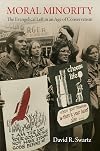
It may come as a shock to some that evangelicals have not always been associated with the right wing. The rise of right-wing evangelicals came in the late 1970s. It was during this time evangelicals became politicised and we saw the rise of the Moral Majority.
Swartz in this well researched and written book traces the rise and decline of the evangelical left - what he terms the Moral Minority. He looks primarily at the period after 1960 - a time when for most evangelicals politics was taboo show more and faith was personal and had no place in the public square.
The key players that Swartz examines include Carl Henry, John Alexander, Jim Wallis, Mark Hatfield, Samuel Escobar, Richard Mouw and Ron Sider. The book is in three parts each looking at the emerging, the broadening and finally the fragmentation of the left. The peak of the movement came in 1973 with the Chicago Declaration of Evangelical Social Concern.
The fall of the evangelical left, according to Swartz, however, was its fragmentation and its focus on identity politics. As he puts it:
‘By the late 1970s, it was clear that the politics of identity in all its forms was stunting the promise of the evangelical left. Rifts widened between men and women, black and white, Anabaptist and Calvinist—and in countless other permutations’ (211). show less
Swartz in this well researched and written book traces the rise and decline of the evangelical left - what he terms the Moral Minority. He looks primarily at the period after 1960 - a time when for most evangelicals politics was taboo show more and faith was personal and had no place in the public square.
The key players that Swartz examines include Carl Henry, John Alexander, Jim Wallis, Mark Hatfield, Samuel Escobar, Richard Mouw and Ron Sider. The book is in three parts each looking at the emerging, the broadening and finally the fragmentation of the left. The peak of the movement came in 1973 with the Chicago Declaration of Evangelical Social Concern.
The fall of the evangelical left, according to Swartz, however, was its fragmentation and its focus on identity politics. As he puts it:
‘By the late 1970s, it was clear that the politics of identity in all its forms was stunting the promise of the evangelical left. Rifts widened between men and women, black and white, Anabaptist and Calvinist—and in countless other permutations’ (211). show less
Statistics
- Works
- 2
- Members
- 55
- Popularity
- #295,339
- Rating
- 4.0
- Reviews
- 1
- ISBNs
- 8