
David R. Morrow
Author of A Workbook for Arguments: A Complete Course in Critical Thinking
About the Author
Works by David R. Morrow
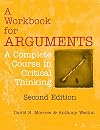
A Workbook for Arguments, Second Edition: A Complete Course in Critical Thinking (2015) 45 copies, 1 review
Tagged
Common Knowledge
There is no Common Knowledge data for this author yet. You can help.
Members
Reviews
Having read A Rulebook For Arguments by Anthony Weston and finding it quite useful, the prospect of reading a book along very similar lines but offering more expanded thought seemed quite intriguing. Thankfully, the following book delivered in spades.
A Workbook For Arguments – A Complete Course In Critical Thinking by David R. Morrow & Anthony Weston is a very comprehensive, incisive, and detailed foray into what it takes to create a critical thinker.
Not only does A Workbook For Arguments show more contain the text from A Rulebook For Arguments with further extensions which help the reader become more robust with the content broken down, but it also features simple, and yet acute advice for the individual to become more apt in argumentation.
In conjunction with that the authors break down about half the exercises in the book with model responses in the back of the book. Most of these exercise detail real world issues one is likely to hear often, detailing the pros and cons of whatever answers were employed, and how each of those may affect an individual or society as a whole.
Also included in the book is a rundown of some of the most common fallacies, which is also useful since fallacies are employed far more often than most realize, and aren’t really taught in school, when in all actuality they should be. Knowing these fallacies is vital to understand not only someone else’s argument and their inherent flaws, but also in constructing and fine-tuning one’s own.
Arguably, the most important part of this book is that from the beginning it guides the reader through the steps in constructing a critical argument in a very logical fashion. Consistently throughout the book, new topics continually build on the prior ones, rather than there being no coherent design.
Personally, this is the kind of book whose contents should be mandatory to learn in school and should definitely not be overlooked for homeschooling, autodidacts and self-teachers.
Simply stated, anyone who is seeking to employ critical thinking, use logic in argumentation and become more robust in most key aspects of argumentation should get this book, if not file it under careful consideration. If you think about it, even if it was priced at double or triple the price, it would STILL be worth it, because college courses covering the same subject are often more costly, and offer barely a fraction of what’s here, IF they offer anything of such high quality.
If you happened to have read A Rulebook For Arguments, and appreciated it, then get this one. You will not regret it. It’s worth it in more ways individuals could imagine.
______________________________________________________
Suggested resources reviewed below for those seeking ideas to self-teach and become autodidacts:
Socratic Logic V3.1 by Peter Kreeft Ph.D.
The Trivium – The Liberal Arts Of Grammar & Rhetoric by Sister Miriam Joseph Ph.D.
How To Read A Book – The Classic Guide To Intelligent Reading by Mortimer J. Adler & Charles Van Doren
Philosophy 101 – An Introduction To Philosophy Via Plato’s Apology by Peter Kreeft Ph.D.
The Imaginative Argument – A Practical Manifesto For Writers by Frank L. Cioffi show less
A Workbook For Arguments – A Complete Course In Critical Thinking by David R. Morrow & Anthony Weston is a very comprehensive, incisive, and detailed foray into what it takes to create a critical thinker.
Not only does A Workbook For Arguments show more contain the text from A Rulebook For Arguments with further extensions which help the reader become more robust with the content broken down, but it also features simple, and yet acute advice for the individual to become more apt in argumentation.
In conjunction with that the authors break down about half the exercises in the book with model responses in the back of the book. Most of these exercise detail real world issues one is likely to hear often, detailing the pros and cons of whatever answers were employed, and how each of those may affect an individual or society as a whole.
Also included in the book is a rundown of some of the most common fallacies, which is also useful since fallacies are employed far more often than most realize, and aren’t really taught in school, when in all actuality they should be. Knowing these fallacies is vital to understand not only someone else’s argument and their inherent flaws, but also in constructing and fine-tuning one’s own.
Arguably, the most important part of this book is that from the beginning it guides the reader through the steps in constructing a critical argument in a very logical fashion. Consistently throughout the book, new topics continually build on the prior ones, rather than there being no coherent design.
Personally, this is the kind of book whose contents should be mandatory to learn in school and should definitely not be overlooked for homeschooling, autodidacts and self-teachers.
Simply stated, anyone who is seeking to employ critical thinking, use logic in argumentation and become more robust in most key aspects of argumentation should get this book, if not file it under careful consideration. If you think about it, even if it was priced at double or triple the price, it would STILL be worth it, because college courses covering the same subject are often more costly, and offer barely a fraction of what’s here, IF they offer anything of such high quality.
If you happened to have read A Rulebook For Arguments, and appreciated it, then get this one. You will not regret it. It’s worth it in more ways individuals could imagine.
______________________________________________________
Suggested resources reviewed below for those seeking ideas to self-teach and become autodidacts:
Socratic Logic V3.1 by Peter Kreeft Ph.D.
The Trivium – The Liberal Arts Of Grammar & Rhetoric by Sister Miriam Joseph Ph.D.
How To Read A Book – The Classic Guide To Intelligent Reading by Mortimer J. Adler & Charles Van Doren
Philosophy 101 – An Introduction To Philosophy Via Plato’s Apology by Peter Kreeft Ph.D.
The Imaginative Argument – A Practical Manifesto For Writers by Frank L. Cioffi show less
You May Also Like
Associated Authors
Statistics
- Works
- 4
- Members
- 127
- Popularity
- #158,247
- Rating
- 4.3
- Reviews
- 1
- ISBNs
- 10
- Languages
- 1