
Edward M. Erdelac
Author of Terovolas
About the Author
Series
Works by Edward M. Erdelac
Associated Works
World War Cthulhu: A Collection of Lovecraftian War Stories (2014) — Contributor — 73 copies, 4 reviews
Steampunk Cthulhu: Mythos Terror in the Age of Steam (Chaosium Fiction #6054) (2014) — Contributor — 27 copies, 2 reviews
Sherlock Holmes and the Occult Detectives Volume One (The Great Detective Universe Book 1) (2020) — Contributor — 8 copies
Occult Detective Magazine #9 — Contributor — 3 copies
Tagged
Common Knowledge
- Legal name
- Erdelac, Edward Michael
- Birthdate
- 1975-09-28
- Gender
- male
- Occupations
- novelist
short story writer
filmmaker
screenwriter - Nationality
- USA
- Birthplace
- Indiana, USA
- Places of residence
- Valley Village, California, USA
- Associated Place (for map)
- USA
Members
Reviews

Camp Sumter or Andersonville is already hell on Earth for the Union soldiers. Starvation, unsanitary conditions and fighting between the prisoners means that survivors are surrounded by constant death. For Barclay Lourdes, a black soldier, Andersonville provides even more struggles. Barclay’s first objective is to survive, but he is in Andersonville for another reason, too. Barclay is trying to figure out just why the conditions are so bad and if something supernatural is at play. Barclay show more starts to notice many strange things in the camp, lead and bone in the cornmeal and strange brands on the dead. When he finds out what is really going on, it is much worse than he imagined.
At first this book sucked me in as a piece of historical fiction. The descriptions of Andersonville, the treatment of the prisoners and some of the shady business that went on inside was written in a gruesomely detailed fashion and I had no problem imagining the emaciated men, the gross food and the array of characters that patrolled the camp from either side. Barclay Lourdes was also an incredibly intriguing character, a black Union soldier, but never a slave. He is hiding secrets from the very beginning, but those secrets are very surprising and layered. The introduction of the supernatural element was definitely a slow build, but worth it. This wasn't something I was fully expecting, or anything I had even heard of before. It was interesting to see how this element just intensified and fed off of all the atrocities that were already happening in Andersonville. Overall, a very well done historical fiction novel with a touch of supernatural horror that managed not to take away from what really happened at Camp Sumter.
This book was received for free in return for an honest review. show less
At first this book sucked me in as a piece of historical fiction. The descriptions of Andersonville, the treatment of the prisoners and some of the shady business that went on inside was written in a gruesomely detailed fashion and I had no problem imagining the emaciated men, the gross food and the array of characters that patrolled the camp from either side. Barclay Lourdes was also an incredibly intriguing character, a black Union soldier, but never a slave. He is hiding secrets from the very beginning, but those secrets are very surprising and layered. The introduction of the supernatural element was definitely a slow build, but worth it. This wasn't something I was fully expecting, or anything I had even heard of before. It was interesting to see how this element just intensified and fed off of all the atrocities that were already happening in Andersonville. Overall, a very well done historical fiction novel with a touch of supernatural horror that managed not to take away from what really happened at Camp Sumter.
This book was received for free in return for an honest review. show less
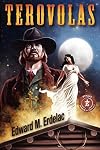
Ever wonder what happened to Professor Abraham Van Helsing after he and his colleagues killed Dracula? Wonder no longer because Edward M. Erdelac (what a terrific name for a horror author!) has the answer. Before reading, I was a little skeptical of TEROVOLAS – after all, DRACULA is a classic work of literature as well as one of my favorite horror novels – but after reading TEROVOLAS, I was reassured. If the idea of Van Helsing traveling to the Wild West and tangling with a werewolf show more instead of a vampire doesn't inspire you to pick up the book, then it just isn't for you.
Mild plot spoilers follow.
As you’ll recall from DRACULA – and if you haven’t yet read it, you’re missing out on a classic – the valiant Texan Quincey P. Morris fell in the battles between Dracula and the vampire hunters. The conceit of TERVOLAS is that Van Helsing, a man of his word, promised to return Quincey’s ashes to his family in Texas. On the long train voyage, Van Helsing meets a beautiful Greek woman who is a kind of mail-order bride for a wealthy Norwegian who has purchased a ranch near the Morris family homestead. Van Helsing soon discovers that all is not well in Texas: the rich Norwegian and his ranch hands have been causing any number of problems; a mountain lion (or something else) has been killing and mutilating livestock; and Quincey’s brother Coleman is a sour fellow who doesn't even seem to want his brother’s remains.
I don’t want to reveal too much about the nature of the supernatural threats that Van Helsing faces in TEROVOLAS, as there are several twists and turns and the eventual reveal is part of the fun. While interesting in their own right, the villains depicted here don’t quite live up to the stature of the iconic Dracula – how could they, after all – the villains of the piece are nevertheless well done. I will just say that while TEROVOLAS doesn't contain even a single vampire, it enlarges the supernatural elements of Van Helsing’s world in a satisfying way that manages to do no damage to Stoker’s DRACULA.
On reading TEROVOLAS, I was pleasantly reminded of the central conceit of George MacDonald Fraser’s FLASHMAN series: a contemporary author (Erdelac in this case) has “discovered” the personal papers of a fictional character and then presents these “false documents” piecemeal as memoir volumes. Here, instead of Flashman, we have the continuing adventures of Abraham Van Helsing. For example, in passing, Erdelac includes some brief references to Van Helsing’s involvement in the dark affairs in Natal as well as the tragic mental deterioration of his wife (due to unmentioned causes) and her subsequent confinement to an asylum. There also was a brief reference to “Hamish and the Great Detective,” so it’s clear that Erdelac has some Holmesian connections in mind as well. I should make clear that, just like DRACULA, TEROVOLAS is also an epistolary novel told through diary entries, letters, newspaper stories, and even a few telegrams. It’s a winning formula, and I hope that Erdelac continues detailing the remainder of Van Helsing’s life.
Strongly recommended for fans of DRACULA and others who just didn't get enough of Abraham Van Helsing the first time around. TEROVOLAS shares many of the strengths and weakness of DRACULA. It tends to have a mix of slow build and intense action, just as DRACULA itself did. The only weakness of TERVOLAS (and DRACULA) is that the epistolary format of the novel puts a certain amount of distance between the reader and the events depicted in the letters and diaries presented. Placing action and combat sequences at one more level of remove from the reader has a tendency to weaken their immediacy and power. But, having said that, I found TEROVOLAS to be an excellent follow-on to DRACULA, and I hope to see further adventures of Van Helsing.
Review copyright © 2013 J. Andrew Byers show less
Mild plot spoilers follow.
As you’ll recall from DRACULA – and if you haven’t yet read it, you’re missing out on a classic – the valiant Texan Quincey P. Morris fell in the battles between Dracula and the vampire hunters. The conceit of TERVOLAS is that Van Helsing, a man of his word, promised to return Quincey’s ashes to his family in Texas. On the long train voyage, Van Helsing meets a beautiful Greek woman who is a kind of mail-order bride for a wealthy Norwegian who has purchased a ranch near the Morris family homestead. Van Helsing soon discovers that all is not well in Texas: the rich Norwegian and his ranch hands have been causing any number of problems; a mountain lion (or something else) has been killing and mutilating livestock; and Quincey’s brother Coleman is a sour fellow who doesn't even seem to want his brother’s remains.
I don’t want to reveal too much about the nature of the supernatural threats that Van Helsing faces in TEROVOLAS, as there are several twists and turns and the eventual reveal is part of the fun. While interesting in their own right, the villains depicted here don’t quite live up to the stature of the iconic Dracula – how could they, after all – the villains of the piece are nevertheless well done. I will just say that while TEROVOLAS doesn't contain even a single vampire, it enlarges the supernatural elements of Van Helsing’s world in a satisfying way that manages to do no damage to Stoker’s DRACULA.
On reading TEROVOLAS, I was pleasantly reminded of the central conceit of George MacDonald Fraser’s FLASHMAN series: a contemporary author (Erdelac in this case) has “discovered” the personal papers of a fictional character and then presents these “false documents” piecemeal as memoir volumes. Here, instead of Flashman, we have the continuing adventures of Abraham Van Helsing. For example, in passing, Erdelac includes some brief references to Van Helsing’s involvement in the dark affairs in Natal as well as the tragic mental deterioration of his wife (due to unmentioned causes) and her subsequent confinement to an asylum. There also was a brief reference to “Hamish and the Great Detective,” so it’s clear that Erdelac has some Holmesian connections in mind as well. I should make clear that, just like DRACULA, TEROVOLAS is also an epistolary novel told through diary entries, letters, newspaper stories, and even a few telegrams. It’s a winning formula, and I hope that Erdelac continues detailing the remainder of Van Helsing’s life.
Strongly recommended for fans of DRACULA and others who just didn't get enough of Abraham Van Helsing the first time around. TEROVOLAS shares many of the strengths and weakness of DRACULA. It tends to have a mix of slow build and intense action, just as DRACULA itself did. The only weakness of TERVOLAS (and DRACULA) is that the epistolary format of the novel puts a certain amount of distance between the reader and the events depicted in the letters and diaries presented. Placing action and combat sequences at one more level of remove from the reader has a tendency to weaken their immediacy and power. But, having said that, I found TEROVOLAS to be an excellent follow-on to DRACULA, and I hope to see further adventures of Van Helsing.
Review copyright © 2013 J. Andrew Byers show less
 This review was written for LibraryThing Early Reviewers.
Ah, it's wonderful to find a book that perfectly satisfies what you were looking for. I was looking for a book that featured a highly complex magic system inspired by real world esotericism, with loads of foreign words and concepts. That's exactly what I got with this book. It doesn't hurt that the writing is excellent, either.
The Rider, as our protagonist is known (because true names are powerful!), is a member of a sect of Jewish mystics called the Merkabah Riders, who are capable of show more travelling the planes of heaven and hell through astral projection. Unfortunately, the Rider's former master, Adon, betrayed the order and has aligned himself with hell in search of power. Shunned by the other riders, THE Rider now travels the American Wild West, seeking to bring his former master to justice.
That set up may sound a bit silly, but this story takes itself completely seriously. Far from some over-the-top characature, the Rider is a soft-spoken, modest man with an extraordinary past. A believable character, in other words.
This book features the first four "episodes" of his journey, separate, sequential stories of modest length, each of which involve him facing down some new threat while dropping hints at the over-arching story of him searching for his former master Adon. As I said, the writing is magnificent. The stories are action-packed, and do a laudable job of putting the Rider in actual, suspense-filled peril. He survives them all, naturally, but it feel like he's actually struggling, instead of some unstoppable super-human badass. The language and diction is beautiful and intelligent, though I can imagine it turning some people off who aren't fond of funny words. If you really can't figure out from context what "funny Hebrew or Yiddish word No. 48" means, there is a short glossary at the back of the book.
Speaking of turn offs, there were two items in particular that left a bad taste in my mouth. Firstly, we are, of course, dealing with a JEWISH mystic, so naturally God is mentioned quite a bit. That made me slightly uncomfortable on occasion, and the other is that the Rider reveals to have participated in the Civil War, on the side of the Union. That wouldn't be so bad, if he didn't state that the reason he joined was because he felt the Confederacy was actually some sort of demonic conspiracy. Being a Georgia boy myself, I was rather offended by the implication that the Confederacy was born not out of any legitimate grievance, but because they were all working for Satan. That's a rare example of literal demonization.
Anyway, those two objections are mostly born of personal taste, and likely won't even register with most people. Nor were they sufficient to ruin or even seriously damage my enjoyment of this magnificent book. show less
The Rider, as our protagonist is known (because true names are powerful!), is a member of a sect of Jewish mystics called the Merkabah Riders, who are capable of show more travelling the planes of heaven and hell through astral projection. Unfortunately, the Rider's former master, Adon, betrayed the order and has aligned himself with hell in search of power. Shunned by the other riders, THE Rider now travels the American Wild West, seeking to bring his former master to justice.
That set up may sound a bit silly, but this story takes itself completely seriously. Far from some over-the-top characature, the Rider is a soft-spoken, modest man with an extraordinary past. A believable character, in other words.
This book features the first four "episodes" of his journey, separate, sequential stories of modest length, each of which involve him facing down some new threat while dropping hints at the over-arching story of him searching for his former master Adon. As I said, the writing is magnificent. The stories are action-packed, and do a laudable job of putting the Rider in actual, suspense-filled peril. He survives them all, naturally, but it feel like he's actually struggling, instead of some unstoppable super-human badass. The language and diction is beautiful and intelligent, though I can imagine it turning some people off who aren't fond of funny words. If you really can't figure out from context what "funny Hebrew or Yiddish word No. 48" means, there is a short glossary at the back of the book.
Speaking of turn offs, there were two items in particular that left a bad taste in my mouth. Firstly, we are, of course, dealing with a JEWISH mystic, so naturally God is mentioned quite a bit. That made me slightly uncomfortable on occasion, and the other is that the Rider reveals to have participated in the Civil War, on the side of the Union. That wouldn't be so bad, if he didn't state that the reason he joined was because he felt the Confederacy was actually some sort of demonic conspiracy. Being a Georgia boy myself, I was rather offended by the implication that the Confederacy was born not out of any legitimate grievance, but because they were all working for Satan. That's a rare example of literal demonization.
Anyway, those two objections are mostly born of personal taste, and likely won't even register with most people. Nor were they sufficient to ruin or even seriously damage my enjoyment of this magnificent book. show less
I was a little concerned that this was going to be a bit silly, but I have to say I was pleasantly surprised. The premise was plausible enough, and I appreciated that the author added enough original characters that it didn't feel like the usage of a preexisting "universe" was a crutch.
I spent a bit of time wondering why, exactly, Van Helsing was used in this story, and suspected that it had little more to do with things than the recent rise of popularity vampire stories have been enjoying. show more It wasn't until the ending was revealed that I realized that the story was used to answer a question and deal with an issue the original work may have raised. I felt this was quite interesting - the idea of a second chance, as it were.
This work did not feel as, for lack of a better word, philosophical as the story from which it sprang, but it was enjoyable. As well as featuring a fun story, it had obvious thought behind the plot, and I quite enjoyed it. show less
I spent a bit of time wondering why, exactly, Van Helsing was used in this story, and suspected that it had little more to do with things than the recent rise of popularity vampire stories have been enjoying. show more It wasn't until the ending was revealed that I realized that the story was used to answer a question and deal with an issue the original work may have raised. I felt this was quite interesting - the idea of a second chance, as it were.
This work did not feel as, for lack of a better word, philosophical as the story from which it sprang, but it was enjoyable. As well as featuring a fun story, it had obvious thought behind the plot, and I quite enjoyed it. show less
This review was written for LibraryThing Early Reviewers.Lists
You May Also Like


Associated Authors
Statistics
- Works
- 25
- Also by
- 16
- Members
- 254
- Popularity
- #90,186
- Rating
- 3.8
- Reviews
- 55
- ISBNs
- 34

