

Lo Scarabeo
Author of Tarot of the New Vision
About the Author
Disambiguation Notice:
Lo Scarabeo is an Italian publisher of art Tarot decks
Series
Works by Lo Scarabeo
Golden Botticelli Tarot (English, Spanish, French, German and Italian Edition) (2007) 22 copies, 1 review
Initiatory Tarot of the Golden Dawn Deck (Lo Scarabeo Decks) (English and Spanish Edition) (2008) 15 copies
Ls Avalon Tarot 3 copies
LS Ancient Enlightened 3 copies
Tarocchi delle Fiabe [Deck] 2 copies
Tarot of the Gnomes 2 copies
Tarot Art Nouveau Deluxe 2 copies
Tarot of Pagan Cats 1 copy
Etteilla Tarot 1 copy
I tarocchi della Zingara 1 copy
Tagged
Common Knowledge
Members
Reviews
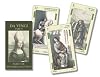
Not much of a book - a basic pamphlet in 5 languages is included, but the attraction here is the whimsical artwork. And it is delightful. All of the cards are rendered as Da Vinci paintings or details thereof, for example, the High Priestess card is the Mona Lisa in a pope hat! My only ding is the size - when they say "mini" they mean it - each card is barely longer than my thumb. At my age it almost requires a magnifying glass, but get it out - the art is worth it!

This is my favourite Tarot deck, and the first one I learned to read effectively. The art is fairly dark and sober, ranging from comic-book style to cards that look like beautiful paintings. There is definitely a gothic feel to this deck. Female nudity predominates, but doesn't detract from the art. I've found it to give accurate, if melancholy, readings. Card-stock is the high quality typical of Lo Scarabeo and easy to shuffle.
I enjoyed this book more than Tarot Fundamentals, the first book in this series. This probably says more about me than it does these books: I'm not a beginner, and much of Tarot Fundamentals was stuff I already knew. Here, more was new to me, so I was more interested.
Tarot Fundamentals introduces you to the tarot and familiarizes you with the cards and the whole idea of reading them. Tarot Experience assumes the reader has that foundation, and focuses on using tarot cards. The first section show more of the book discusses different ways to use the cards: for ritual, magic, dream interpretation, and so on. After that, we get into the main part of the book, which is an in-depth work on reading the cards. The authors take several approaches. One section explains the differences for the reader between giving five-minute, twenty-minute, and sixty-minute readings. It's pragmatic as all get-out, and I really appreciated it. There are chapters on designing your own spreads, reading reversals, handling scary cards, how to read for friends & family/strangers/skeptics, the differences between predictive and advisory readings, psychological and philosophical issues, and doing readings on the topics most people ask about (love, career, and money). There's also a section on card meanings: one page per card, with the meanings worded for readings on personal life, psyche and soul, and divination. And of course, in a book focused on doing readings, there are spreads scattered throughout.
This is a good book, but I just can't bring myself to give it the fifth star. The proofreading is as atrocious as in Tarot Fundamentals if not more so: misspellings, missing words, homophones, punctuation gone awry, odd grammar, strange syntax. While there are several good spreads in this book, there's no index to them. Be prepared to bookmark your favorites. And at least twice I saw a spread referred to as an example, but the page on which to find the spread had been left out: "Acknowledging this, the Reader should select a spread such as Looking for Love on page __." Gah.
This book would probably be most useful to advanced beginners and intermediate tarot readers. It's not a necessary purchase, but it'd be interesting, and I'm glad I read it. show less
Tarot Fundamentals introduces you to the tarot and familiarizes you with the cards and the whole idea of reading them. Tarot Experience assumes the reader has that foundation, and focuses on using tarot cards. The first section show more of the book discusses different ways to use the cards: for ritual, magic, dream interpretation, and so on. After that, we get into the main part of the book, which is an in-depth work on reading the cards. The authors take several approaches. One section explains the differences for the reader between giving five-minute, twenty-minute, and sixty-minute readings. It's pragmatic as all get-out, and I really appreciated it. There are chapters on designing your own spreads, reading reversals, handling scary cards, how to read for friends & family/strangers/skeptics, the differences between predictive and advisory readings, psychological and philosophical issues, and doing readings on the topics most people ask about (love, career, and money). There's also a section on card meanings: one page per card, with the meanings worded for readings on personal life, psyche and soul, and divination. And of course, in a book focused on doing readings, there are spreads scattered throughout.
This is a good book, but I just can't bring myself to give it the fifth star. The proofreading is as atrocious as in Tarot Fundamentals if not more so: misspellings, missing words, homophones, punctuation gone awry, odd grammar, strange syntax. While there are several good spreads in this book, there's no index to them. Be prepared to bookmark your favorites. And at least twice I saw a spread referred to as an example, but the page on which to find the spread had been left out: "Acknowledging this, the Reader should select a spread such as Looking for Love on page __." Gah.
This book would probably be most useful to advanced beginners and intermediate tarot readers. It's not a necessary purchase, but it'd be interesting, and I'm glad I read it. show less
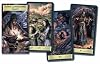
Ochres, sepia, dark yellows and greys - an unusual but overall eyecatching palette that works. My only quibble is the mouths on a number of face are drawn irritatingly just enough oversized to be awkward - but given the theme, this may be deliberate. On the other hand, the deck is quite different and some of the cards stand out (Sun, Priestess, Death) in a way the empahasises the 'different take' of the deck. Overall, a nice addition to the 'tarot decks as art' collection.
You May Also Like


Associated Authors
Statistics
- Works
- 307
- Members
- 2,004
- Popularity
- #12,848
- Rating
- 3.9
- Reviews
- 25
- ISBNs
- 371
- Languages
- 3