
Jonathan Owens
Author of A Linguistic History of Arabic
About the Author
Jonathan Owens is Professor of Arabic Linguistics at the University of Bayreuth, Germany. Starting his linguistics career with a SOAS PhD on Creole Arabic Nubi of East Africa, he has taught and conducted research at universities in Libya (Garyounis), Nigeria (Maiduguri), Jordan (Yarmouk), and the show more USA (University of Maryland). His books include A Grammar of Libyan Arabic (1984), A Short Reference Grammar of Nigerian Arabic (1993), and The Foundations of Grammar: an Introduction to Medieval Arabic Grammatical Theory (1988). show less
Works by Jonathan Owens
Associated Works
Perspectives on Arabic Linguistics: Papers from the Annual Symposium on Arabic linguistics, Volume XXI: Provo, Utah, March 2007 (Amsterdam Studies in the Theory and History of… (2008) — Contributor — 4 copies
Tagged
Common Knowledge
- Gender
- male
Members
Reviews
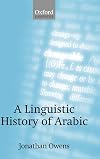
Owens works hard to free Arabic historical linguistics from the many assumptions that have plagued the field. He does this primarily by establishing a basis for variation within what he terms “pre-diasporic” Arabic based on data from contemporary dialects, especially geographically distant dialects that would not conceivably experience language contact. (Commonalities shared by these dialects but not by Classical Arabic may be reliably reconstructed into Old Arabic.) Owens gathered his show more own data on Nigerian Arabic and eastern Libyan Arabic especially, but he gains significant contributions from an isolated dialect (a “Sprachinsel”) in Uzbekistan.
Owens makes special use of Sibawaih’s records of synchronic variation to show that features that varied in Old Arabic (such as “imala,” a phonological rule) continued into present-day dialects.
In ch. 5, Owens uses quantitative methods to show a remarkable affinity between Arabic in the western Sudanic area (= Chad, Cameroon, Nigeria, and western Sudan) and Uzbekistan. He shows that historically this affinity must be related to migration patterns out of the Arabian Peninsula before Arabic grammar was codified. Some of the features shared between this distant dialects are not shared by Classical Arabic, which is important evidence of poorly documented variation in Old Arabic.
In ch. 8, Owens gives his own reconstructions of Old Arabic object pronouns suffixes. Significantly, there is no trace of a noun case system in these suffixes, and again, there are also discrepancies between the reconstructed paradigm and those typically given as “Classical Arabic.” show less
Owens makes special use of Sibawaih’s records of synchronic variation to show that features that varied in Old Arabic (such as “imala,” a phonological rule) continued into present-day dialects.
In ch. 5, Owens uses quantitative methods to show a remarkable affinity between Arabic in the western Sudanic area (= Chad, Cameroon, Nigeria, and western Sudan) and Uzbekistan. He shows that historically this affinity must be related to migration patterns out of the Arabian Peninsula before Arabic grammar was codified. Some of the features shared between this distant dialects are not shared by Classical Arabic, which is important evidence of poorly documented variation in Old Arabic.
In ch. 8, Owens gives his own reconstructions of Old Arabic object pronouns suffixes. Significantly, there is no trace of a noun case system in these suffixes, and again, there are also discrepancies between the reconstructed paradigm and those typically given as “Classical Arabic.” show less
You May Also Like
Associated Authors
Statistics
- Works
- 13
- Also by
- 3
- Members
- 79
- Popularity
- #226,896
- Rating
- 5.0
- Reviews
- 1
- ISBNs
- 29
- Languages
- 1